Recognising Repair as Knowledge and Justice in India’s Digital Economy

UPSC CURRENT AFFAIRS – 04th August 2025 Home / Recognising Repair as Knowledge and Justice in India’s Digital Economy Why in News? In May 2025, India advanced its sustainable electronics policy by adopting a Repairability Index and incentivising formal recycling. Introduction In May 2025, the Indian government took a progressive step by accepting a report that proposed a Repairability Index for mobile phones and household appliances. This index evaluates products based on three key criteria: Ease of repair Availability of spare parts Software support duration Additionally, the government introduced new e-waste policies that include minimum incentive payments to promote formal recycling channels. These policy developments reflect a growing alignment with global concerns around electronic waste, sustainability, and consumer rights. Repair as a Cultural and Intellectual Resource While these policy moves are commendable, the article argues that repair should not be viewed merely as a service or a right, but as a form of knowledge and cultural practice. In India, the informal repair economy—consisting of mobile fixers in Delhi’s Karol Bagh, appliance technicians in Chennai’s Ritchie Street, and others—has historically played a vital role in prolonging the life of devices, often far beyond their planned obsolescence. Repairers work with limited resources, without formal training, and rely heavily on experiential learning and improvisation. Their skills, though undocumented, form an essential part of India’s technological resilience. Tacit Knowledge and Its Importance Tacit knowledge refers to know-how and intuitive expertise that is learned through observation, repetition, and practice, rather than formal education. For instance, an appliance repairer in Bhopal recalls learning by silently watching his uncle at work, rather than through explicit instruction. This form of knowledge is: Context-specific Adaptive Deeply embodied in experience Modern technologies such as Artificial Intelligence (AI) often benefit indirectly from such human knowledge, especially in diagnostics and decision-making systems. However, the contributors of this tacit knowledge remain unrecognised and excluded from formal systems of reward or participation. This creates an imbalance where AI systems continue to evolve, while the communities enabling them remain invisible and unsupported. Current Indian Policies: Progress and Gaps Positive Developments: Right to Repair Framework (2022) and a national portal (2023) covering electronics, automobiles, and farm equipment E-Waste (Management) Rules, 2022, which include Extended Producer Responsibility (EPR) Broader technological initiatives like Digital Public Infrastructure (DPI) and National Strategy on AI (NSAI) Policy Gaps: Limited Focus on Repair: The E-Waste Rules emphasise recycling but mention repair only in passing, missing its role as a preventive strategy. Skilling Mismatch: The Pradhan Mantri Kaushal Vikas Yojana (PMKVY) offers short-term courses aimed at formal industrial jobs. However, informal repair work requires improvisation and contextual problem-solving, which these courses do not accommodate. Lack of Support in Education Policy: The National Education Policy (NEP) 2020 promotes experiential learning and Indian knowledge systems but offers no concrete support for transmitting hands-on repair knowledge. Mission LiFE and Implementation Gaps: While the campaign promotes sustainable lifestyles, it lacks a mechanism to support the actual workforce—repairers—who make reuse and repair possible. The result is a disconnection between policy intentions (circular economy) and policy execution (lack of support for repairers). The Concept of ‘Unmaking’ and Circular Economy Concept of “unmaking” — is the process of disassembling, repairing, or repurposing products after their initial use. This process: Reveals design flaws Extends product lifespan Supports reuse and innovation Unmaking turns repair from an act of maintenance into a form of insight and learning. A discarded phone part can restore communication for someone. A salvaged circuit board can become a teaching aid. Informal repairers practice unmaking daily. Their work supports India’s circular economy, in which reuse is not an afterthought but a design principle. Recognising their role is crucial to sustainable development. Repair Justice and AI Integration Modern digital devices are increasingly difficult to repair. According to a 2023 report by iFixit, only 23% of smartphones sold in Asia are considered easily repairable. This design bias towards compactness and proprietary systems restricts repair access. To ensure repair justice, there is need for: Policy Reforms and Institutional Action: The Ministry of Electronics and Information Technology (MeitY) should include repairability in AI procurement and hardware standards. The Department of Consumer Affairs should expand the Right to Repair framework by involving communities and creating a product classification system based on repairability. The e-Shram portal, under the Ministry of Labour and Employment, should formally recognise informal repair workers and connect them to social protection and benefits. The Ministry of Skill Development and Entrepreneurship should design training programmes tailored to the diagnostic and improvisational nature of repair work, not just formal industrial standards. Technological Aids: Use decision trees to standardise common repair processes without erasing local knowledge. Deploy Large Language Models (LLMs) to document and translate tacit repair knowledge into structured formats, preserving it for wider learning. This approach can ensure digital inclusivity and intergenerational knowledge preservation. Ethical and Societal Implications The issue of repair justice goes beyond technology and environment. It touches upon: Social equity: Acknowledging marginalised but skilled labour Knowledge preservation: Valuing non-formal, embodied knowledge systems Environmental ethics: Promoting responsible consumption and waste reduction Supporting the informal repair economy is therefore a step toward building a just, repair-ready technological future. It aligns with both environmental sustainability and social justice. Introduction Economic Implications For Indian Exporters These reforms reduce transaction costs and compliance hurdles Encourage a more competitive and efficient export environment Promote value addition in key sectors like leather For Tamil Nadu The reforms particularly benefit the state’s leather industry, a major contributor to employment and exports Boost the marketability of GI-tagged E.I. leather, enhancing rural and traditional industries For Trade Policy These decisions indicate a shift from regulatory controls to policy facilitation Reinforce the goals of Make in India, Atmanirbhar Bharat, and India’s ambition to become a leading export power Recently, BVR Subrahmanyam, CEO of NITI Aayog, claimed that India has overtaken Japan to become the fourth-largest economy in the world, citing data from the International Monetary Fund (IMF). India’s rank as the world’s largest economy varies by measure—nominal GDP or
Timely Justice and the Crisis of Judicial Delays in India
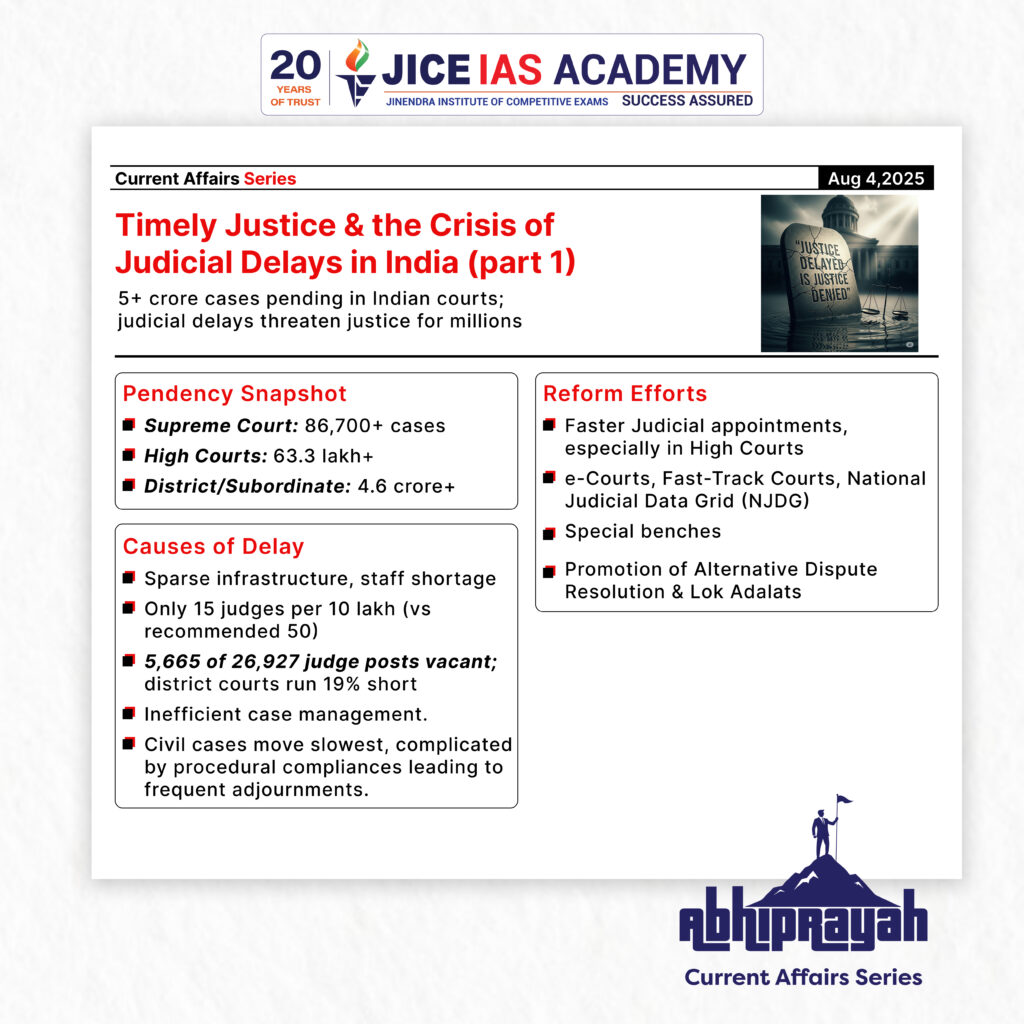
UPSC CURRENT AFFAIRS – 04th August 2025 Home / Timely Justice and the Crisis of Judicial Delays in India Why in News? India’s judiciary is facing a critical crisis of pendency, with over 5 crore cases stuck across courts. Introduction The adage “Justice delayed is justice denied” captures the essence of a fair legal system. Timely justice builds public trust, ensures social stability, and upholds the rule of law. Yet, in India, the enormity of pending cases has reached alarming levels, making judicial delay a chronic crisis. President Droupadi Murmu’s remark on the public’s hesitation to approach courts — termed the “black coat syndrome” — reflects this widespread lack of confidence in the system. Extent of Pendency: A Crisis in Numbers As per the latest data: Supreme Court: Over 86,700 cases High Courts: Over 3 lakh cases pending. District & Subordinate Courts: Over 6 crore cases pending. Total: More than 5 crore cases across all levels. These figures highlight an unsustainable backlog, straining India’s justice delivery system and affecting millions of litigants. Structural and Systemic Causes of Delay Despite good faith among judges, lawyers, and litigants, multiple systemic constraints hinder timely resolution: Inadequate Infrastructure and Manpower: Courts lack sufficient courtrooms, support staff, and digital facilities. India has only 15 judges per 10 lakh population, far below the Law Commission’s 1987 recommendation of 50. Vacant Judicial Positions: Of the 26,927 sanctioned judges, 5,665 posts remain vacant. District courts — the backbone of the judiciary — function with a 19% shortfall in judge strength. Inefficient Case Management: Absence of clear timelines for stages like filing, evidence, and hearings. Frequent adjournments, procedural delays, and weak monitoring mechanisms slow down justice. Nature and Complexity of Cases: Civil cases (like property or contractual disputes) often involve complex evidence and documentation. Criminal cases, which receive priority, tend to move faster than civil matters. Disparity in Case Disposal Rates The pace of justice varies significantly across courts and case types: Criminal Cases Resolved Within a Year: High Courts: 3% Supreme Court: 5% District Courts: 6% Civil Cases Resolved Within a Year (District Courts): Only 7% Civil Cases Pending Over 5 Years: Nearly 20% This disparity reveals that district courts, which handle the majority of civil disputes, are the least equipped to ensure timely disposal. Steps Taken for Judicial Reform The judiciary and the executive have been working on several fronts: Filling Vacancies: The Supreme Court and the Union Government are actively working to expedite appointments, especially in High Courts. Process Simplification & Digitalisation: Use of e-Courts, virtual hearings, and National Judicial Data Grid (NJDG) for tracking cases. Fast Track Courts and Special Benches: To expedite sensitive cases like rape, POCSO, and cheque bounce cases. Alternative Dispute Resolution (ADR): A Promising Solution ADR mechanisms provide cost-effective, quick, and citizen-centric justice alternatives: Mediation and Arbitration: Encourage out-of-court settlements. Lok Adalats: Organised across taluks, districts, and High Courts on fixed dates. From 2021 to March 2025, resolved: 5 crore cases in total. 21 crore pre-litigation cases 34 crore pending court cases Lok Adalats’ success reflects their ability to unburden courts and improve access to justice, especially in rural areas. Way Forward To restore public faith and uphold constitutional ideals, the following steps are vital: Judicial Capacity Expansion: Increase sanctioned judge strength to meet population-based norms. Invest in court infrastructure, including digital systems. Strict Timelines and Case Management Rules: Mandate stage-wise deadlines for each case type. Empower registrars and judicial clerks to handle procedural tasks. Promote ADR & Pre-Litigation Resolution: Institutionalise mediation centers in all districts. Mandate pre-litigation mediation in select civil cases. Judicial Accountability and Monitoring: Create a performance audit system for tracking case progress. Encourage court-wise pendency dashboards. Introduction Economic Implications For Indian Exporters These reforms reduce transaction costs and compliance hurdles Encourage a more competitive and efficient export environment Promote value addition in key sectors like leather For Tamil Nadu The reforms particularly benefit the state’s leather industry, a major contributor to employment and exports Boost the marketability of GI-tagged E.I. leather, enhancing rural and traditional industries For Trade Policy These decisions indicate a shift from regulatory controls to policy facilitation Reinforce the goals of Make in India, Atmanirbhar Bharat, and India’s ambition to become a leading export power Recently, BVR Subrahmanyam, CEO of NITI Aayog, claimed that India has overtaken Japan to become the fourth-largest economy in the world, citing data from the International Monetary Fund (IMF). India’s rank as the world’s largest economy varies by measure—nominal GDP or purchasing power parity (PPP)—each with key implications for economic analysis. Significance and Applications
Forestland Evictions in Assam and Their Regional Impact

UPSC CURRENT AFFAIRS – 03rd August 2025 Home / Forestland Evictions in Assam and Their Regional Impact Why in News? The Assam government’s eviction drive targeting encroachments on forestlands has triggered strong administrative and civil reactions across the Northeast. The Gauhati High Court on July 30, 2025, directed Assam and four neighboring States to constitute a high-level committee for coordinating forestland clearance and border settlement issues. Key Highlights Assam has conducted repeated eviction drives since 2016, intensified after the 2021 elections. In June–July 2025, over 1,000 families were evicted from Paikan Reserve Forest. A Union Environment Ministry report stated that over 3,620.9 sq. km of Assam’s forestland is encroached. Affected families include both migrant and indigenous groups, although the State government clarified that tribal people covered under the Forest Rights Act (FRA), 2006 would be protected. Neighboring States—Nagaland, Meghalaya, Mizoram, Arunachal Pradesh, and Manipur—have heightened border vigilance to prevent spillover of displaced persons. Constitutional and Legal Framework Article 48A (DPSP) obligates the State to protect forests and wildlife. The Forest (Conservation) Act, 1980 and the Indian Forest Act, 1927 restrict unauthorized land use in designated forest areas. The Forest Rights Act, 2006 (FRA) safeguards the rights of Scheduled Tribes and traditional forest dwellers, provided their claims are verified and documented. Article 21 ensures the Right to Life, interpreted by the Supreme Court to include dignified rehabilitation during evictions. 6th Schedule The 6th Schedule, is crucial in the Northeast, especially in Meghalaya, Mizoram, Tripura, and Assam, as it provides constitutional protection to tribal land, culture, and autonomy. Impact of the 6th Schedule: Autonomous District Councils (ADCs) established under the 6th Schedule can make laws on land, forest, and customary practices. Many areas claimed by Assam’s neighbors fall under these ADCs. Disputes often arise when eviction drives affect land claimed by ADCs across undefined borders. Tribal populations under ADCs often resist State-led evictions, claiming autonomy and protection under the Schedule. The lack of clear coordination between State Forest Departments and ADCs can lead to inter-agency conflict, affecting eviction legitimacy and forest conservation. Example: The Meghalaya ADCs have opposed Assam’s actions in border zones, arguing that evictions disrupt tribal settlements protected by the 6th Schedule. Assam’s Karbi Anglong and Dima Hasao districts, which are 6th Schedule areas, are also affected by such eviction operations and cross-border claims. Regional Concerns and Border Vigilance Neighboring States initiated strict border checks, citing risks of demographic changes and land conflict. In Nagaland, local NGOs and even extremist groups activated “border monitoring” mechanisms fearing influx. The reaction reflects the sensitivity around ethnic identity and land rights in the hill States, rooted in long-standing inter-ethnic mistrust. Policy and Administrative Implications A national-level protocol is required to balance environmental protection, forest rights, and humanitarian safeguards. There is a need for mandatory Environmental and Social Impact Assessments (ESIA) before large-scale evictions. States must verify FRA compliance, uphold tribal rights under the 6th Schedule, and ensure rehabilitation under the National Rehabilitation and Resettlement Policy, 2007. Cooperative mechanisms, such as interstate commissions and joint cadastral surveys, must be institutionalized to resolve border and land disputes peacefully. Introduction Economic Implications For Indian Exporters These reforms reduce transaction costs and compliance hurdles Encourage a more competitive and efficient export environment Promote value addition in key sectors like leather For Tamil Nadu The reforms particularly benefit the state’s leather industry, a major contributor to employment and exports Boost the marketability of GI-tagged E.I. leather, enhancing rural and traditional industries For Trade Policy These decisions indicate a shift from regulatory controls to policy facilitation Reinforce the goals of Make in India, Atmanirbhar Bharat, and India’s ambition to become a leading export power Recently, BVR Subrahmanyam, CEO of NITI Aayog, claimed that India has overtaken Japan to become the fourth-largest economy in the world, citing data from the International Monetary Fund (IMF). India’s rank as the world’s largest economy varies by measure—nominal GDP or purchasing power parity (PPP)—each with key implications for economic analysis. Significance and Applications
Arya Samaj Marriages Under Judicial Scrutiny Amid Anti-Conversion Law Enforcement

UPSC CURRENT AFFAIRS – 03rd August 2025 Home / Arya Samaj Marriages Under Judicial Scrutiny Amid Anti-Conversion Law Enforcement Why in News? The Allahabad High Court recently directed the Uttar Pradesh government to investigate the proliferation of fake Arya Samaj societies that are solemnising marriages without verifying the age of the bride and groom. This came in the context of a case where a Muslim man claimed to have married a minor Hindu girl through an Arya Samaj ceremony, allegedly bypassing the state’s anti-conversion law. Key Highlights The Arya Samaj, founded in 1875 by Swami Dayanand Saraswati, was a Hindu reform movement that promoted inter-caste and interfaith marriages through a process called shuddhi (purification). The Arya Marriage Validation Act, 1937, was enacted to give legal recognition to marriages between self-declared Arya Samajists, even if they previously belonged to different castes or religions. Arya Samaj marriages are recognized under the Hindu Marriage Act, 1955, for Hindus, Buddhists, Jains, and Sikhs. Non-Hindus can convert and marry via Arya Samaj, with the conversion process often expedited. Such marriages are popular among eloping couples due to their speed, lower cost, and absence of public notice requirements, unlike the Special Marriage Act which mandates a 30-day notice. Courts have found that many Arya Samaj organizations do not verify age, conduct proper conversions, or follow documentation norms, sometimes issuing certificates without legal authority. The Supreme Court in 2022 remarked that Arya Samaj has “no business” issuing marriage certificates, and the Delhi High Court ordered stricter witness verification during such ceremonies. Legal Framework and Procedural Conflicts The Arya Marriage Validation Act, 1937, ensures that marriages conducted by Arya Samaj are valid even if the individuals were from different religions or castes before declaring themselves as Arya Samajists. Shuddhi is a religious purification ritual used by Arya Samaj to convert individuals to Hinduism, but is often performed without adhering to statutory procedures required under anti-conversion laws. The Uttar Pradesh Prohibition of Unlawful Conversion of Religion Act, 2021, requires a 60-day pre-conversion declaration, a post-conversion notice to the District Magistrate, and a formal inquiry. The Act places the burden of proof on the accused to show that the conversion was not done by coercion or fraud, and declares such marriages void if legal procedures are not followed. Policy Relevance Anti-conversion laws in several states, including Uttar Pradesh, Madhya Pradesh, and Uttarakhand, aim to regulate religious conversions and prevent conversions done solely for the purpose of marriage. These laws conflict with the informal and rapid nature of Arya Samaj marriages, which often do not include official inquiries or advance notice of religious conversion. Courts are increasingly insisting that Arya Samaj institutions comply with statutory procedures, especially in cases involving minors, forged documents, or interfaith marriages. A Supreme Court petition, pending since 2022, seeks clarity on whether Arya Samaj marriages involving interfaith couples must also adhere to the Special Marriage Act provisions. India Impact Legal scrutiny of Arya Samaj marriages reflects broader societal and legal tensions surrounding interfaith and intercaste marriages, religious freedom, and state oversight. Couples seeking quick legal validation of their marriages, particularly eloping interfaith couples, may now face legal complications or prosecution if proper procedures are not followed. The situation underscores the need for harmonizing personal laws, possibly through a Uniform Civil Code, or reforms in marriage registration and religious conversion protocols. Supreme Court judgments in these matters will have far-reaching implications for how marriages and conversions are regulated in India, especially in states with active anti-conversion frameworks. Introduction Economic Implications For Indian Exporters These reforms reduce transaction costs and compliance hurdles Encourage a more competitive and efficient export environment Promote value addition in key sectors like leather For Tamil Nadu The reforms particularly benefit the state’s leather industry, a major contributor to employment and exports Boost the marketability of GI-tagged E.I. leather, enhancing rural and traditional industries For Trade Policy These decisions indicate a shift from regulatory controls to policy facilitation Reinforce the goals of Make in India, Atmanirbhar Bharat, and India’s ambition to become a leading export power Recently, BVR Subrahmanyam, CEO of NITI Aayog, claimed that India has overtaken Japan to become the fourth-largest economy in the world, citing data from the International Monetary Fund (IMF). India’s rank as the world’s largest economy varies by measure—nominal GDP or purchasing power parity (PPP)—each with key implications for economic analysis. Significance and Applications
Bird Mortality Raises Ecological Concerns Amid India’s Wind Energy Expansion

UPSC CURRENT AFFAIRS – 03rd August 2025 Home / Bird Mortality Raises Ecological Concerns Amid India’s Wind Energy Expansion Why in News? India added 5 GW of wind energy in the first half of 2025, reflecting an 82% year-on-year growth. A recent study by the Wildlife Institute of India (WII) has raised serious concerns about bird mortality due to wind turbines in the Thar Desert, Rajasthan, particularly in biodiversity-rich and migratory zones. Key Findings from the WII Study The study was conducted across 3,000 sq. km in Jaisalmer, home to 900 turbines and 272 bird species. Researchers found 124 bird carcasses around 90 wind turbines, estimating 4,464 bird deaths per 1,000 sq. km per year. Control sites away from turbines showed no bird carcasses, strengthening the case for direct mortality from turbine structures. Raptors and the critically endangered Great Indian Bustard were the most affected groups. The Thar Desert lies on the Central Asian Flyway, a major global migratory route. Ecological Concerns and Patterns Bird collisions occur due to the blade rotation and turbine height intersecting with migratory and soaring bird flight paths. Raptors are especially at risk due to their long lifespan, low reproduction rate, and soaring behavior. Associated infrastructure like power lines adds to mortality, which earlier studies had overlooked. The estimate of 1.24 bird deaths per turbine per month in Thar is far higher than previous national averages. Existing Tools and Mitigation Measures AVISTEP (Avian Sensitivity Tool for Energy Planning) maps India’s regions into low to very high avian sensitivity zones. Suggested mitigation measures include painting one turbine blade for better visibility, seasonal shutdowns, and avoidance-based siting. However, in India, onshore wind projects are not required to conduct Environmental Impact Assessments (EIA), leaving biodiversity impacts unaccounted for. Shift to Offshore Wind Energy India aims to install 30 GW of offshore wind capacity by 2030, starting with 4 GW bids in Gujarat and Tamil Nadu. Offshore wind is seen as an alternative to land acquisition bottlenecks but brings marine ecological risks, including noise pollution, habitat disruption, and turbidity. The National Offshore Wind Energy Policy mandates EIAs for these projects. National Offshore Wind Energy Policy (2015) Launched by the Ministry of New and Renewable Energy (MNRE) in 2015, this policy provides a framework for the development of offshore wind farms in India’s Exclusive Economic Zone (EEZ). Key Features: Identifies zones suitable for offshore wind energy, especially off the coasts of Gujarat and Tamil Nadu. Empowers NIWE (National Institute of Wind Energy) as the nodal agency for offshore wind resource assessment and development. Mandates Environmental Impact Assessments (EIAs) and Marine Spatial Planning to minimize ecological harm to marine and coastal biodiversity. A rapid EIA for the Gulf of Khambhat identified marine mammals and birds in the region but underestimated avian migratory sensitivity, as per experts. Policy Implications and India’s Balancing Act India’s rapid renewable expansion must be aligned with ecological sustainability and biodiversity conservation. The findings underscore the need to revise renewable energy regulations, especially for onshore wind, by mandating site-specific ecological assessments. With India positioned along major migratory routes, its policies and practices could serve as a model for biodiversity-conscious energy transitions across the Global South. A careful balance between energy security and ecological integrity will be key to achieving long-term sustainability goals Raptors and the Critically Endangered Great Indian Bustard Raptors are birds of prey that include species like eagles, vultures, hawks, falcons, and kites. These birds are characterized by sharp talons, keen eyesight, and hooked beaks. Raptors play a crucial role in ecosystems by controlling rodent populations and cleaning up carrion. Raptors are especially vulnerable to wind turbines because of their soaring flight patterns, which often occur at the height of rotating blades. They are also long-lived species that reproduce slowly, making them more susceptible to population declines from even small increases in mortality. The Great Indian Bustard (GIB) is one of the rarest birds in the world, listed as Critically Endangered by the IUCN Red List. Once widespread across India’s grasslands, fewer than 150 individuals are now believed to survive, mostly in Rajasthan and Gujarat. GIBs are vulnerable to collisions with power lines and wind turbine blades due to poor frontal vision and low flight heights, making wind energy projects in their habitats a major conservation threat. AVISTEP – Avian Sensitivity Tool for Energy Planning AVISTEP is an open-access digital tool developed by BirdLife International, used for identifying avian-sensitive areas across India for renewable energy planning. The tool maps both onshore and offshore zones into categories of avian sensitivity: Very High, High, Moderate, and Low The categorization is based on data from bird migration routes, endangered species habitats, and biodiversity hotspots. Purpose of AVISTEP: Helps wind and solar developers avoid ecologically sensitive areas during the planning stage. Encourages a precautionary approach in siting infrastructure to reduce bird mortality. Though AVISTEP provides a guiding framework, it is not legally binding, and ground-level ecological studies are still necessary before project approvals Introduction Economic Implications For Indian Exporters These reforms reduce transaction costs and compliance hurdles Encourage a more competitive and efficient export environment Promote value addition in key sectors like leather For Tamil Nadu The reforms particularly benefit the state’s leather industry, a major contributor to employment and exports Boost the marketability of GI-tagged E.I. leather, enhancing rural and traditional industries For Trade Policy These decisions indicate a shift from regulatory controls to policy facilitation Reinforce the goals of Make in India, Atmanirbhar Bharat, and India’s ambition to become a leading export power Recently, BVR Subrahmanyam, CEO of NITI Aayog, claimed that India has overtaken Japan to become the fourth-largest economy in the world, citing data from the International Monetary Fund (IMF). India’s rank as the world’s largest economy varies by measure—nominal GDP or purchasing power parity (PPP)—each with key implications for economic analysis. Significance and Applications
U.K. Set to Recognise Palestine: Historical Significance, Geopolitical Shift, and India’s Strategic Lens

UPSC CURRENT AFFAIRS – 03rd August 2025 Home / U.K. Set to Recognise Palestine: Historical Significance, Geopolitical Shift, and India’s Strategic Lens Why in News? The Prime Minister of the United Kingdom has announced that Britain will recognize the State of Palestine at the upcoming UN General Assembly in September 2025, unless Israel agrees to a ceasefire, allows humanitarian aid into Gaza, and recommits to the two-state solution. This declaration marks a major shift in Western diplomatic stance, with France, Canada, and Portugal also expressing similar intentions in the backdrop of Israel’s prolonged military campaign in Gaza. Key Highlights Of the 193 member states of the United Nations, 147 already recognize Palestine. However, most Western powers had resisted such recognition, arguing it should only follow a final negotiated peace settlement. The move by the U.K. and France, both permanent members of the UN Security Council and members of the G7, represents a potential turning point, likely increasing pressure on Israel and isolating the United States diplomatically. The U.K.’s recognition of Palestine carries deep historical symbolism, as it was the first major power to support the Zionist movement for a Jewish homeland in Palestine through the Balfour Declaration of 1917. Concepts Recognition of statehood in international law refers to a formal acknowledgment of a political entity’s sovereignty, enabling it to enter into diplomatic relations and join international organizations, though not necessarily the UN itself without Security Council approval. The two-state solution envisions an independent Palestine coexisting peacefully alongside Israel and has long been supported by the international community as a resolution to the Israeli–Palestinian conflict. Treaties The Balfour Declaration (1917) The Balfour Declaration was a formal statement issued by British Foreign Secretary Arthur Balfour on November 2, 1917, during World War I. It was addressed to Lord Rothschild, a prominent British Zionist, and stated that “His Majesty’s Government view with favour the establishment in Palestine of a national home for the Jewish people.” The declaration marked the first official endorsement by a major world power of Zionist aspirations for a Jewish homeland in Palestine. At the time, Palestine was part of the Ottoman Empire, but Britain sought to win the support of global Jewry, especially in the U.S. and Russia, for the Allied war effort. While the declaration supported the Jewish cause, it also stated that “nothing shall be done which may prejudice the civil and religious rights of existing non-Jewish communities in Palestine.” The declaration is considered a turning point in Middle Eastern geopolitics, as it laid the foundation for increased Jewish migration to Palestine, tensions with the Arab population, and the eventual establishment of Israel in 1948. The Sykes–Picot Agreement (1916) The Sykes–Picot Agreement was a secret treaty negotiated in 1916 between Britain and France, with assent from Russia, during World War I. The agreement was named after British diplomat Sir Mark Sykes and French diplomat François Georges-Picot. It proposed the division of Ottoman-controlled Arab territories in the Middle East into British and French spheres of influence, after the defeat of the Ottoman Empire. Under the agreement: France would control modern-day Syria and Lebanon. Britain would control Iraq, Jordan, and parts of Palestine. Palestine was to be placed under international administration due to its religious significance. The agreement contradicted Britain’s earlier promise to support Arab independence if the Arabs revolted against the Ottomans, as seen in the Hussein–McMahon Correspondence. When the agreement was made public by the Bolsheviks after the Russian Revolution, it generated Arab outrage and is widely viewed as a symbol of colonial betrayal and the start of Western manipulation of the Middle East. U.K.’s recognition of Palestine and Strategic Significance The U.K.’s recognition reflects a shift in Western policy that prioritizes human rights, humanitarian law, and conflict resolution over historical alliances and Cold War-era realpolitik. This move may influence other European and G7 countries to adopt similar positions, creating momentum for broader international consensus on Palestinian statehood. Britain’s change in stance also increases pressure on multilateral institutions such as the UN, the International Criminal Court, and the Human Rights Council to act on issues of occupation, settlement activity, and alleged war crimes. India’s Impact and Policy Relevance India recognized Palestine in 1974 and has consistently supported the Palestinian cause while simultaneously deepening its strategic ties with Israel through defense, agriculture, and technology partnerships. India follows a de-hyphenated policy, treating relations with Israel and Palestine independently, and has often abstained from UN votes that single out either party. The U.K.’s stance may prompt recalibration of India’s diplomatic approach, particularly in multilateral forums, to maintain its image as a neutral, rule-based actor amid increasing polarization. India’s longstanding support for the two-state solution, combined with its growing strategic clout, may place it in a unique position to act as a potential mediator or bridge-builder between Global South solidarity and Global North institutions. Introduction Economic Implications For Indian Exporters These reforms reduce transaction costs and compliance hurdles Encourage a more competitive and efficient export environment Promote value addition in key sectors like leather For Tamil Nadu The reforms particularly benefit the state’s leather industry, a major contributor to employment and exports Boost the marketability of GI-tagged E.I. leather, enhancing rural and traditional industries For Trade Policy These decisions indicate a shift from regulatory controls to policy facilitation Reinforce the goals of Make in India, Atmanirbhar Bharat, and India’s ambition to become a leading export power Recently, BVR Subrahmanyam, CEO of NITI Aayog, claimed that India has overtaken Japan to become the fourth-largest economy in the world, citing data from the International Monetary Fund (IMF). India’s rank as the world’s largest economy varies by measure—nominal GDP or purchasing power parity (PPP)—each with key implications for economic analysis. Significance and Applications
India’s First Analog Space Mission – HOPE Station in Ladakh
UPSC CURRENT AFFAIRS – 03rd August 2025 Home / India’s First Analog Space Mission – HOPE Station in Ladakh Why in News? India has launched its first analog space mission station, named Human Outer Planet Exploration (HOPE), on August 1, 2025, at Tso Kar, Ladakh. The mission is organized by Protoplanet, a Bengaluru-based private space research organization, in collaboration with the Indian Space Research Organisation (ISRO). It marks a significant step in India’s preparations for long-duration manned space missions to the Moon and Mars. Key Highlights The HOPE research station is located in the Tso Kar basin, a high-altitude cold desert that mimics the terrain and conditions of the Moon and Mars. The site was selected after nine years of geological and environmental study, indicating a strong scientific basis for the mission. A rotating crew will conduct 10-day isolation missions inside the station to simulate deep space conditions. The first crew includes Rahul Mogalapalli and Yaman Akot, scientists trained in aerospace engineering and planetary science. Research will focus on physiological, psychological, and epigenetic impacts of space-like isolation, helping design systems for future human spaceflight. ISRO contributed through partial funding and guidance on candidate selection, showcasing increasing public-private collaboration in India’s space sector. This aligns with India’s larger space vision, including the Gaganyaan mission, the proposed Bharatiya Antariksh Station by 2035, and a manned Moon mission by 2040. Concepts Analog space missions are Earth-based experiments designed to replicate the operational, psychological, and environmental conditions astronauts face in outer space. Such missions allow for safe, cost-effective testing of life-support systems, mission planning, and human adaptability before actual deployment. Epigenetic studies in this mission will examine how environmental stress alters gene expression without changing DNA sequences, a crucial area for long-duration spaceflight health monitoring. The mission will track key variables such as sleep patterns, metabolic changes, and cognitive functions, offering real-time data applicable to space exploration and even Earth-based stress research. Related Policy and Vision The mission is aligned with the Indian government’s space policy roadmap that encourages private participation and innovation in frontier technology. Reforms such as the establishment of IN-SPACe (Indian National Space Promotion and Authorization Center) have enabled private players like Protoplanet to contribute meaningfully to national objectives. The mission also strengthens India’s positioning in international space collaboration and scientific diplomacy, especially as global efforts to reach Mars intensify. Similar analog missions globally include the Mars Desert Research Station in the United States, Flashline Mars Arctic Research Station in Canada, and BIOS-3 in Russia, all of which contribute to astronaut training and protocol development. Introduction Economic Implications For Indian Exporters These reforms reduce transaction costs and compliance hurdles Encourage a more competitive and efficient export environment Promote value addition in key sectors like leather For Tamil Nadu The reforms particularly benefit the state’s leather industry, a major contributor to employment and exports Boost the marketability of GI-tagged E.I. leather, enhancing rural and traditional industries For Trade Policy These decisions indicate a shift from regulatory controls to policy facilitation Reinforce the goals of Make in India, Atmanirbhar Bharat, and India’s ambition to become a leading export power Recently, BVR Subrahmanyam, CEO of NITI Aayog, claimed that India has overtaken Japan to become the fourth-largest economy in the world, citing data from the International Monetary Fund (IMF). India’s rank as the world’s largest economy varies by measure—nominal GDP or purchasing power parity (PPP)—each with key implications for economic analysis. Significance and Applications
Malaria Elimination in India by 2030: Innovations, Vaccines, and the New Battlegrounds
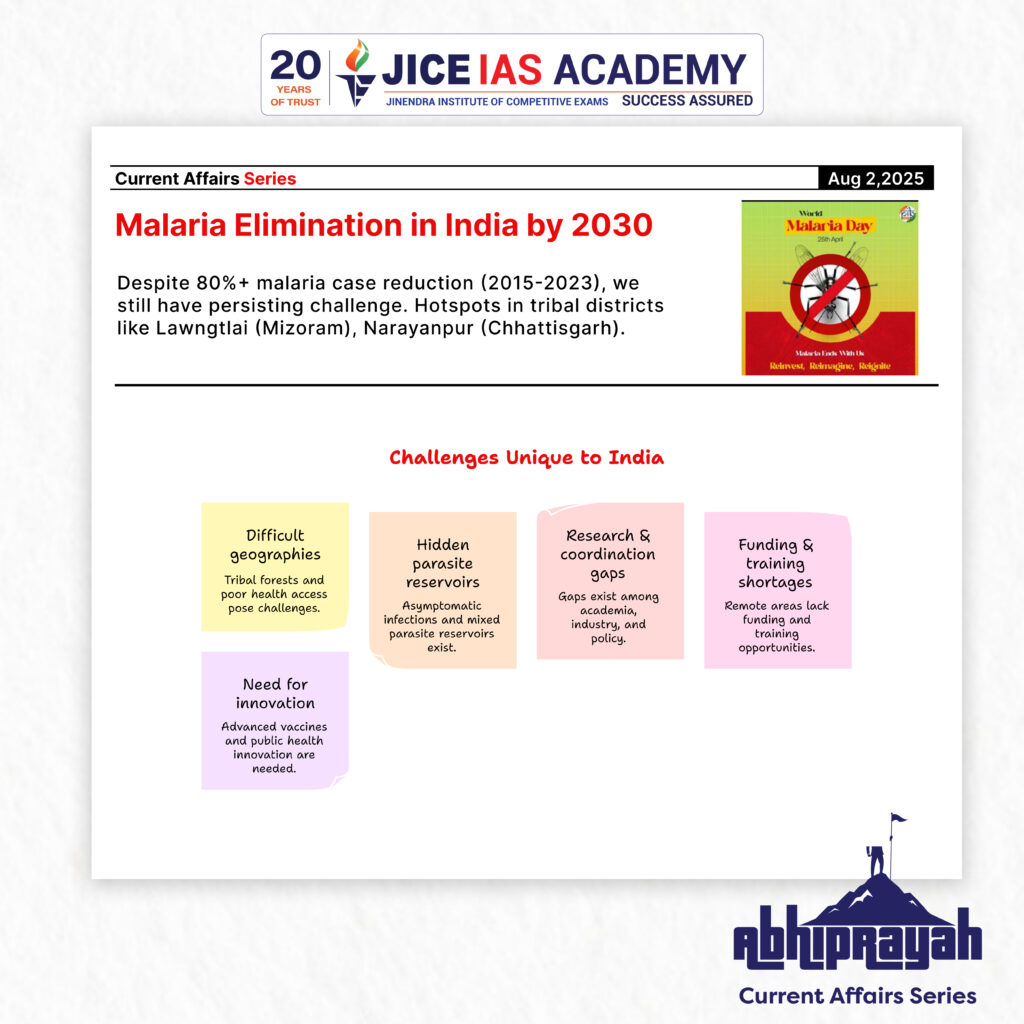
UPSC CURRENT AFFAIRS – 02nd August 2025 Home / Malaria Elimination in India by 2030: Innovations, Vaccines, and the New Battlegrounds Why in News? Despite major progress, India’s malaria elimination goal by 2030 faces new frontlines—hidden parasite reservoirs, dual-species infections, and the need for next-generation vaccines and public health innovation. Introduction India has made remarkable progress in malaria control, with an over 80% reduction in malaria cases between 2015 and 2023. Yet, the road to malaria elimination by 2030 is far from easy. Unlike before, the challenge is no longer a uniform national burden—it is about tackling resilient parasite strains, asymptomatic carriers, hard-to-reach tribal and forest regions, and technological gaps. The disease’s complex life cycle and the dual burden of Plasmodium falciparum and Plasmodium vivax require a multi-pronged, innovative approach rooted in science, vaccine development, policy cohesion, and health system preparedness. India’s Malaria Landscape: Uneven and Complex National gains mask localized hotspots, especially in tribal districts such as: Lawngtlai (Mizoram): 56 cases per 1,000 people Narayanpur (Chhattisgarh): 22 cases per 1,000 people Mixed infections, especially in Jharkhand, where 20% of cases show both P. falciparum and P. vivax, complicate treatment and tracking. P. vivax, unlike P. falciparum, can relapse from dormant liver forms, requiring longer-term strategies. Asymptomatic carriers quietly maintain transmission chains in areas showing “success” in reducing reported cases. Breakthrough Vaccines: Hope and Limitations First-generation vaccines like RTS,S and R21/Matrix-M offer partial protection (~55–77%) and target only one parasite stage, leading to reinfections. Whole-parasite vaccines (PfSPZ) and blood-stage vaccines (PfRH5) show higher efficacy and broader strain coverage but remain in trial phases. India’s AdFalciVax, developed by ICMR (2025), is a dual-stage vaccine targeting both infection and transmission. It is room-temperature stable, induced a strong immune response in mice, but human deployment may take 7–8 years. Transmission-blocking vaccines (TBVs), including India’s and global efforts (e.g., Mali, Thailand), show promise but face scalability and long-term efficacy challenges. AdFalciVax – India’s Indigenous Dual-Stage Malaria Vaccine (2025) Developed by Indian Council of Medical Research (ICMR). Dual-stage vaccine combining: PfCSP – Pre-erythrocytic antigen (prevents infection). Pfs230 & Pfs48/45 – Transmission-blocking antigens (prevent parasite spread via mosquitoes). Key Achievements: Induced a strong immune response in mice, lasting nearly a human decade. Stable at room temperature, making it suitable for rural deployment. Human trials yet to begin; deployment expected in 7–8 years. Marks India’s first major step into the domain of Transmission-Blocking Vaccines (TBVs). Transmission-Blocking Vaccines (TBVs) – Global and Indian Developments Pfs230D1 (Mali trial): Achieved 78% reduction in transmission. AdFalciVax (India): Integrates both infection prevention and transmission-blocking. For Plasmodium vivax: Pvs230D1M (Thailand trial): Reduced mosquito transmission by up to 96%. India is also developing TBVs specifically targeting vivax. New Vaccine Frontiers Immune Response Boosters Ferritin nanoparticle + CpG adjuvant: Cut liver-stage parasite load by 95% in mice AdFalciVax + Alum: Showed 90%+ protection with even mild adjuvants mRNA-based Platforms CureVac + NIH (Pfs25 antigen): Complete mosquito transmission blockage in mice BioNTech (BNT165e): mRNA-based blood-stage vaccine, FDA put on hold T-Cell Directed Vaccines Modified PfCSP + MIP3α molecule → enhanced T-cell targeting, 88% reduction in liver stage parasite load (in mice) Engineered Antibodies D1D2.v-IgG: Binds parasite protein (RIFIN) 110x more strongly, restoring immune function in lab tests Vector Control and Genetic Engineering Gene Drive Systems Fertility-disrupting genes introduced in Anopheles gambiae → colony wiped out in lab in 1 year Challenges: Ecological risks Evolution of resistance Ethical concerns Targeted Gene Editing (FREP1) One-letter gene change → malaria parasite development blocked in mosquitoes Spread to 90% lab population in 10 generations Self-Limiting Infections Mosquitoes die sooner if infected → reduces transmission naturally Less selective pressure on parasite → lower resistance risk Challenges Unique to India Difficult Geographies Northeast, central tribal belts, and forested areas → poor health access Asymptomatic Reservoirs Adults and older children carry parasites silently Require mass surveillance and diagnostics Mixed Infections Need dual-species vaccines, drugs, and diagnostic tools Research Gaps P. cynomolgi is the best model for P. vivax, but legal hurdles in primate research stalled Indian progress Coordination Deficit Lack of collaboration between academia, industry, and policy Funding gaps, especially post-discovery phase Training gaps among doctors, paramedics in remote zones The Way Forward: A Full-Spectrum Strategy Science + Systems Innovation alone is not enough. Need: Trained personnel Surveillance of drug resistance Strengthened rural health infrastructure Strategic deployment of multiple vaccines Political Will and Public Investment Like COVID-19, malaria elimination needs a mission-mode approach Push for GMP-grade production, clinical trial infrastructure, public-private partnerships Inclusive Health Policies Prioritize tribal and vulnerable regions Combine vector control, vaccines, and community engagement Global and National Collaboration Build alliances with WHO, ICMR, SII, NIH, and academic networks Conclusion While the India-U.K. FTA is a diplomatic and economic milestone, the digital trade concessions present a serious challenge to India’s long-term digital autonomy and technological self-reliance. In the age of data-driven geopolitics, sovereignty is not just about borders — it is about algorithms, access, and infrastructure. India must not repeat the mistakes of the colonial past in the digital future. A clear national roadmap for digital industrialisation, informed policy frameworks, and assertive negotiation strategies are essential to secure a prosperous and independent digital future. Introduction Economic Implications For Indian Exporters These reforms reduce transaction costs and compliance hurdles Encourage a more competitive and efficient export environment Promote value addition in key sectors like leather For Tamil Nadu The reforms particularly benefit the state’s leather industry, a major contributor to employment and exports Boost the marketability of GI-tagged E.I. leather, enhancing rural and traditional industries For Trade Policy These decisions indicate a shift from regulatory controls to policy facilitation Reinforce the goals of Make in India, Atmanirbhar Bharat, and India’s ambition to become a leading export power Recently, BVR Subrahmanyam, CEO of NITI Aayog, claimed that India has overtaken Japan to become the fourth-largest economy in the world, citing data from the International Monetary Fund (IMF). India’s rank as the world’s largest economy varies by measure—nominal GDP or purchasing power parity (PPP)—each with key implications for economic analysis. Significance and Applications
India-U.K. Free Trade Agreement and the Threat to India’s Digital Sovereignty

UPSC CURRENT AFFAIRS – 02nd August 2025 Home / India-U.K. Free Trade Agreement and the Threat to India’s Digital Sovereignty Why in News? The India-U.K. Free Trade Agreement (CETA), hailed as a ‘gold standard’, includes controversial digital trade provisions that may undermine India’s long-held positions on digital sovereignty and national data protection. Introduction The recently concluded Comprehensive Economic and Trade Agreement (CETA) between India and the United Kingdom has been widely celebrated for securing favorable terms in agriculture and manufacturing. However, its digital trade chapter has attracted criticism from experts who argue that it compromises India’s digital sovereignty — a critical concern in today’s data-driven economy. The agreement includes unprecedented concessions that contradict India’s earlier stances at global forums such as the WTO, especially regarding source code access, data governance, and open government data. Key Digital Sector Concerns in the FTA 1. Source Code Disclosure Concession India’s earlier stance: Sought ex ante (pre-emptive) access to source code for regulatory scrutiny in critical digital sectors like AI, telecom, and health tech. CETA’s provision: Restricts India’s ability to demand such access, allowing only ex post (after-the-fact) access during investigations. Implications: Undermines regulatory autonomy. Hampers real-time monitoring of foreign digital services. Contradicts India’s past WTO position and global trend reversals (e.g., U.S. dropped similar positions in 2023). 2. Open Government Data for Foreign Access CETA grants non-discriminatory access to U.K. firms for India’s Open Government Data. Concerns: Data today is a critical economic and strategic resource, not just for transparency but for AI development and innovation. Foreign access could dilute India’s competitive edge in AI and compromise national security. Even though non-binding, the inclusion sets a precedent for future obligations. 3. Data Flow and Localisation Commitments India has resisted the free flow of data and opposed restrictions on data localisation at the WTO. FTA clause: India commits to enter consultations with the U.K. if similar concessions are granted to any other country. Implication: Introduces vulnerability in India’s future data policy flexibility. Creates external pressure for policy harmonisation that may be detrimental to India’s digital industrialisation. Strategic Implications 1. Risk of Becoming a ‘Digital Colony’ By surrendering data rights and digital policy space, India risks: Losing out in the global AI race. Becoming dependent on foreign Big Tech architectures. Reliving patterns of colonial exploitation, this time in the digital economy. 2. Irreversibility of Digital Trade Rules Unlike tariff concessions in goods, digital trade rules are structural and difficult to reverse. Early commitments can lock India into disadvantageous frameworks, limiting future digital innovation and industrial policy. 3. Absence of Domestic Advocacy The digital sector lacks a political constituency unlike agriculture or textiles. Hence, digital sovereignty issues are underrepresented in negotiations and overlooked in public discourse. Way Forward: Safeguarding Digital Sovereignty 1. Formulate a Digital Industrialisation Policy Develop a comprehensive national policy on digital sovereignty and data governance. Clarify national objectives on data localisation, platform governance, and digital infrastructure. 2. Integrate Digital Experts in Trade Negotiations Appoint digital economy experts and technologists as part of trade negotiation teams. Ensure top-level political backing to protect long-term strategic interests. 3. Develop India’s Own Digital Trade Framework Lead efforts to craft a South-led digital trade model aligned with developmental and sovereignty goals. Collaborate with other developing nations resisting western digital dominance. 4. Public Awareness and Legislative Backing Create wider awareness about digital sovereignty through public discourse. Pass robust data protection and digital competition laws to reinforce domestic policy strength in negotiations. Conclusion While the India-U.K. FTA is a diplomatic and economic milestone, the digital trade concessions present a serious challenge to India’s long-term digital autonomy and technological self-reliance. In the age of data-driven geopolitics, sovereignty is not just about borders — it is about algorithms, access, and infrastructure. India must not repeat the mistakes of the colonial past in the digital future. A clear national roadmap for digital industrialisation, informed policy frameworks, and assertive negotiation strategies are essential to secure a prosperous and independent digital future. Introduction Economic Implications For Indian Exporters These reforms reduce transaction costs and compliance hurdles Encourage a more competitive and efficient export environment Promote value addition in key sectors like leather For Tamil Nadu The reforms particularly benefit the state’s leather industry, a major contributor to employment and exports Boost the marketability of GI-tagged E.I. leather, enhancing rural and traditional industries For Trade Policy These decisions indicate a shift from regulatory controls to policy facilitation Reinforce the goals of Make in India, Atmanirbhar Bharat, and India’s ambition to become a leading export power Recently, BVR Subrahmanyam, CEO of NITI Aayog, claimed that India has overtaken Japan to become the fourth-largest economy in the world, citing data from the International Monetary Fund (IMF). India’s rank as the world’s largest economy varies by measure—nominal GDP or purchasing power parity (PPP)—each with key implications for economic analysis. Significance and Applications
Mangroves as Drivers of Climate and Economic Resilience
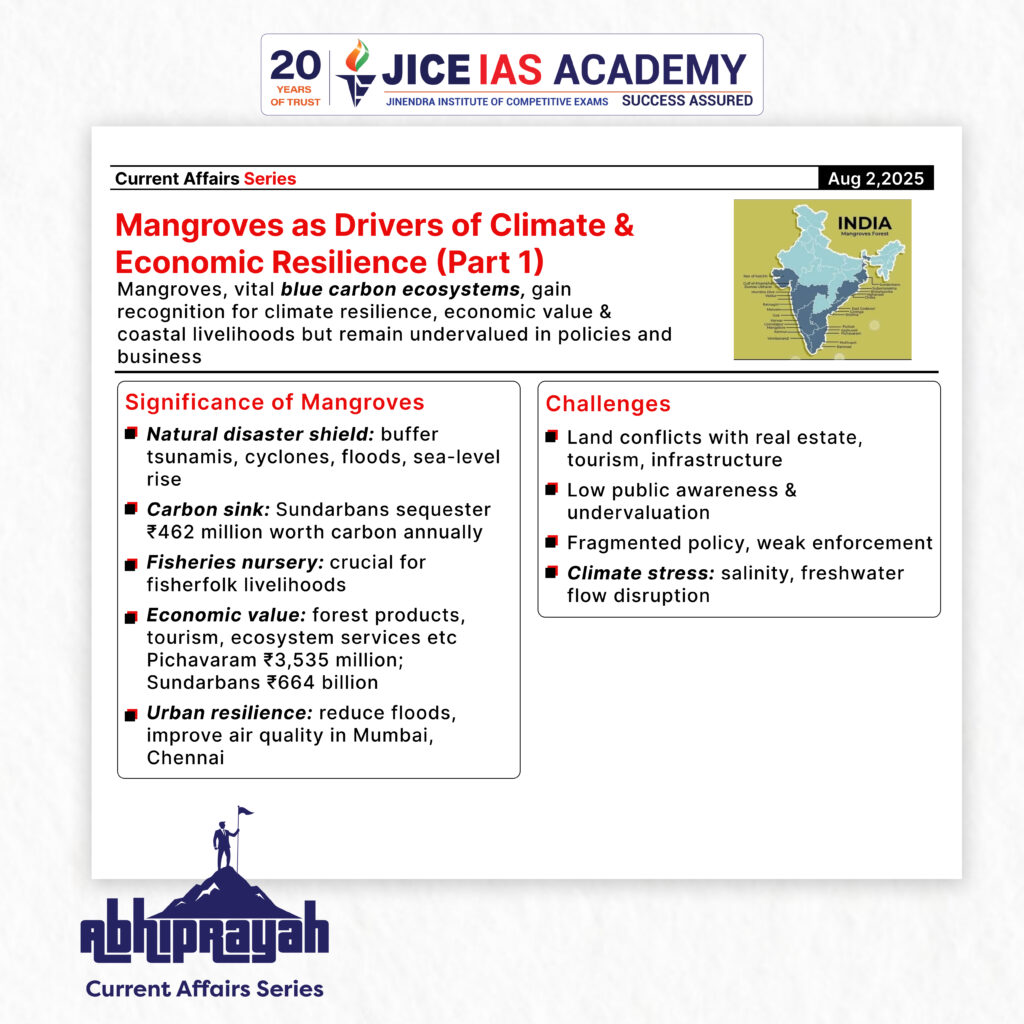
UPSC CURRENT AFFAIRS – 02nd August 2025 Home / Mangroves as Drivers of Climate and Economic Resilience Why in News? Mangroves, critical blue carbon ecosystems, are increasingly recognized for their vital role in climate resilience, economic stability, and sustainable livelihoods, yet remain undervalued in policy and business frameworks. Introduction Mangroves, once relegated to the periphery of environmental planning, are emerging as vital components of natural infrastructure. These intertidal forests along coastlines protect against extreme weather events, nurture biodiversity, sequester carbon, and sustain coastal livelihoods. Despite their substantial ecological and economic benefits, mangroves are often missing from financial balance sheets, infrastructure planning, and corporate responsibility frameworks. As India and the world face rising sea levels, urban coastal vulnerability, and biodiversity loss, mangroves offer a natural solution that combines climate adaptation with economic opportunity. Their conservation and regeneration now require a holistic, technology-enabled, community-led and science-based approach. Significance of Mangroves: Ecosystem and Economic Services Natural Disaster Shield: Act as buffers against tsunamis, cyclones, floods, and sea-level rise. Carbon Sequestration: Serve as ‘blue carbon’ sinks — Sundarbans alone sequester carbon worth ₹462 million annually. Fisheries and Livelihoods: Function as nurseries for juvenile fish; essential to fisherfolk and coastal livelihoods. Economic Value: Pichavaram mangroves (Tamil Nadu): ecosystem services valued at ₹3,535 million. Sundarbans (West Bengal): total ecosystem services worth ₹664 billion. Urban Resilience: In cities like Mumbai and Chennai, mangroves reduce flood risk, improve air quality, and provide green cover. Challenges to Mangrove Protection Land Use Conflicts: Real estate, infrastructure, and tourism developments threaten mangrove lands. Lack of Awareness: Ecosystem services are undervalued due to insufficient public understanding. Policy Gaps: Fragmented legal frameworks, weak enforcement, and lack of integration in development plans. Climate Pressure: Rising salinity and irregular freshwater flows disrupt ecosystem dynamics. Steps to Protect Mangroves Mapping with Technology: Leveraging Natural Capital Data Tools: Satellite imagery, drone data, and AI-driven geospatial analysis help quantify blue carbon and track degradation. Policy Impact: Improved mapping feeds into evidence-based policymaking and restoration prioritisation. Inclusion: Recognizes the ecological wisdom of coastal communities and supports equitable benefit-sharing. Community-Led Conservation: Empowering Coastal Stakeholders Livelihood Integration: Fisherfolk depend on mangroves for sustainable catch. Alternative livelihoods: aquaculture, beekeeping, eco-tourism. Degradation in Urban Settings: Mangroves near cities suffer due to pollution and encroachment. Solution Models: Community-based governance like Eco-Development Committees (EDCs) and Joint Forest Management Committees (JFMCs). Building trust and participation ensures long-term ecological health and social equity. Citizen Science and Engagement Platforms Participatory Monitoring: Citizens trained to assess: Mangrove area and health Freshwater flows and biodiversity indicators Community dependence and perceived ecosystem value Tools and Platforms: Development of a “Mangrove Health Tool” Public engagement through platforms like “Mangrove Mitras” (Friends of Mangroves) Outcome: Creates a feedback loop between citizen awareness, scientific insight, and local action. Policy and Business Imperatives Mainstream Mangroves in Planning: Recognize mangroves as economic infrastructure, not just biodiversity areas. Integrate mangroves in coastal zone regulations (CRZ), urban planning, and disaster risk reduction frameworks. Green Finance and Corporate Involvement: Encourage natural capital accounting. Facilitate carbon credits and ESG investments focused on mangrove regeneration. Coalition Approach: Government, private sector, civil society, and scientific institutions must collaborate. Mangrove Coalition efforts are an example of cross-sectoral governance. Way Forward Integrated Coastal Zone Management (ICZM) should prioritize mangrove preservation as a central theme. Link local conservation to national and global climate commitments such as India’s Panchamrit and SDGs. Data-driven conservation and people-centric policies are needed to secure long-term mangrove health. Reframe the narrative — “Mangroves drive business” — by showing their ROI in disaster savings, fishery yield, and carbon storage. Introduction Economic Implications For Indian Exporters These reforms reduce transaction costs and compliance hurdles Encourage a more competitive and efficient export environment Promote value addition in key sectors like leather For Tamil Nadu The reforms particularly benefit the state’s leather industry, a major contributor to employment and exports Boost the marketability of GI-tagged E.I. leather, enhancing rural and traditional industries For Trade Policy These decisions indicate a shift from regulatory controls to policy facilitation Reinforce the goals of Make in India, Atmanirbhar Bharat, and India’s ambition to become a leading export power Recently, BVR Subrahmanyam, CEO of NITI Aayog, claimed that India has overtaken Japan to become the fourth-largest economy in the world, citing data from the International Monetary Fund (IMF). India’s rank as the world’s largest economy varies by measure—nominal GDP or purchasing power parity (PPP)—each with key implications for economic analysis. Significance and Applications