
UPSC CURRENT AFFAIRS – 12th June 2025

Home / UPSC / Current Affairs / 5,300‑yr‑old Early Harappan settlement in Gujarat

5,300‑yr‑old Early Harappan settlement in Gujarat

Why in News?

  • The University of Kerala’s excavation at Lakhapar in Kachchh, Gujarat, has revealed a 5,300-year-old Early Harappan settlement.

Introduction

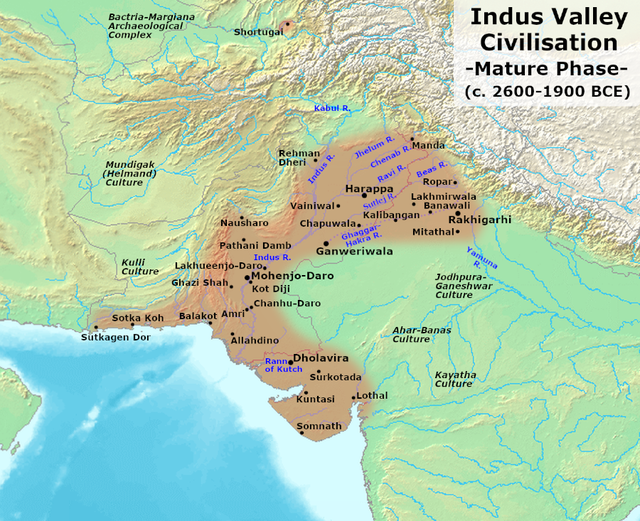
  • In a significant archaeological breakthrough, researchers from the University of Kerala have uncovered a 5,300-year-old Early Harappan habitation site near Lakhapar village in Kachchh district, Gujarat. 
  • This discovery offers a rare and critical cultural context to previously found Harappan burials in the region, establishing Lakhapar as a crucial site in understanding the settlement-burial continuum of the Harappan civilization in western India.

Background and Location

  • The site lies on either side of the Gaduli–Lakhapar road, spanning nearly three hectares, close to the now-quiet Gandi river, which once served as a perennial water source.
  • It is situated just 1.5 km from the known Early Harappan necropolis of Juna Khatiya, where nearly 197 burials were documented over three excavation seasons (2019–2022).
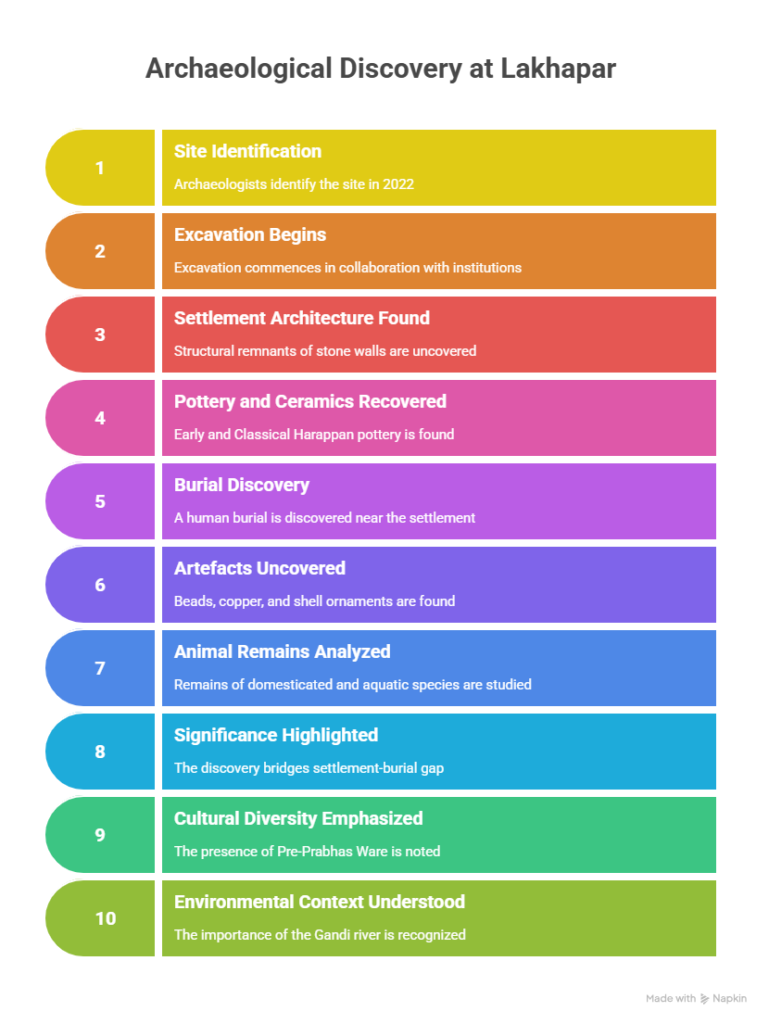
  • The site was first identified in 2022 by archaeologists Dr. Abhayan G.S. and Dr. Rajesh S.V. of the Department of Archaeology, University of Kerala, and later excavated in collaboration with national and international institutions.

Key Findings

  1. Settlement Architecture
  • Excavations revealed structural remnants with stone walls made of local sandstone and shale, indicating a well-planned layout.
  • The scale and material suggest permanent occupation, rather than a seasonal or temporary encampment.
  1. Pottery and Ceramic Traditions
  • Pottery from both Early (c. 3300 BCE) and Classical Harappan phases were recovered.
  • A notable find is the Pre-Prabhas Ware—a rare ceramic tradition previously found at only three other sites in Gujarat. This suggests the existence of a culturally distinct subgroup within the broader Harappan civilization.
  • The co-occurrence of Early and Classical Harappan pottery suggests continuity or transitional phases in settlement occupation.
  1. Burial Discovery
  • A human burial was discovered in close proximity to the habitation site.
    • The skeleton was interred in a pit, without architectural features or grave markers.
    • Pre-Prabhas Ware pottery was found with the burial, marking the first known association of this ceramic with funerary practices.
    • This suggests a previously undocumented ritual system and adds depth to our understanding of Harappan mortuary traditions.

Artefacts and Material Culture

  • A wide range of artefacts were found, reflecting a vibrant economy and interregional connections:
    • Beads are made of semi-precious stones: carnelian, agate, amazonite, and steatite.
    • Copper and terracotta artefacts, indicating metallurgical knowledge and artistic expression.
    • Shell ornaments, pointing to coastal resource exploitation and trade.
    • Rohri chert blades, indicating long-distance trade or cultural ties with Sindh (modern-day Pakistan).

Subsistence and Environment

  • Animal remains include:
    • Domesticated species: cattle, sheep, goats.
    • Aquatic species: fish bones, edible shell fragments.
  • This implies a mixed subsistence economy based on animal husbandry and fishing.
  • Archaeobotanical samples have been collected to analyse plant remains and reconstruct ancient diet patterns and agricultural practices.

Significance of the Lakhapar Discovery

  1. Bridging the Settlement-Burial Gap
  • While Gujarat has multiple Early Harappan burial sites (e.g., Dhaneti), associated habitation evidence has been sparse.
  • Lakhapar offers a unique opportunity to study the living and the dead of the same cultural group, contributing to a more holistic understanding of Early Harappan life.
  1. Cultural Diversity within the Harappan Civilization
  • The presence of Pre-Prabhas Ware suggests regional ceramic traditions, emphasizing diversity within Harappan cultural expressions.
  • This supports the idea of the Harappan civilization as a heterogeneous network rather than a monolithic culture.
  1. Environmental and Hydrological Context
  • The site’s proximity to the Gandi river, once perennial, underscores the importance of water sources in Harappan settlement planning.
  • The desertification of Kachchh over millennia may explain the eventual abandonment of such settlements.

Conclusion

  • The discovery of the Lakhapar Early Harappan settlement marks a major contribution to South Asian archaeology, enriching our understanding of urbanization, mortuary practices, and regional diversity within the Indus Valley Civilization. 
  • It bridges crucial archaeological gaps between habitation and burial, offering a comprehensive view of socio-cultural dynamics in Early Harappan Gujarat.
  • As further analysis of botanical, faunal, and material remains continues, Lakhapar may serve as a key to unlocking the lesser-known frontiers of the Harappan world.

Economic Implications

For Indian Exporters

  • These reforms reduce transaction costs and compliance hurdles
  • Encourage a more competitive and efficient export environment
  • Promote value addition in key sectors like leather

For Tamil Nadu

  • The reforms particularly benefit the state’s leather industry, a major contributor to employment and exports
  • Boost the marketability of GI-tagged E.I. leather, enhancing rural and traditional industries

For Trade Policy

  • These decisions indicate a shift from regulatory controls to policy facilitation

Reinforce the goals of Make in India, Atmanirbhar Bharat, and India’s ambition to become a leading export power

Recently, BVR Subrahmanyam, CEO of NITI Aayog, claimed that India has overtaken Japan to become the fourth-largest economy in the world, citing data from the International Monetary Fund (IMF). 

India’s rank as the world’s largest economy varies by measure—nominal GDP or purchasing power parity (PPP)—each with key implications for economic analysis.

Significance and Applications

One Response

Leave a Reply

Your email address will not be published. Required fields are marked *

Call Us Now !

Copyright © JICE ACADEMY FOR EXCELLENCE PRIVATE LIMITED