
UPSC CURRENT AFFAIRS – 31th May 2025
Artificial Intelligence and the Future of Learning
Why in News?
The advent of Artificial Intelligence (AI) is driving a quiet yet profound revolution in the field of education.
Introduction
AI is not merely an add-on to traditional methods—it is fundamentally altering how students learn, how teachers teach, and how educational institutions operate. With a focus on personalization, adaptability, and efficiency, AI is redefining education to suit the diverse and dynamic needs of 21st-century learners.
Rethinking Education in the Digital Age
AI has moved beyond being a futuristic concept; it is now deeply embedded in today’s educational ecosystem. Its integration has led to:
- Personalized learning experiences
- Automated evaluations
- Predictive interventions
- Streamlined administration
At its heart, AI in education aims to promote equity, engagement, and individualized growth—ensuring that no learner is left behind.
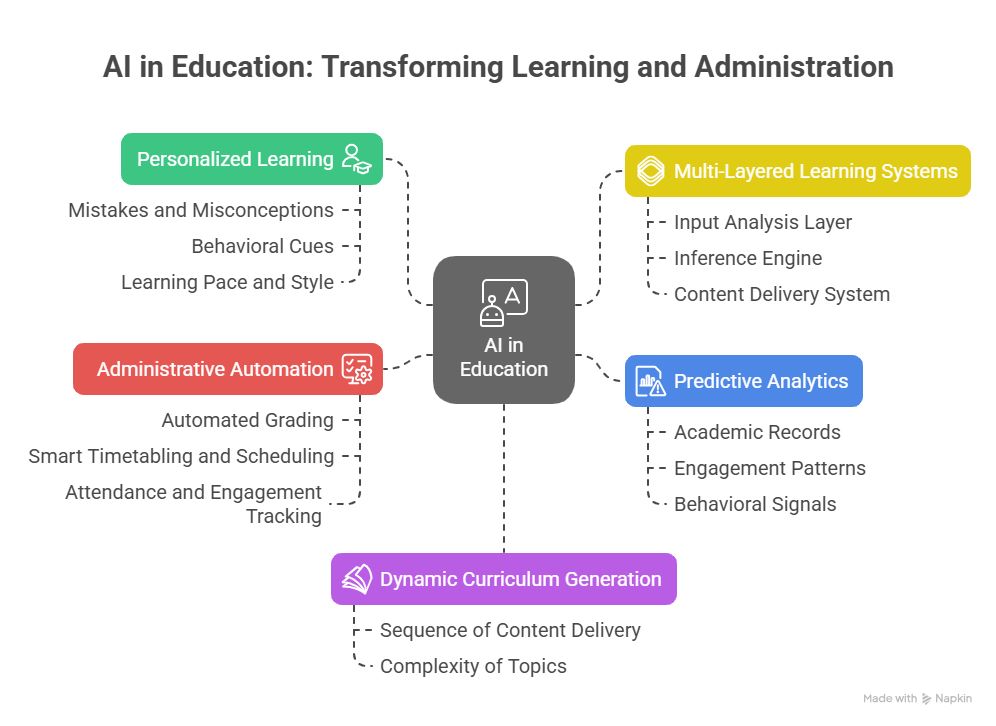
1. Personalized Learning: A Unique Path for Every Learner
One of the most impactful uses of AI is the creation of individualized learning profiles. Machine learning algorithms analyze students’ performance patterns, identifying:
- Mistakes and misconceptions
- Behavioral cues like hesitation or repeated attempts
- Learning pace and style
Tools like cognitive mapping and behavioral analytics distinguish between productive struggles and actual confusion. AI systems then adapt the content in real-time, ensuring students receive the right support at the right time.
2. Dynamic Curriculum Generation: Complexity with Precision
AI goes a step further by dynamically generating curricula. It adjusts both:
- The sequence of content delivery
- The complexity of topics presented
For example:
- If a student struggles with algebra, the system reverts to earlier foundational concepts and introduces simpler problems first.
- As mastery is built, the system incrementally increases the difficulty.
Statistical benefits include:
- 40% reduction in cognitive overload
- 27% improvement in concept retention
Reinforcement learning ensures the system learns from the learner, fine-tuning itself for greater accuracy over time.
3. Multi-Layered Learning Systems: Intelligence Beneath the Surface
Modern AI-driven educational platforms operate on three core layers:
i) Input Analysis Layer
- Processes learner inputs (text, time taken, behavior)
- Uses Natural Language Processing (NLP) to understand explanations
- Sentiment analysis detects emotions like frustration or disengagement
ii) Inference Engine
- Builds student knowledge models using Bayesian networks and decision trees
- Predicts future performance and accounts for memory decay
- Suggests revision schedules and interventions
iii) Content Delivery System
- Presents materials based on Cognitive Load Theory
- Segments content into manageable parts
- Increases efficiency, reducing learning time by 20% or more
4. Predictive Analytics: Prevention Before Intervention
AI’s ability to predict academic risk is a breakthrough in student retention. Advanced models analyze:
- Academic records
- Engagement patterns
- Behavioral signals on learning platforms
Ensemble models like random forests and gradient boosting achieve up to 92% accuracy in forecasting dropouts or performance dips—weeks in advance of traditional detection methods.
This gives institutions time to:
- Intervene early
- Offer additional support
- Re-engage at-risk students
5. Administrative Automation: Giving Teachers Back Their Time
AI is revolutionizing the administrative side of education, improving both accuracy and efficiency. Key advancements include:
Automated Grading
- Handwriting recognition (up to 95% accuracy)
- Essay scoring aligned with human markers
Smart Timetabling and Scheduling
- Conflict-free class schedules
- Optimal use of resources and classroom space
Attendance and Engagement Tracking
- Face recognition and biometric tools
- Real-time student participation data
Conclusion:
Fnu Imran Ahamed highlights a compelling future where AI transforms education into a personalized, proactive, and precision-driven system. But this transformation does not diminish the role of educators. Instead, it enhances their impact, allowing them to focus on mentorship, creativity, and emotional connection.

3rd UN conference on landlocked countries
UPSC CURRENT AFFAIRS – 08th August 2025 Home / 3rd UN conference on landlocked countries Why in News? At the

Issue of soapstone mining in Uttarakhand’s Bageshwar
UPSC CURRENT AFFAIRS – 08th August 2025 Home / Issue of soapstone mining in Uttarakhand’s Bageshwar Why in News? Unregulated

Groundwater Pollution in India – A Silent Public Health Emergency
UPSC CURRENT AFFAIRS – 08th August 2025 Home / Groundwater Pollution in India – A Silent Public Health Emergency Why
Universal banking- need and impact
UPSC CURRENT AFFAIRS – 08th August 2025 Home / Universal banking- need and impact Why in News? The Reserve Bank
India’s “Goldilocks” Economy: A Critical Appraisal
UPSC CURRENT AFFAIRS – 08th August 2025 Home / India’s “Goldilocks” Economy: A Critical Appraisal Why in News? The Finance

U.S.-India Trade Dispute: Trump’s 50% Tariffs and India’s Oil Imports from Russia
UPSC CURRENT AFFAIRS – 07th August 2025 Home / U.S.-India Trade Dispute: Trump’s 50% Tariffs and India’s Oil Imports from

Eco-Friendly Solution to Teak Pest Crisis: KFRI’s HpNPV Technology
UPSC CURRENT AFFAIRS – 07th August 2025 Home / Eco-Friendly Solution to Teak Pest Crisis: KFRI’s HpNPV Technology Why in

New Species of Non-Venomous Rain Snake Discovered in Mizoram
UPSC CURRENT AFFAIRS – 07th August 2025 Home / New Species of Non-Venomous Rain Snake Discovered in Mizoram Why in

For Indian Exporters
- These reforms reduce transaction costs and compliance hurdles
- Encourage a more competitive and efficient export environment
- Promote value addition in key sectors like leather
For Tamil Nadu
- The reforms particularly benefit the state’s leather industry, a major contributor to employment and exports
- Boost the marketability of GI-tagged E.I. leather, enhancing rural and traditional industries
For Trade Policy
- These decisions indicate a shift from regulatory controls to policy facilitation
Reinforce the goals of Make in India, Atmanirbhar Bharat, and India’s ambition to become a leading export power
Recently, BVR Subrahmanyam, CEO of NITI Aayog, claimed that India has overtaken Japan to become the fourth-largest economy in the world, citing data from the International Monetary Fund (IMF).
India’s rank as the world’s largest economy varies by measure—nominal GDP or purchasing power parity (PPP)—each with key implications for economic analysis.