
UPSC CURRENT AFFAIRS – 03rd August 2025
Arya Samaj Marriages Under Judicial Scrutiny Amid Anti-Conversion Law Enforcement
Why in News?
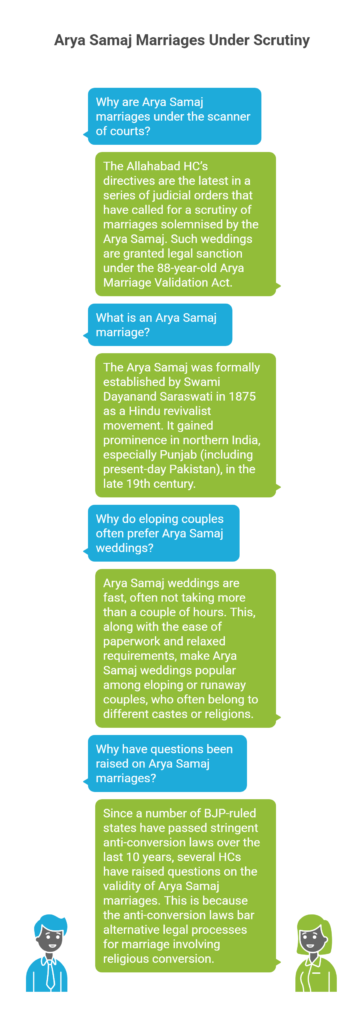
- The Allahabad High Court recently directed the Uttar Pradesh government to investigate the proliferation of fake Arya Samaj societies that are solemnising marriages without verifying the age of the bride and groom.
- This came in the context of a case where a Muslim man claimed to have married a minor Hindu girl through an Arya Samaj ceremony, allegedly bypassing the state’s anti-conversion law.
Key Highlights
- The Arya Samaj, founded in 1875 by Swami Dayanand Saraswati, was a Hindu reform movement that promoted inter-caste and interfaith marriages through a process called shuddhi (purification).
- The Arya Marriage Validation Act, 1937, was enacted to give legal recognition to marriages between self-declared Arya Samajists, even if they previously belonged to different castes or religions.
- Arya Samaj marriages are recognized under the Hindu Marriage Act, 1955, for Hindus, Buddhists, Jains, and Sikhs. Non-Hindus can convert and marry via Arya Samaj, with the conversion process often expedited.
- Such marriages are popular among eloping couples due to their speed, lower cost, and absence of public notice requirements, unlike the Special Marriage Act which mandates a 30-day notice.
- Courts have found that many Arya Samaj organizations do not verify age, conduct proper conversions, or follow documentation norms, sometimes issuing certificates without legal authority.
- The Supreme Court in 2022 remarked that Arya Samaj has “no business” issuing marriage certificates, and the Delhi High Court ordered stricter witness verification during such ceremonies.
Legal Framework and Procedural Conflicts
- The Arya Marriage Validation Act, 1937, ensures that marriages conducted by Arya Samaj are valid even if the individuals were from different religions or castes before declaring themselves as Arya Samajists.
- Shuddhi is a religious purification ritual used by Arya Samaj to convert individuals to Hinduism, but is often performed without adhering to statutory procedures required under anti-conversion laws.
- The Uttar Pradesh Prohibition of Unlawful Conversion of Religion Act, 2021, requires a 60-day pre-conversion declaration, a post-conversion notice to the District Magistrate, and a formal inquiry.
- The Act places the burden of proof on the accused to show that the conversion was not done by coercion or fraud, and declares such marriages void if legal procedures are not followed.
Policy Relevance
- Anti-conversion laws in several states, including Uttar Pradesh, Madhya Pradesh, and Uttarakhand, aim to regulate religious conversions and prevent conversions done solely for the purpose of marriage.
- These laws conflict with the informal and rapid nature of Arya Samaj marriages, which often do not include official inquiries or advance notice of religious conversion.
- Courts are increasingly insisting that Arya Samaj institutions comply with statutory procedures, especially in cases involving minors, forged documents, or interfaith marriages.
- A Supreme Court petition, pending since 2022, seeks clarity on whether Arya Samaj marriages involving interfaith couples must also adhere to the Special Marriage Act provisions.
India Impact
- Legal scrutiny of Arya Samaj marriages reflects broader societal and legal tensions surrounding interfaith and intercaste marriages, religious freedom, and state oversight.
- Couples seeking quick legal validation of their marriages, particularly eloping interfaith couples, may now face legal complications or prosecution if proper procedures are not followed.
- The situation underscores the need for harmonizing personal laws, possibly through a Uniform Civil Code, or reforms in marriage registration and religious conversion protocols.
- Supreme Court judgments in these matters will have far-reaching implications for how marriages and conversions are regulated in India, especially in states with active anti-conversion frameworks.

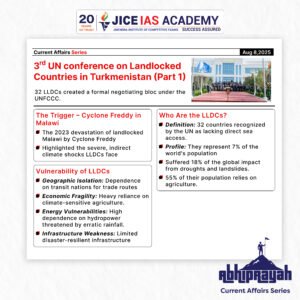
3rd UN conference on landlocked countries
UPSC CURRENT AFFAIRS – 08th August 2025 Home / 3rd UN conference on landlocked countries Why in News? At the

Issue of soapstone mining in Uttarakhand’s Bageshwar
UPSC CURRENT AFFAIRS – 08th August 2025 Home / Issue of soapstone mining in Uttarakhand’s Bageshwar Why in News? Unregulated

Groundwater Pollution in India – A Silent Public Health Emergency
UPSC CURRENT AFFAIRS – 08th August 2025 Home / Groundwater Pollution in India – A Silent Public Health Emergency Why
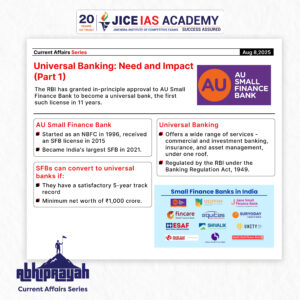
Universal banking- need and impact
UPSC CURRENT AFFAIRS – 08th August 2025 Home / Universal banking- need and impact Why in News? The Reserve Bank
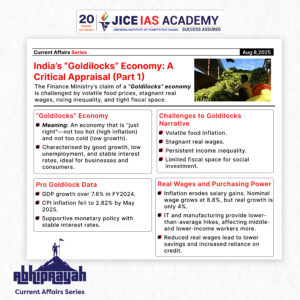
India’s “Goldilocks” Economy: A Critical Appraisal
UPSC CURRENT AFFAIRS – 08th August 2025 Home / India’s “Goldilocks” Economy: A Critical Appraisal Why in News? The Finance

U.S.-India Trade Dispute: Trump’s 50% Tariffs and India’s Oil Imports from Russia
UPSC CURRENT AFFAIRS – 07th August 2025 Home / U.S.-India Trade Dispute: Trump’s 50% Tariffs and India’s Oil Imports from
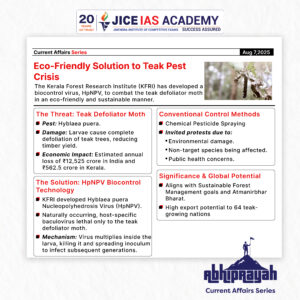
Eco-Friendly Solution to Teak Pest Crisis: KFRI’s HpNPV Technology
UPSC CURRENT AFFAIRS – 07th August 2025 Home / Eco-Friendly Solution to Teak Pest Crisis: KFRI’s HpNPV Technology Why in

New Species of Non-Venomous Rain Snake Discovered in Mizoram
UPSC CURRENT AFFAIRS – 07th August 2025 Home / New Species of Non-Venomous Rain Snake Discovered in Mizoram Why in

Introduction
Economic Implications
For Indian Exporters
- These reforms reduce transaction costs and compliance hurdles
- Encourage a more competitive and efficient export environment
- Promote value addition in key sectors like leather
For Tamil Nadu
- The reforms particularly benefit the state’s leather industry, a major contributor to employment and exports
- Boost the marketability of GI-tagged E.I. leather, enhancing rural and traditional industries
For Trade Policy
- These decisions indicate a shift from regulatory controls to policy facilitation
Reinforce the goals of Make in India, Atmanirbhar Bharat, and India’s ambition to become a leading export power
Recently, BVR Subrahmanyam, CEO of NITI Aayog, claimed that India has overtaken Japan to become the fourth-largest economy in the world, citing data from the International Monetary Fund (IMF).
India’s rank as the world’s largest economy varies by measure—nominal GDP or purchasing power parity (PPP)—each with key implications for economic analysis.