UPSC CURRENT AFFAIRS – 12th July 2025
Astra BVRAAM with Indigenous RF Seeker Successfully Flight-Tested by DRDO and IAF
Why in News?
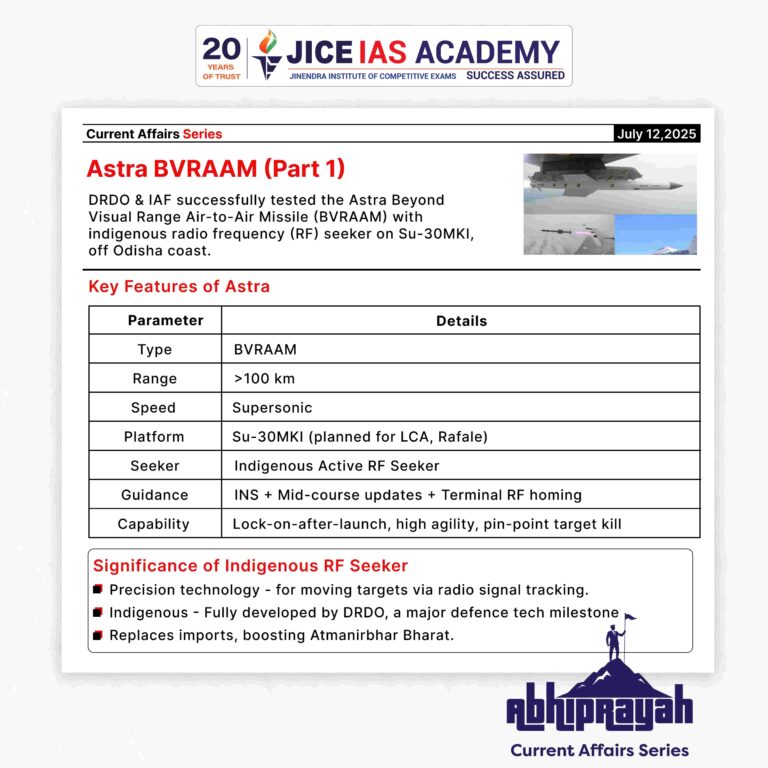
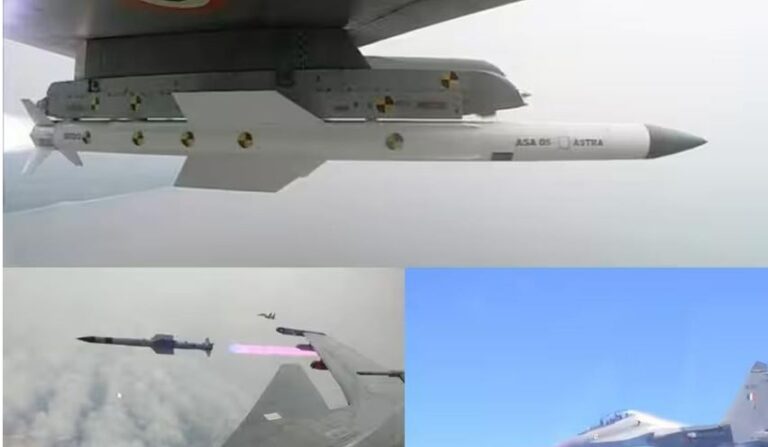
DRDO and IAF successfully flight-tested the indigenous Astra BVRAAM with an indigenous Radio Frequency seeker, marking a major milestone in India’s air-to-air missile capability.
Introduction
- Defence Research and Development Organisation (DRDO) and the Indian Air Force (IAF) successfully conducted a major flight test of the indigenous Astra Beyond Visual Range Air-to-Air Missile (BVRAAM).
About Astra BVRAAM
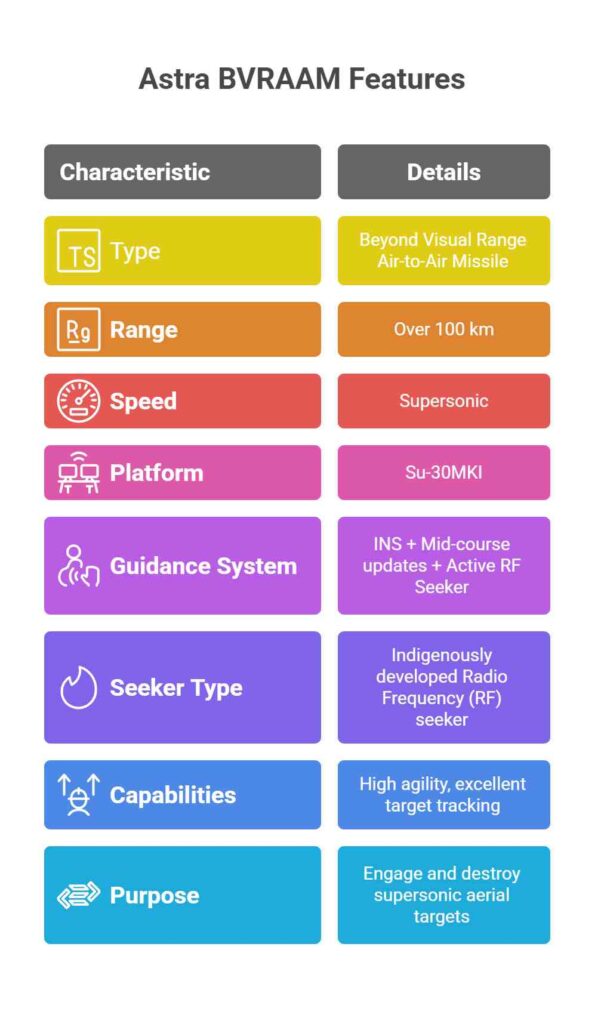
Feature | Details |
Type | Beyond Visual Range Air-to-Air Missile (BVRAAM) |
Range | Over 100 km |
Speed | Supersonic |
Platform | Su-30MKI (with plans for integration with other aircraft) |
Guidance System | Inertial Navigation System (INS) + Mid-course updates + Active RF Seeker |
Seeker Type | Indigenously developed Radio Frequency (RF) seeker |
Capabilities | High agility, excellent target tracking, and lock-on after launch capability |
Purpose | To engage and destroy highly maneuvering supersonic aerial targets at long ranges |
Significance of the Indigenous RF Seeker
- Critical Technology: The RF seeker is one of the most complex and critical components in modern air-to-air missiles. It enables precision homing on moving targets by detecting and locking onto the radio signals emitted by enemy aircraft.
- Indigenous Development: The seeker was designed and developed entirely by DRDO, marking a breakthrough in strategic defence technology.
- Import Substitution: Replacing imported RF seekers with an indigenous version strengthens India’s Atmanirbhar Bharat initiative and reduces foreign dependency.
Strategic Implications
- Enhanced Air Superiority: With a range exceeding 100 km, Astra provides the IAF with a significant edge in Beyond Visual Range combat, enabling first-shot, first-kill capability.
- Indigenous Capability Building: The successful test reinforces India’s ability to design, develop, and deploy state-of-the-art missile systems independently.
- Export Potential: Astra’s success paves the way for defence exports to friendly nations, contributing to India’s growing stature as a global defence supplier.
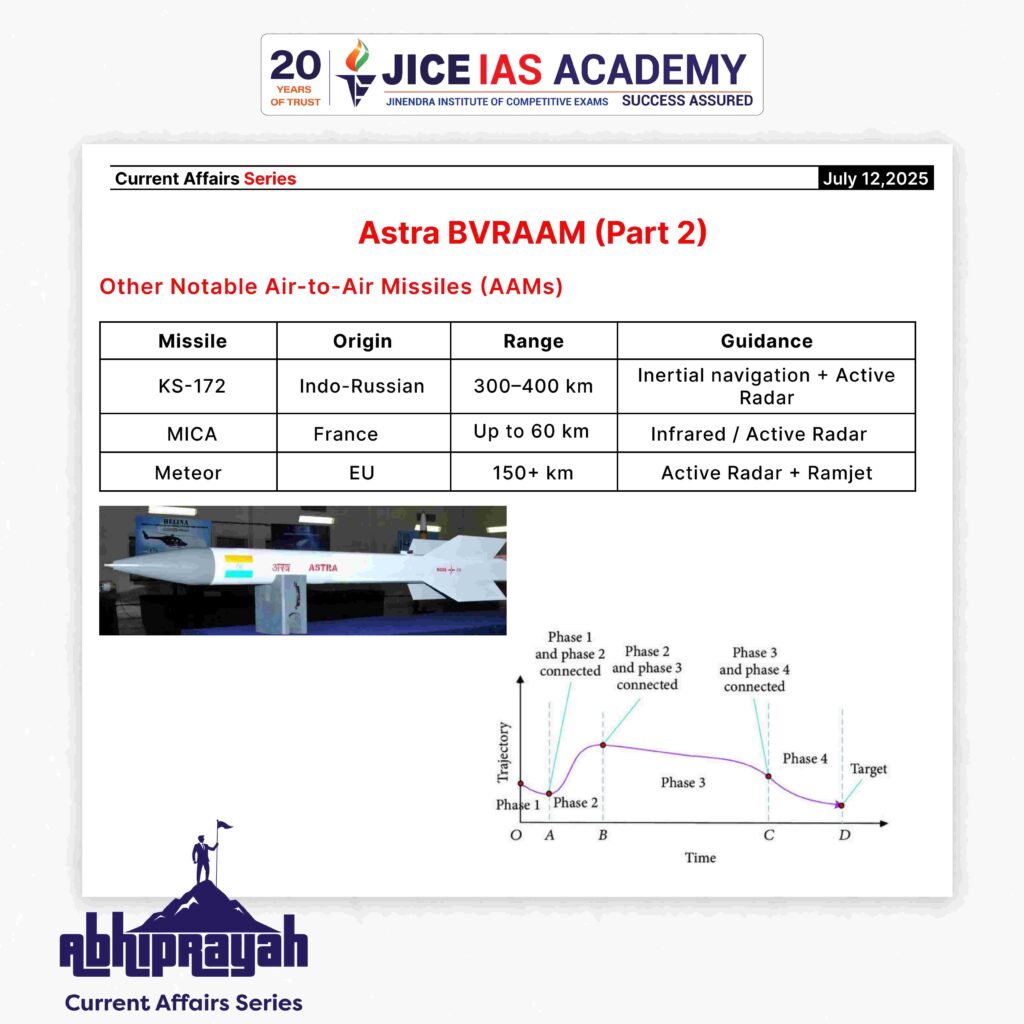
Other AAMs and related systems
- Novator KS-172 (K-100): This is a medium-range AAM, jointly developed with Russia. It uses inertial navigation and active radar homing for guidance, with a range of 300–400 km and a speed of Mach 3.3.
- MICA: While primarily a medium-range, multi-platform missile, the MBDA MICA is also available in an air-to-air configuration, utilizing either infrared or active radar guidance. It has a range of 500 m to 60 km.
- Meteor: India is also integrating the MBDA Meteor, a long-range active radar-guided AAM, on its Rafale fighter jets.

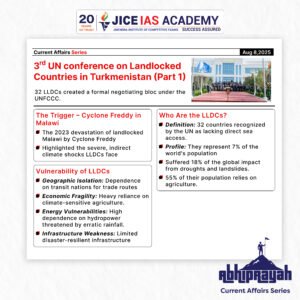
3rd UN conference on landlocked countries
UPSC CURRENT AFFAIRS – 08th August 2025 Home / 3rd UN conference on landlocked countries Why in News? At the
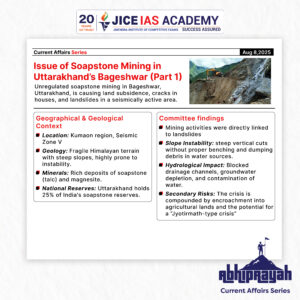
Issue of soapstone mining in Uttarakhand’s Bageshwar
UPSC CURRENT AFFAIRS – 08th August 2025 Home / Issue of soapstone mining in Uttarakhand’s Bageshwar Why in News? Unregulated
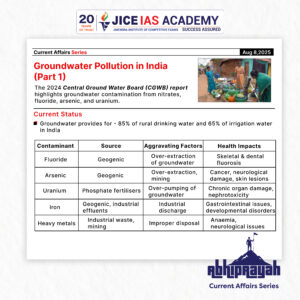
Groundwater Pollution in India – A Silent Public Health Emergency
UPSC CURRENT AFFAIRS – 08th August 2025 Home / Groundwater Pollution in India – A Silent Public Health Emergency Why
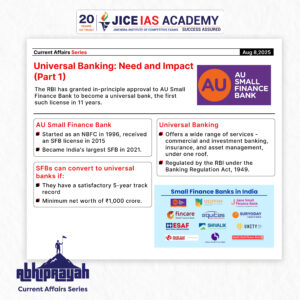
Universal banking- need and impact
UPSC CURRENT AFFAIRS – 08th August 2025 Home / Universal banking- need and impact Why in News? The Reserve Bank

India’s “Goldilocks” Economy: A Critical Appraisal
UPSC CURRENT AFFAIRS – 08th August 2025 Home / India’s “Goldilocks” Economy: A Critical Appraisal Why in News? The Finance

U.S.-India Trade Dispute: Trump’s 50% Tariffs and India’s Oil Imports from Russia
UPSC CURRENT AFFAIRS – 07th August 2025 Home / U.S.-India Trade Dispute: Trump’s 50% Tariffs and India’s Oil Imports from
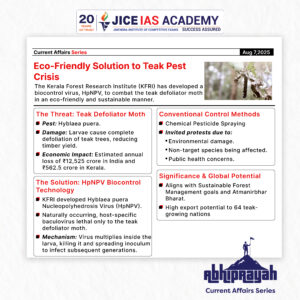
Eco-Friendly Solution to Teak Pest Crisis: KFRI’s HpNPV Technology
UPSC CURRENT AFFAIRS – 07th August 2025 Home / Eco-Friendly Solution to Teak Pest Crisis: KFRI’s HpNPV Technology Why in
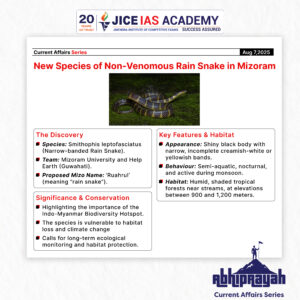
New Species of Non-Venomous Rain Snake Discovered in Mizoram
UPSC CURRENT AFFAIRS – 07th August 2025 Home / New Species of Non-Venomous Rain Snake Discovered in Mizoram Why in

Economic Implications
For Indian Exporters
- These reforms reduce transaction costs and compliance hurdles
- Encourage a more competitive and efficient export environment
- Promote value addition in key sectors like leather
For Tamil Nadu
- The reforms particularly benefit the state’s leather industry, a major contributor to employment and exports
- Boost the marketability of GI-tagged E.I. leather, enhancing rural and traditional industries
For Trade Policy
- These decisions indicate a shift from regulatory controls to policy facilitation
Reinforce the goals of Make in India, Atmanirbhar Bharat, and India’s ambition to become a leading export power
Recently, BVR Subrahmanyam, CEO of NITI Aayog, claimed that India has overtaken Japan to become the fourth-largest economy in the world, citing data from the International Monetary Fund (IMF).
India’s rank as the world’s largest economy varies by measure—nominal GDP or purchasing power parity (PPP)—each with key implications for economic analysis.