
UPSC CURRENT AFFAIRS – 07th July 2025

Home / UPSC / Current Affairs / Centre moots ‘AVAS’ sound alerts for e-vehicles

Centre moots ‘AVAS’ sound alerts for e-vehicles

various auto-rickshaws and motorcycles

Why in News?

  • To enhance pedestrian safety, the Government of India has proposed mandating Acoustic Vehicle Alerting Systems (AVAS) in electric vehicles moving at speeds below 20 kmph due to their low sound emissions.

Introduction

  • The Central Government of India is in the process of introducing a new safety regulation for electric vehicles (EVs), which mandates the installation of a device called the Acoustic Vehicle Alerting System (AVAS)
  • This step is being taken by the Ministry of Road Transport and Highways (MoRTH) in response to the growing number of electric vehicles on Indian roads, particularly two-wheelers, three-wheelers, and e-rickshaws, and the associated risk of silent movement at low speeds.

The Core Issue:

  • Electric vehicles, by design, operate almost silently at lower speeds. Unlike conventional vehicles with internal combustion engines, EVs do not emit engine noise, especially when moving at speeds below 20 km per hour
  • This silent movement poses a serious safety hazard for pedestrians, cyclists, and other vulnerable road users, particularly in densely populated urban and residential areas.
  • At low speeds, even tyre noise is minimal, making it difficult for people to detect the presence of an approaching electric vehicle. 
  • This significantly increases the likelihood of accidents, particularly in areas where visibility is limited or where there is heavy foot traffic.

What is AVAS?

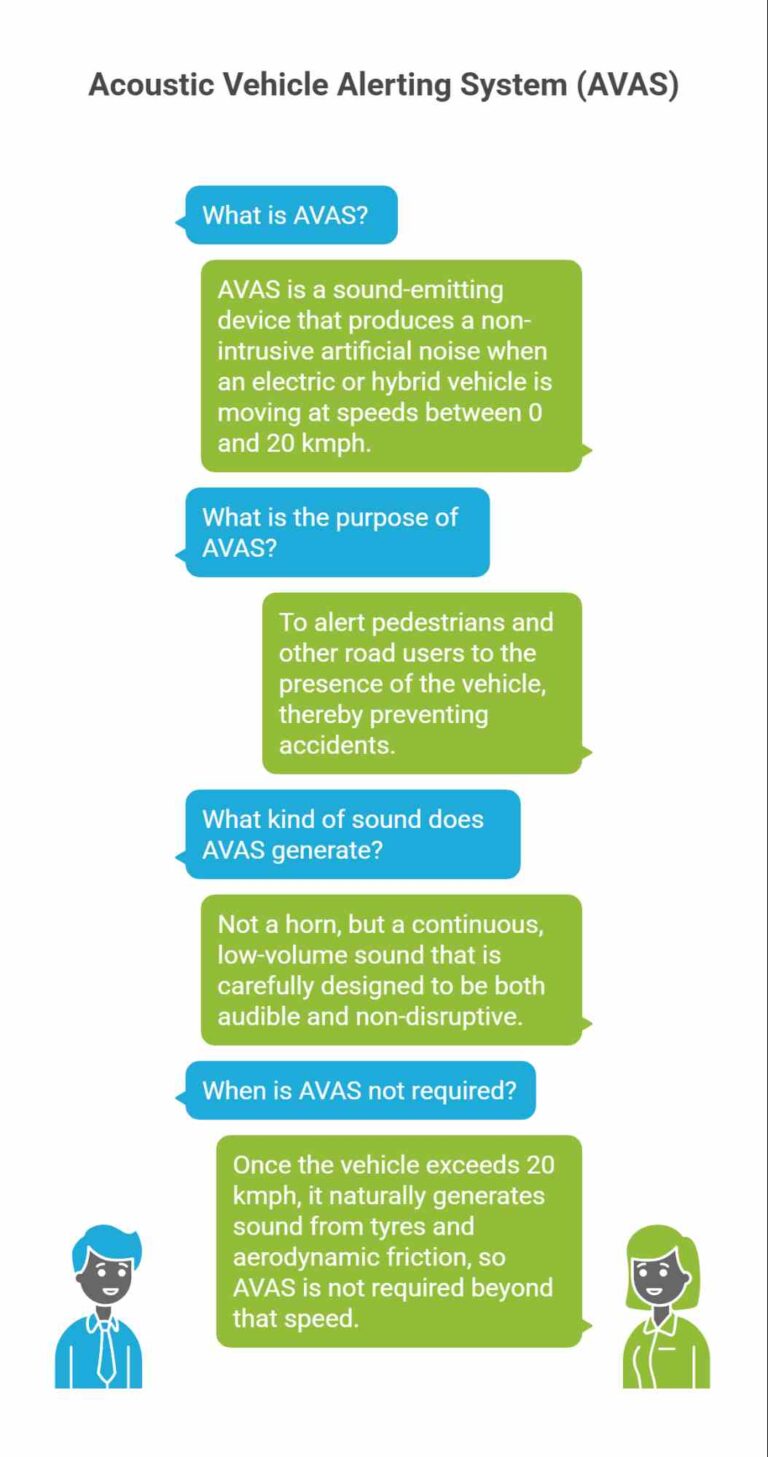
  • The Acoustic Vehicle Alerting System (AVAS) is a sound-emitting device that produces a non-intrusive artificial noise when an electric or hybrid vehicle is moving at speeds between 0 and 20 kmph
  • The purpose of this artificial sound is to alert pedestrians and other road users to the presence of the vehicle, thereby preventing accidents.
  • The sound generated by AVAS is not a horn, but a continuous, low-volume sound that is carefully designed to be both audible and non-disruptive
  • Once the vehicle exceeds 20 kmph, it naturally generates sound from tyres and aerodynamic friction, so AVAS is not required beyond that speed.
acoustic vehicle alerting system

Policy Initiative:

  • The Ministry of Road Transport and Highways (MoRTH) has already published a draft guideline under the framework of Automotive Industry Standards (AIS), proposing the mandatory installation of AVAS in electric vehicles.
  • This proposal was discussed in the Central Motor Vehicles Rules – Technical Standing Committee (CMVR-TSC), which is the apex authority responsible for motor vehicle safety standards in India. 
  • Once the consultation process is completed, a final regulation is expected to be notified soon.

International Precedents:

India is not the first country to consider the need for AVAS. Many advanced countries have already implemented similar safety norms:

  • In the United States, the National Highway Traffic Safety Administration (NHTSA) requires all electric and hybrid vehicles to produce warning sounds at speeds up to 30 kmph.
  • Japan has also mandated AVAS in electric and hybrid vehicles through its Ministry of Land, Infrastructure, Transport and Tourism.
  • These international practices have set a benchmark for India’s regulatory approach, ensuring that the country keeps pace with global road safety standards.

Scientific Research and Industry Involvement

  • In parallel with policy development, a scientific study is being conducted by the Indian Institute of Technology (IIT), Delhi, to assess the need for AVAS in Indian conditions. 
  • The study was commissioned by the Society of Indian Automobile Manufacturers (SIAM), the apex industry body representing vehicle manufacturers in India.
  • According to Dr. Anoop Chawla, Professor of Mechanical Engineering at IIT Delhi, the study is still ongoing and aims to explore:
    • Human auditory perception of different types of vehicle sounds
    • The extent to which lack of sound contributes to accidents
    • Appropriate volume and frequency of the artificial sound
    • Whether different vehicle types require different AVAS configurations
  • This research will help refine the design parameters of AVAS systems and guide their implementation in a way that is effective, scientifically validated, and suited to Indian road environments.

Rising Need for AVAS in India’s Mobility Ecosystem

  • The need for such a regulation is particularly urgent given the rapid increase in the number of electric vehicles, especially e-rickshaws, in urban and semi-urban areas. 
  • These vehicles are widely used for last-mile connectivity, school transport, local deliveries, and public mobility in small towns and city colonies.
  • Given that these areas are often congested with pedestrians and non-motorized vehicles, the risk of collision increases significantly when electric vehicles approach silently. 
  • Vulnerable groups such as children, senior citizens, and people with visual impairments are particularly at risk.

Impact of the Regulation

The proposed AVAS regulation will help bridge the gap between the environmental benefits of electric vehicles and the need for ensuring pedestrian safety. Once implemented, the rule would:

  • Mandate all new electric and hybrid vehicles to be equipped with AVAS, especially in the two- and three-wheeler segments
  • Establish technical standards for sound levels and operational conditions
  • Encourage manufacturers to develop standardized yet customizable AVAS solutions

Economic Implications

For Indian Exporters

  • These reforms reduce transaction costs and compliance hurdles
  • Encourage a more competitive and efficient export environment
  • Promote value addition in key sectors like leather

For Tamil Nadu

  • The reforms particularly benefit the state’s leather industry, a major contributor to employment and exports
  • Boost the marketability of GI-tagged E.I. leather, enhancing rural and traditional industries

For Trade Policy

  • These decisions indicate a shift from regulatory controls to policy facilitation

Reinforce the goals of Make in India, Atmanirbhar Bharat, and India’s ambition to become a leading export power

Recently, BVR Subrahmanyam, CEO of NITI Aayog, claimed that India has overtaken Japan to become the fourth-largest economy in the world, citing data from the International Monetary Fund (IMF). 

India’s rank as the world’s largest economy varies by measure—nominal GDP or purchasing power parity (PPP)—each with key implications for economic analysis.

Significance and Applications

Leave a Reply

Your email address will not be published. Required fields are marked *

Call Us Now !

Copyright © JICE ACADEMY FOR EXCELLENCE PRIVATE LIMITED