UPSC CURRENT AFFAIRS – 04th August 2025

Home / UPSC / Current Affairs / Bio-Fortified Potatoes and the South Asia Regional Centre of CIP in Agra

Bio-Fortified Potatoes and the South Asia Regional Centre of CIP in Agra

Why in News?

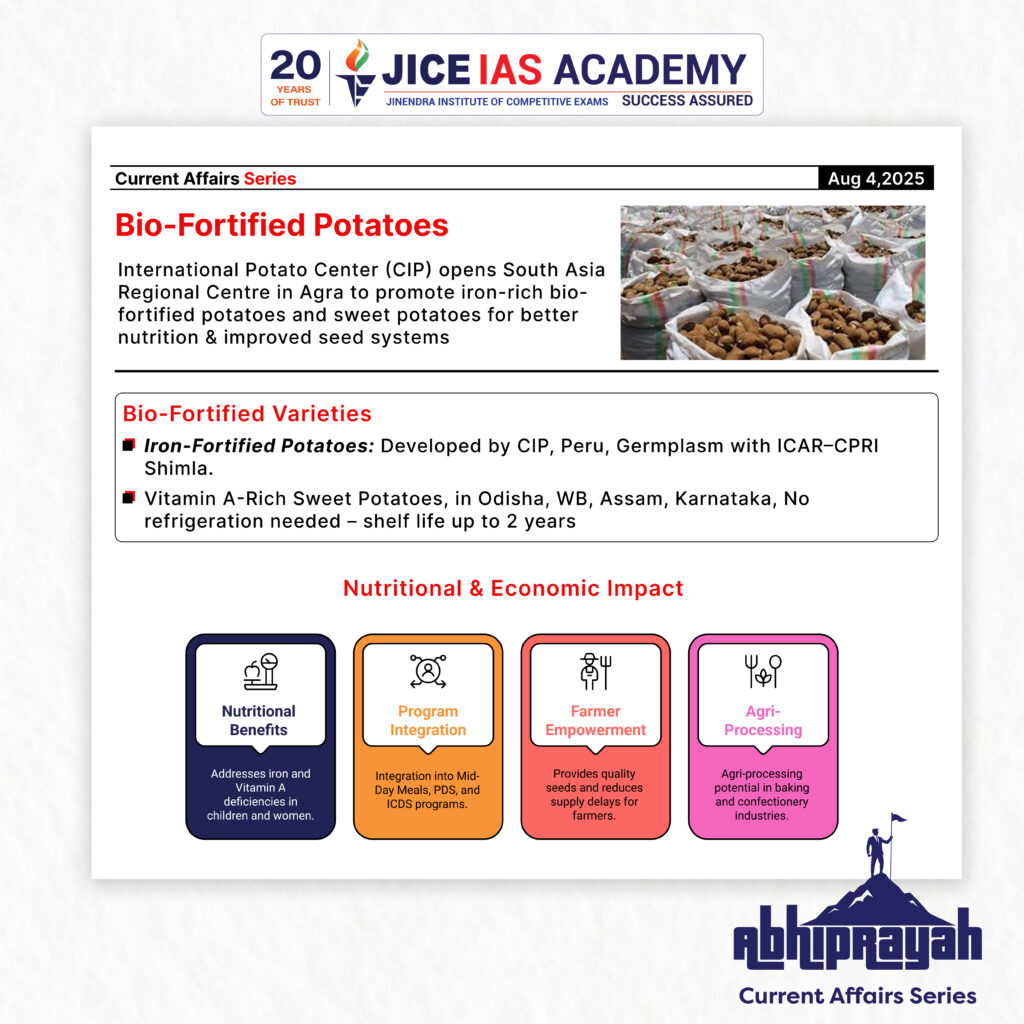
  • The International Potato Center (CIP) has established its South Asia Regional Centre in Agra, aiming to promote bio-fortified potatoes and sweet potatoes in India to enhance nutritional security and seed system efficiency.

Introduction

  • On August 1, 2025, Dr. Simon Heck, Director General of the Peru-based International Potato Center (CIP), announced that bio-fortified potatoes enriched with iron will soon be available in Indian markets.

Key Highlights:

Bio-Fortified Potatoes and Sweet Potatoes:

  • Iron-Fortified Potatoes:
    • First variety released in Peru.
    • Germplasm shared with ICAR – Central Potato Research Institute (CPRI), Shimla.
    • Currently under evaluation and adaptation for Indian conditions.
  • Vitamin A-Fortified Sweet Potatoes:
    • Already cultivated in Odisha, West Bengal, Assam, and Karnataka.
    • Developed using CIP technology.
    • Identified by their bright orange flesh, rich in beta-carotene.

Significance of CIP’s South Asia Centre in Agra:

  • Strategically located in the Indo-Gangetic plains, the world’s largest potato-producing region.
  • Land provided by Government of Uttar Pradesh, handed to the National Horticulture Board (NHB).
  • Established through an agreement with the Union Ministry of Agriculture (July 2025).

Objectives:

  • Facilitate access to high-quality potato and sweet potato seeds.
  • Enhance farmers’ integration in the value chain, including food processing.
  • Promote low-input, climate-resilient potato varieties.
  • Improve seed multiplication infrastructure and ensure timely availability.

Nutritional and Economic Impact:

  • Nutritional Security:
    • Targeting iron and Vitamin A deficiencies, especially among vulnerable groups.
    • Plans to integrate nutritious potato varieties into public procurement programmes such as mid-day meals.
  • Farmer Empowerment:
    • Addressing key issues such as delayed or poor-quality seed supply.
    • Ensuring timely access to the right variety of seed at the right time.

Regional and International Implications:

  • Governance: A Coordination Committee with Secretaries of Agriculture from India, Nepal, Bhutan, and Bangladesh will oversee operations.
  • Global Trade and Processing:
    • Sweet potatoes can be stored without refrigeration for up to two years, ideal for Africa and tropical markets.
    • High potential in baking and confectionery industries.
  • Market Stabilisation:
    • CIP aims to reduce market gluts and shortages through:
      • Development of seasonally staggered varieties.
      • Support from market boards to regulate supply.

Conclusion:

  • The establishment of the South Asia Regional Centre of the International Potato Center (CIP) in Agra marks a critical step in improving nutritional outcomes, strengthening seed systems, and empowering potato farmers across India and the region.
  • The initiative aligns with India’s goals of nutrition security, agricultural sustainability, and global agri-leadership. global agri-leadership.

Introduction

Economic Implications

For Indian Exporters

  • These reforms reduce transaction costs and compliance hurdles
  • Encourage a more competitive and efficient export environment
  • Promote value addition in key sectors like leather

For Tamil Nadu

  • The reforms particularly benefit the state’s leather industry, a major contributor to employment and exports
  • Boost the marketability of GI-tagged E.I. leather, enhancing rural and traditional industries

For Trade Policy

  • These decisions indicate a shift from regulatory controls to policy facilitation

Reinforce the goals of Make in India, Atmanirbhar Bharat, and India’s ambition to become a leading export power

Recently, BVR Subrahmanyam, CEO of NITI Aayog, claimed that India has overtaken Japan to become the fourth-largest economy in the world, citing data from the International Monetary Fund (IMF). 

India’s rank as the world’s largest economy varies by measure—nominal GDP or purchasing power parity (PPP)—each with key implications for economic analysis.

Significance and Applications

Leave a Reply

Your email address will not be published. Required fields are marked *

Call Us Now !

Copyright © JICE ACADEMY FOR EXCELLENCE PRIVATE LIMITED