
UPSC CURRENT AFFAIRS – 20th July 2025

Home / UPSC / Current Affairs / BioEmu AI Reveals Protein Choreography, Boosting Fast-Track Drug Discovery

BioEmu AI Reveals Protein Choreography, Boosting Fast-Track Drug Discovery

Why in News?

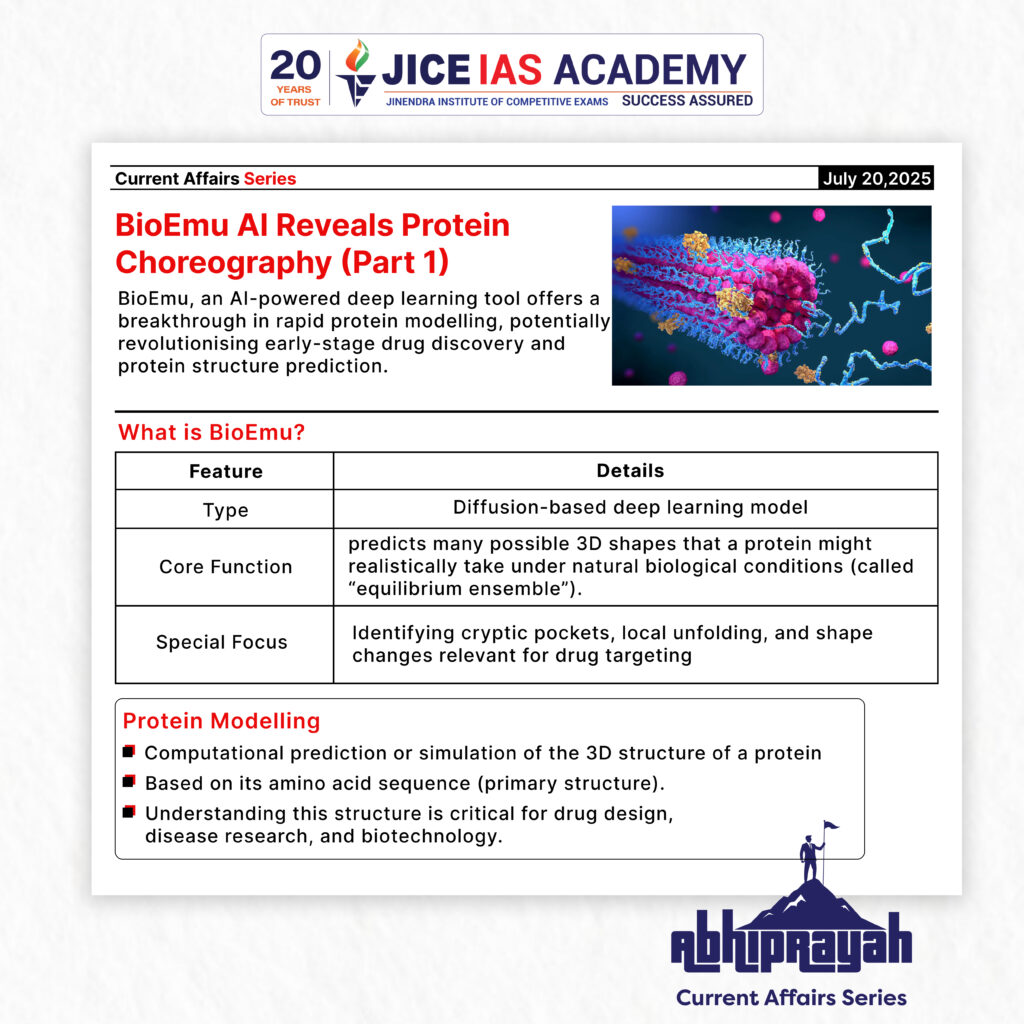
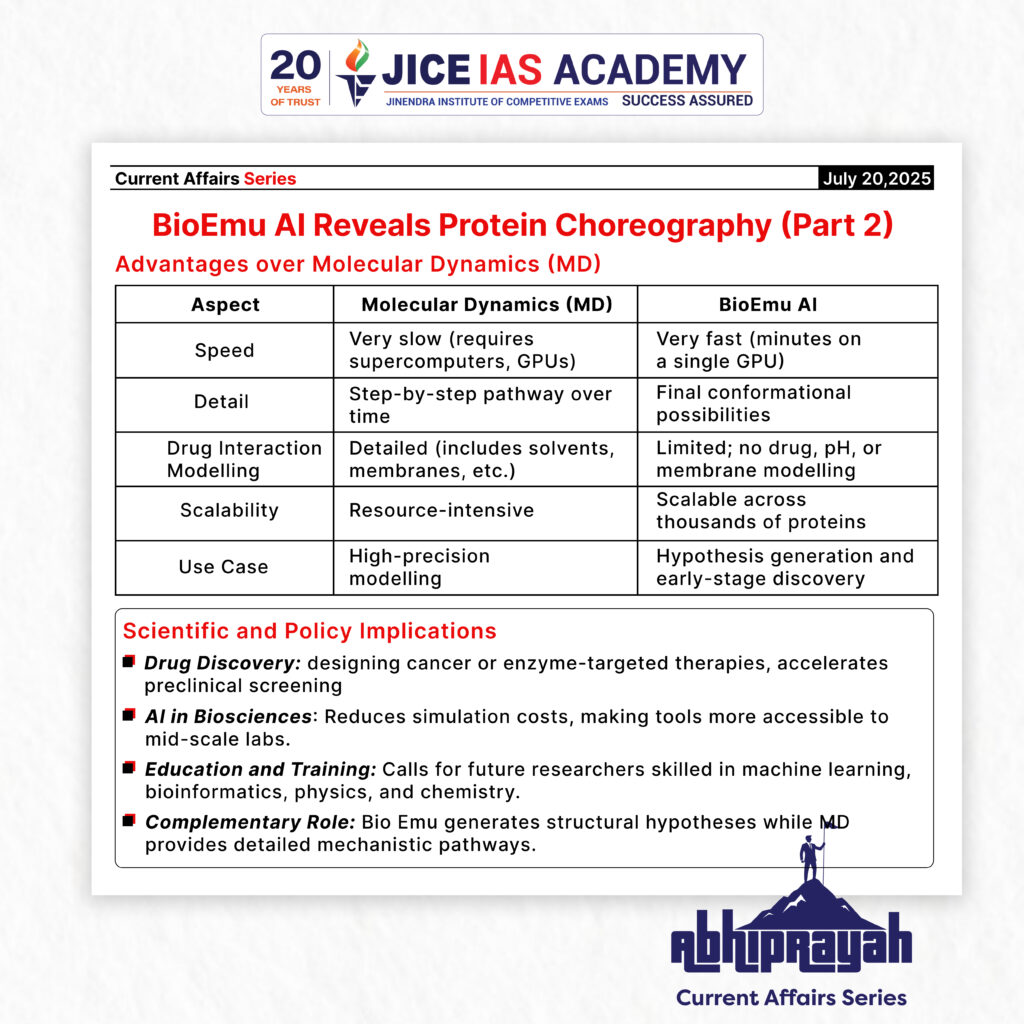
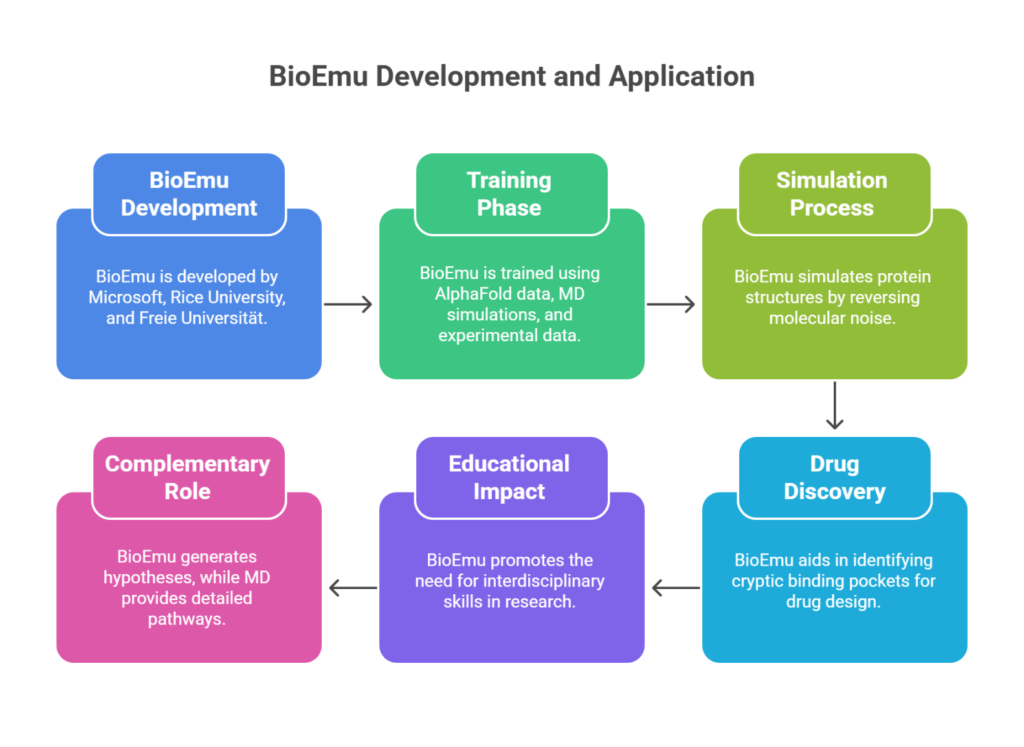
  • BioEmu, a new AI-based protein modelling tool developed by Microsoft, Rice University (USA), and Freie Universität (Germany), has been introduced as a faster, cheaper alternative to classical molecular dynamics (MD) simulations.
  • It models the entire range of protein conformations (equilibrium ensemble) in biological conditions, potentially transforming large-scale drug discovery and protein function prediction.

What is BioEmu?

  • Type: Deep learning–based diffusion model.
  • Purpose: Predicts multiple biologically plausible conformations of proteins, not just one static structure.
  • Input Data:
    • AlphaFold-predicted protein assemblies.
    • 200 ms of MD simulations across proteins.
    • Half a million protein mutants with experimental stability data.

How It Works

  • Trained to simulate the reverse of molecular noise, generating thousands of plausible structures in minutes.
  • Focuses on static snapshots, not dynamic molecular motion.
  • Can model shape changes, local unfolding, and cryptic binding pockets (useful for drug targeting).

Limitations

  • Cannot:
    • Simulate time-based transitions or how changes occur.
    • Model multi-protein interactions, drug molecules, or cell walls.
    • Handle external conditions (temperature, pH, membranes).
  • Less reliable than AlphaFold in certainty estimation.
  • Should be used as a hypothesis-generation tool, not a final decision system.

Scientific and Policy Implications

  • Drug Discovery:
    • Predicts cryptic binding pockets, essential for designing cancer or enzyme-targeted therapies.
    • Accelerates preclinical screening by narrowing down candidates.
  • AI in Biosciences:
    • Signifies a move toward hybrid approaches combining AI + classical physics.
    • Reduces simulation costs, making tools more accessible to mid-scale labs.
  • Education and Training:
    • Calls for future researchers skilled in machine learning, bioinformatics, physics, and chemistry.
  • Complementary Role:
    • BioEmu generates structural hypotheses.
    • MD provides detailed mechanistic pathways.

Conclusion

BioEmu marks a significant leap in protein modelling, enabling rapid, large-scale, resource-efficient predictions of protein flexibility. While it cannot replace traditional simulation methods, its role as a frontline AI companion to MD simulations promises to redefine the pace of biomedical research and drug discovery. Its success underscores the need for cross-disciplinary expertise to leverage AI’s full potential in life sciences.

Economic Implications

For Indian Exporters

  • These reforms reduce transaction costs and compliance hurdles
  • Encourage a more competitive and efficient export environment
  • Promote value addition in key sectors like leather

For Tamil Nadu

  • The reforms particularly benefit the state’s leather industry, a major contributor to employment and exports
  • Boost the marketability of GI-tagged E.I. leather, enhancing rural and traditional industries

For Trade Policy

  • These decisions indicate a shift from regulatory controls to policy facilitation

Reinforce the goals of Make in India, Atmanirbhar Bharat, and India’s ambition to become a leading export power

Recently, BVR Subrahmanyam, CEO of NITI Aayog, claimed that India has overtaken Japan to become the fourth-largest economy in the world, citing data from the International Monetary Fund (IMF). 

India’s rank as the world’s largest economy varies by measure—nominal GDP or purchasing power parity (PPP)—each with key implications for economic analysis.

Significance and Applications

Leave a Reply

Your email address will not be published. Required fields are marked *

Call Us Now !

Copyright © JICE ACADEMY FOR EXCELLENCE PRIVATE LIMITED