
UPSC CURRENT AFFAIRS – 13th June 2025
Boeing 787: Success and Setbacks
Why in News?
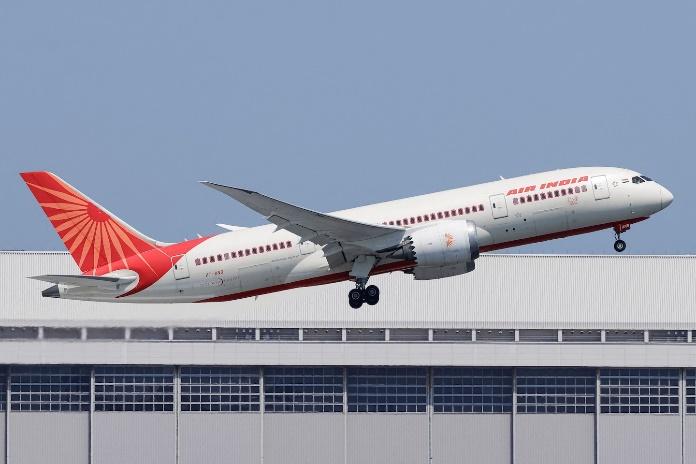
The crash of Air India AI171, the first-ever hull loss of a Boeing 787-8 Dreamliner, highlights serious safety, engineering, and regulatory concerns in modern commercial aviation.
Introduction
- Recently, Air India flight AI171 crashed just five minutes after taking off from Ahmedabad, en route to London.
- The aircraft involved was a Boeing 787-8 Dreamliner, carrying 230 passengers and 12 crew members.
- A massive fireball was witnessed near Meghaninagar, shortly after the aircraft went down.
- The Aircraft Accident Investigation Bureau (AAIB) has been tasked with investigating the cause of the crash.
- This crash marks the first ever complete loss (“hull loss”) of a Boeing 787-8 aircraft.
- The crash incident has reminded many of the 1988 crash of Indian Airlines Flight 113 in Ahmedabad.
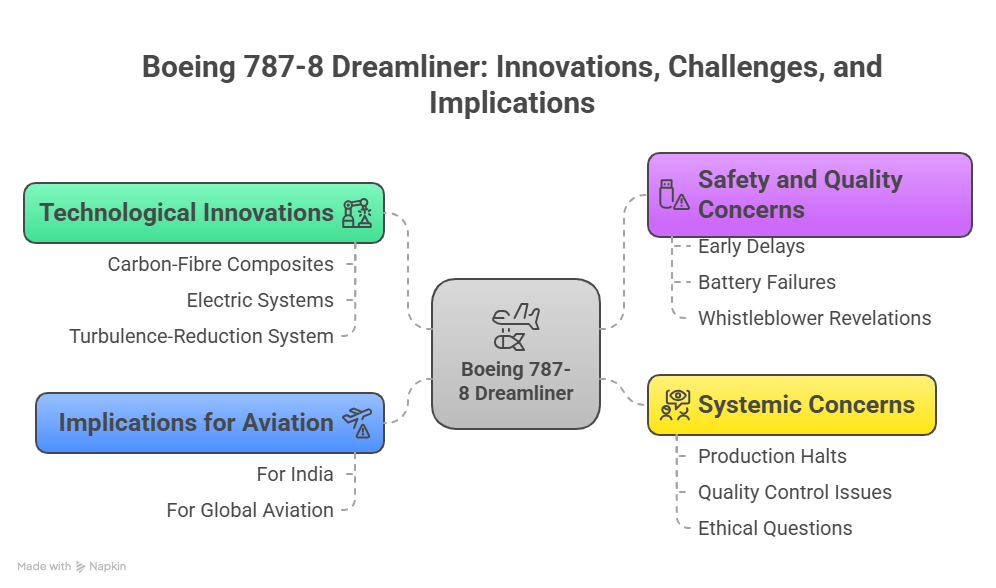
Boeing 787-8 Dreamliner: A Technological Gamechanger
A New Direction in Aircraft Design
- The Boeing 787-8 Dreamliner was introduced in 2011 and was considered a revolutionary aircraft in commercial aviation.
- It was the first major airliner to use carbon-fibre composite materials extensively instead of aluminum, reducing the aircraft’s weight.
- The aircraft’s engines — either General Electric GEnx or Rolls-Royce Trent 1000 — are high-bypass turbofans that significantly improved fuel efficiency.
- The Dreamliner was designed to consume approximately 20% less fuel than previous twinjet models of similar size.
- The aircraft replaced traditional pneumatic and hydraulic systems with electric systems to increase efficiency and reduce mechanical complexity.
- Due to its electrical systems and onboard power usage, the Boeing 787-8 was often referred to as the “electric aircraft.”
Innovation in Passenger Comfort
- Boeing implemented a computer-controlled turbulence-reduction system that significantly improved flight stability and reduced motion sickness.
- The system worked by using sensors that detected air pressure changes and adjusted wing surfaces to reduce turbulence effects.
- The 787-8 aircraft cabin was pressurized to a lower equivalent altitude, improving comfort and reducing fatigue among passengers.
- Engine design changes also helped reduce shear noise, which in turn reduced the need for soundproofing materials inside the cabin.
- This led to a quieter cabin environment and further decreased the overall aircraft weight.
Safety and Quality Concerns: A Troubled Legacy
Early Delays and Battery Failures
- The Boeing 787-8 program was delayed by nearly two years due to challenges in managing its global supply chain and integration issues.
- Boeing had expected suppliers to deliver fully assembled sections like the fuselage and wings, but this was not achieved in practice.
- The delays led to customer dissatisfaction and the cancellation of at least 60 orders.
- In early 2013, aviation regulators around the world grounded all Boeing 787s after two aircraft suffered battery failures involving lithium-ion cells.
- These battery failures resulted in leaks of corrosive fluids, which posed significant safety risks.
- The incidents were particularly alarming due to the aircraft’s dependence on electrical systems for critical operations.
Whistleblower Revelations
- John Barnett, a former Boeing employee, raised alarms about metal slivers left near crucial flight control wiring in some 787 aircraft.
- He warned that if these metal slivers penetrated the wiring, they could cause catastrophic failures.
- In 2024, Barnett was found dead with an apparent self-inflicted gunshot wound while involved in a legal dispute with Boeing.
- Another Boeing engineer, Sam Salehpour, alleged that fuselage sections of the 787 were joined improperly, potentially leading to long-term structural failure.
- He claimed that when he raised these safety concerns internally, he was reassigned to another aircraft project — the Boeing 777.
- The U.S. Federal Aviation Administration (FAA) has opened an investigation into Salehpour’s claims and Boeing’s production practices.
Production Halts and Grounding Orders
- In 2019, Boeing was forced to slow production of the 787 due to quality control issues, particularly concerning fuselage fitment.
- From January 2021 to August 2022, Boeing did not deliver any new 787 aircraft due to these ongoing concerns.
- Following the whistleblower revelations, the FAA required Boeing to inspect and remove metal slivers before delivering any new aircraft.
- Although Boeing maintained that the slivers did not pose immediate danger, it agreed to comply with the directive.
Systemic Concerns in Boeing’s Strategy
- Boeing’s 787 program was based on a new approach to commercial air travel that focused on point-to-point connectivity between smaller cities.
- Unlike the Airbus A380, which was built for the hub-and-spoke model and carried 500–800 passengers, the 787 targeted smaller markets with lower passenger loads.
- The strategy aimed to reduce travel time rather than ticket prices, offering non-stop connectivity on long-haul routes.
- Boeing was under intense pressure to meet ambitious production targets and deliver aircraft on schedule.
- Critics have argued that this pressure may have led to compromises in quality control and oversight.
- The treatment of whistleblowers and recurring safety concerns have raised ethical questions about Boeing’s internal governance.
- Similar issues had earlier plagued Boeing’s 737 Max aircraft, which were involved in two deadly crashes in 2018 and 2019.
- Together, these incidents indicate a potential systemic failure in Boeing’s approach to safety and production.
Implications for India and the Global Aviation Sector
For India
- The AI171 crash is the most serious aviation accident in India in recent years.
- The incident will prompt reviews of aircraft maintenance, safety standards, and operational readiness.
- The Directorate General of Civil Aviation (DGCA) is likely to introduce stricter oversight measures.
- Aviation training programs and emergency response systems may undergo upgrades following the AAIB report.
For Global Aviation
- Global regulators may reconsider the airworthiness certification of Boeing 787 aircraft.
- Airline operators around the world may conduct safety audits of their existing Dreamliner fleets.
- Passenger confidence in Boeing’s wide-body aircraft could be significantly affected.
- The crash may influence airline purchase decisions, possibly shifting demand toward Airbus models or new-generation Boeing aircraft with enhanced oversight.
Conclusion
- The crash of Air India flight AI171 is both a tragic loss and a wake-up call for the global aviation industry.
- While the Boeing 787-8 introduced advanced technology and efficiency, it also brought new safety challenges.
- Ongoing investigations and whistleblower allegations point to deeper concerns in Boeing’s quality control and ethics.
- The incident underscores the need for transparent investigations, strong regulatory frameworks, and accountability in aircraft manufacturing.
- In the pursuit of innovation, aviation companies must prioritize passenger safety and uphold public trust at all costs.

3rd UN conference on landlocked countries
UPSC CURRENT AFFAIRS – 08th August 2025 Home / 3rd UN conference on landlocked countries Why in News? At the

Issue of soapstone mining in Uttarakhand’s Bageshwar
UPSC CURRENT AFFAIRS – 08th August 2025 Home / Issue of soapstone mining in Uttarakhand’s Bageshwar Why in News? Unregulated

Groundwater Pollution in India – A Silent Public Health Emergency
UPSC CURRENT AFFAIRS – 08th August 2025 Home / Groundwater Pollution in India – A Silent Public Health Emergency Why

Universal banking- need and impact
UPSC CURRENT AFFAIRS – 08th August 2025 Home / Universal banking- need and impact Why in News? The Reserve Bank

India’s “Goldilocks” Economy: A Critical Appraisal
UPSC CURRENT AFFAIRS – 08th August 2025 Home / India’s “Goldilocks” Economy: A Critical Appraisal Why in News? The Finance

U.S.-India Trade Dispute: Trump’s 50% Tariffs and India’s Oil Imports from Russia
UPSC CURRENT AFFAIRS – 07th August 2025 Home / U.S.-India Trade Dispute: Trump’s 50% Tariffs and India’s Oil Imports from
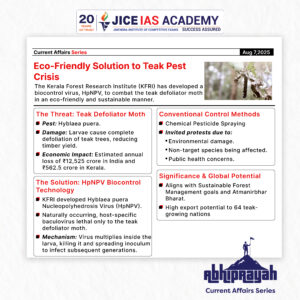
Eco-Friendly Solution to Teak Pest Crisis: KFRI’s HpNPV Technology
UPSC CURRENT AFFAIRS – 07th August 2025 Home / Eco-Friendly Solution to Teak Pest Crisis: KFRI’s HpNPV Technology Why in

New Species of Non-Venomous Rain Snake Discovered in Mizoram
UPSC CURRENT AFFAIRS – 07th August 2025 Home / New Species of Non-Venomous Rain Snake Discovered in Mizoram Why in

Economic Implications
For Indian Exporters
- These reforms reduce transaction costs and compliance hurdles
- Encourage a more competitive and efficient export environment
- Promote value addition in key sectors like leather
For Tamil Nadu
- The reforms particularly benefit the state’s leather industry, a major contributor to employment and exports
- Boost the marketability of GI-tagged E.I. leather, enhancing rural and traditional industries
For Trade Policy
- These decisions indicate a shift from regulatory controls to policy facilitation
Reinforce the goals of Make in India, Atmanirbhar Bharat, and India’s ambition to become a leading export power
Recently, BVR Subrahmanyam, CEO of NITI Aayog, claimed that India has overtaken Japan to become the fourth-largest economy in the world, citing data from the International Monetary Fund (IMF).
India’s rank as the world’s largest economy varies by measure—nominal GDP or purchasing power parity (PPP)—each with key implications for economic analysis.