
UPSC CURRENT AFFAIRS – 12th June 2025
Centre to wield quality control ‘stick’ to drive exports
Why in News?
India is shifting from subsidies to Quality Control Orders (QCOs) to boost export competitiveness by enforcing minimum product standards.
Background:
- The Indian government has taken a significant policy turn by moving away from its traditional reliance on subsidies to boost export-oriented sectors.
- Instead, it is now emphasizing a “carrot and stick” strategy centred around the enforcement of Quality Control Orders (QCOs) to improve product standards and enhance India’s global competitiveness.
Background: Subsidy-led Export Promotion
Historically, India has relied on subsidies and tax incentives to promote exports. These include:
- Interest equalization schemes
- MEIS/RODTEP schemes for merchandise exporters
- PLI (Production Linked Incentives) for specific sectors
However, according to a senior government official, this approach has not yielded the desired export performance, partly due to quality issues in exported goods.
New Strategy: Carrot and Stick Approach
- Increased Emphasis on QCOs
- QCOs are regulatory tools issued under the Bureau of Indian Standards (BIS) Act, requiring mandatory minimum quality standards for goods.
- As of March 2025, 187 QCOs covering 769 products have been notified by various ministries.
- These apply not only to domestic production but also to imported and export-bound goods.
- Non-subsidy Support
The government has expressed willingness to provide support in the form of:
- Easing land acquisition processes
- Addressing regulatory hurdles
- Infrastructure development
This reflects a shift towards facilitating competitiveness, rather than artificially sustaining exports through financial incentives.
QCOs: A Double-Edged Sword
Government’s View:
- According to Commerce Minister Piyush Goyal, QCOs are a necessary step to ensure India meets global quality standards, improving market access and brand perception of Indian goods.
Counterview from NITI Aayog:
- Vice Chairman Suman Bery criticized QCOs as a “malign intervention”, arguing they could:
- Disincentivize low-cost imports,
- Hurt MSMEs who cannot meet strict standards due to cost constraints,
- Lead to protectionism under the guise of quality.
Exemptions and Relief Measures
To strike a balance, the government has:
- Exempted certain import categories from QCO compliance when the final goods are meant for export.
- These exemptions apply under schemes like:
- Advance Authorisation
- Export Oriented Units (EOUs)
- Special Economic Zones (SEZs)
This ensures exporters who rely on foreign inputs do not face disruption.
Special Case: Rare Earth Batteries and Strategic Subsidies
While the government remains firm on reducing blanket subsidies, it is reconsidering subsidies in strategic sectors like:
- Rare Earth Batteries, due to China’s export ban creating a supply crunch.
- This is part of a national security and energy independence agenda.
Such targeted subsidies could be provided to foster domestic manufacturing of critical technologies and reduce external dependencies.
Industry Reaction and Demands
Example: Federation of Indian Mineral Industries (FIMI)
- FIMI has demanded an upfront subsidy of ₹10,000–15,000 per kWh for alternate fuel Heavy Earth Moving Machinery (HEMM).
- It argues that electric HEMMs cost nearly 3 times more than diesel ones, acting as a barrier to green transition in mining.
This reflects a sectoral divergence between government policy and industry expectations, especially in capital-intensive green technologies.
Implications for Policy and Economy
Positive Outcomes:
- Encourages innovation and quality improvement
- Reduces wasteful subsidies
- Aligns with WTO-compliant export promotion strategies
- Supports India’s aspiration to become a manufacturing hub
Challenges:
- MSMEs may struggle to comply with stringent QCO norms
- Potential reduction in export volume if quality compliance isn’t matched
- Risk of bureaucratic overreach in QCO enforcement
- Industry resistance, especially in green technology adoption
Conclusion
- India’s pivot from subsidies to regulatory quality enforcement through QCOs marks a strategic shift in export and industrial policy.
- While it aims to build a self-reliant and quality-driven export ecosystem, care must be taken to support vulnerable sectors like MSMEs and balance quality norms with ease of doing business.
- Selective and strategic subsidies, especially in critical sectors like rare earth technologies, may still play a role in ensuring long-term competitiveness and resilience.

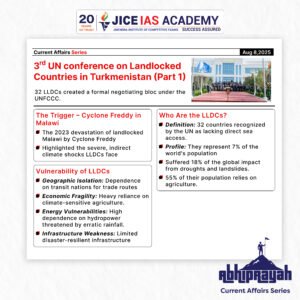
3rd UN conference on landlocked countries
UPSC CURRENT AFFAIRS – 08th August 2025 Home / 3rd UN conference on landlocked countries Why in News? At the
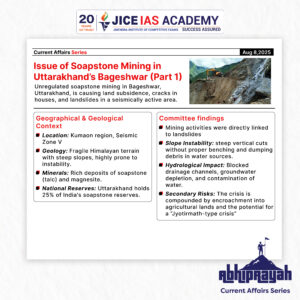
Issue of soapstone mining in Uttarakhand’s Bageshwar
UPSC CURRENT AFFAIRS – 08th August 2025 Home / Issue of soapstone mining in Uttarakhand’s Bageshwar Why in News? Unregulated
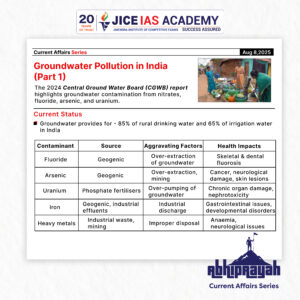
Groundwater Pollution in India – A Silent Public Health Emergency
UPSC CURRENT AFFAIRS – 08th August 2025 Home / Groundwater Pollution in India – A Silent Public Health Emergency Why
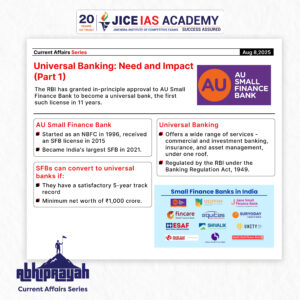
Universal banking- need and impact
UPSC CURRENT AFFAIRS – 08th August 2025 Home / Universal banking- need and impact Why in News? The Reserve Bank

India’s “Goldilocks” Economy: A Critical Appraisal
UPSC CURRENT AFFAIRS – 08th August 2025 Home / India’s “Goldilocks” Economy: A Critical Appraisal Why in News? The Finance
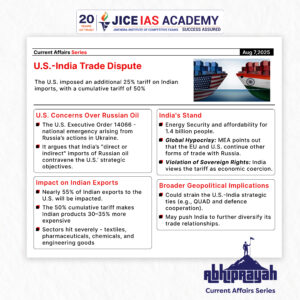
U.S.-India Trade Dispute: Trump’s 50% Tariffs and India’s Oil Imports from Russia
UPSC CURRENT AFFAIRS – 07th August 2025 Home / U.S.-India Trade Dispute: Trump’s 50% Tariffs and India’s Oil Imports from
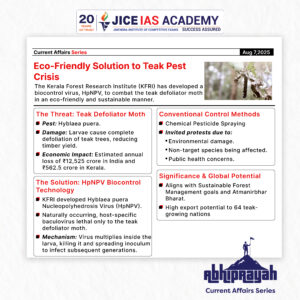
Eco-Friendly Solution to Teak Pest Crisis: KFRI’s HpNPV Technology
UPSC CURRENT AFFAIRS – 07th August 2025 Home / Eco-Friendly Solution to Teak Pest Crisis: KFRI’s HpNPV Technology Why in

New Species of Non-Venomous Rain Snake Discovered in Mizoram
UPSC CURRENT AFFAIRS – 07th August 2025 Home / New Species of Non-Venomous Rain Snake Discovered in Mizoram Why in

Economic Implications
For Indian Exporters
- These reforms reduce transaction costs and compliance hurdles
- Encourage a more competitive and efficient export environment
- Promote value addition in key sectors like leather
For Tamil Nadu
- The reforms particularly benefit the state’s leather industry, a major contributor to employment and exports
- Boost the marketability of GI-tagged E.I. leather, enhancing rural and traditional industries
For Trade Policy
- These decisions indicate a shift from regulatory controls to policy facilitation
Reinforce the goals of Make in India, Atmanirbhar Bharat, and India’s ambition to become a leading export power
Recently, BVR Subrahmanyam, CEO of NITI Aayog, claimed that India has overtaken Japan to become the fourth-largest economy in the world, citing data from the International Monetary Fund (IMF).
India’s rank as the world’s largest economy varies by measure—nominal GDP or purchasing power parity (PPP)—each with key implications for economic analysis.