UPSC CURRENT AFFAIRS – 31st July 2025

Home / UPSC / Current Affairs / Challenges and Gaps in India’s Legal Aid System

Challenges and Gaps in India’s Legal Aid System

Why in News?

  • Despite a legal mandate to provide free legal aid to nearly 80% of India’s population, access remains limited due to low funding, poor utilisation, and shrinking human resources.

Introduction

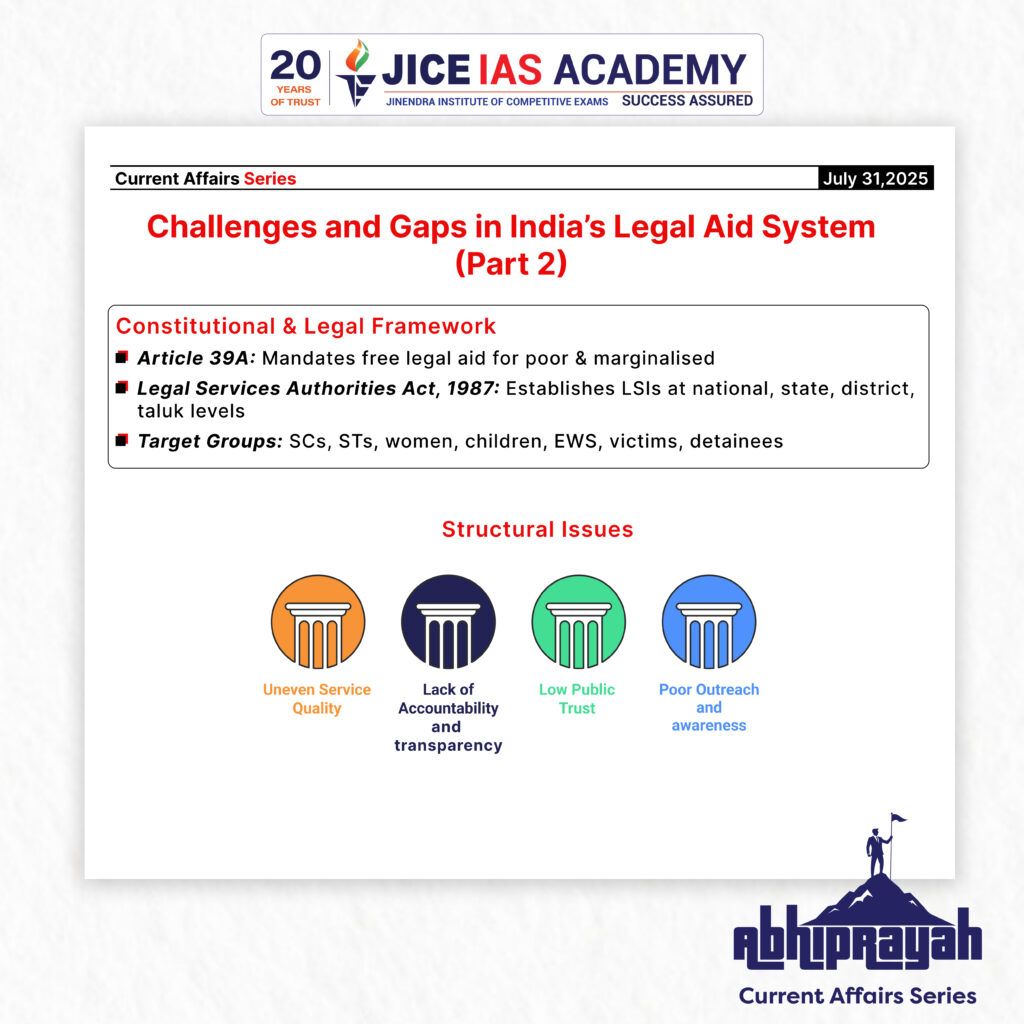
  • Legal aid is a constitutional right in India, enshrined under Article 39A of the Constitution, which mandates the state to ensure that opportunities for securing justice are not denied to any citizen by reason of economic or other disabilities.
  • To institutionalise this, the Legal Services Authorities Act, 1987 was enacted, creating a framework of Legal Services Institutions (LSIs) at the national, state, district, and taluk levels.
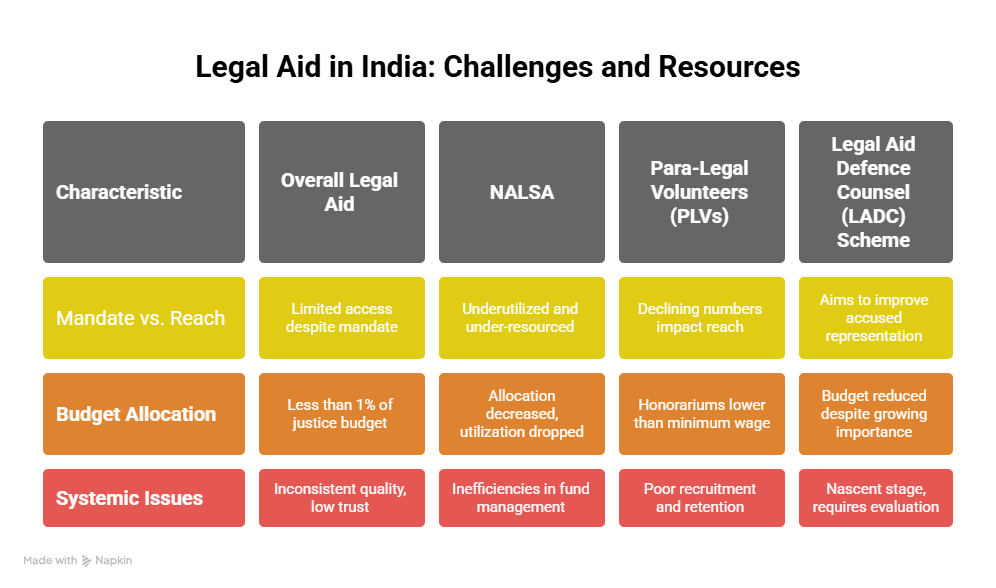
  • However, despite this robust framework, legal aid remains severely underutilised and under-resourced, with a significant gap between its mandate and actual reach.

Mandate and Actual Reach

    • As per the Legal Services Authorities Act, legal aid is intended to benefit nearly 80% of India’s population, including economically weaker sections, Scheduled Castes (SCs), Scheduled Tribes (STs), women, children, persons in custody, and victims of disasters or violence. However, the actual reach remains modest.
    • Only 15.50 lakh people received legal aid services between April 2023 and March 2024.
    • Although this marks a 28% increase from the previous year (12.14 lakh), it still falls short of the scale envisioned.

    Legal aid is typically delivered through front offices at:

    • District and subordinate courts,
    • Prisons,
    • Juvenile justice boards,
    • Legal aid clinics in rural and remote areas (1 clinic per 163 villages as per the India Justice Report 2025).

    The reach and quality of services remain dependent on financial and human resource availability.

Per Capita Legal Aid Spending

  • National average (2022-23): ₹6 per capita.
  • Highest: Haryana (₹16).
  • Below average: Jharkhand, Assam (₹5 each), Uttar Pradesh (₹4), Bihar (₹3), and West Bengal (₹2).
  • Spending doubled from ₹3 in 2019 to ₹7 in 2023, but disparities persist.

Shrinking Human Resources: Para-Legal Volunteers

  • Para-legal volunteers (PLVs) play a crucial role as intermediaries between the public and legal aid institutions. However, their numbers are declining due to financial neglect:

    • PLVs declined by 38% from 2019 to 2024.
    • In 2023, there were only 3.1 PLVs per lakh population, down from 5.7 in 2019.
    • States like West Bengal and Uttar Pradesh had just 1 PLV per lakh.

Legal Aid Defence Counsel (LADC) Scheme

  • To improve representation for accused persons, NALSA launched the LADC Scheme in 2022, modelled on the public defender system.

    Key Features:

    • Dedicated to defending only the accused.
    • Aims to reduce burden on panel lawyers and enhance quality of legal representation.
    • Operational in 610 of 670 districts.

Persistent Structural Issues

  • Despite budgetary increases in some States, several systemic issues continue to hinder the effectiveness of legal aid:

    • Inconsistent quality of service across regions.
    • Lack of accountability and monitoring.
    • Low trust among citizens regarding the efficacy of free legal aid.
    • Insufficient outreach and awareness programs.
    • Delayed justice delivery undermining people’s faith in the system.

Introduction

Economic Implications

For Indian Exporters

  • These reforms reduce transaction costs and compliance hurdles
  • Encourage a more competitive and efficient export environment
  • Promote value addition in key sectors like leather

For Tamil Nadu

  • The reforms particularly benefit the state’s leather industry, a major contributor to employment and exports
  • Boost the marketability of GI-tagged E.I. leather, enhancing rural and traditional industries

For Trade Policy

  • These decisions indicate a shift from regulatory controls to policy facilitation

Reinforce the goals of Make in India, Atmanirbhar Bharat, and India’s ambition to become a leading export power

Recently, BVR Subrahmanyam, CEO of NITI Aayog, claimed that India has overtaken Japan to become the fourth-largest economy in the world, citing data from the International Monetary Fund (IMF). 

India’s rank as the world’s largest economy varies by measure—nominal GDP or purchasing power parity (PPP)—each with key implications for economic analysis.

Significance and Applications

Leave a Reply

Your email address will not be published. Required fields are marked *

Call Us Now !

Copyright © JICE ACADEMY FOR EXCELLENCE PRIVATE LIMITED