
UPSC CURRENT AFFAIRS – 3rd June 2025

Home / UPSC / Current Affairs / China’s Arunachal Claim Lacks Legal Backing

China’s Arunachal Claim Lacks Legal Backing

arunachal pradesh india china border

Why in News?

  • China has renamed 27 places in Arunachal Pradesh to reinforce its territorial claim over the Indian state, which it refers to as “Zangnan,” challenging India’s sovereignty and international legal norms. 

Introduction

  • China has once again attempted to assert its territorial claims over Arunachal Pradesh—referred to by Beijing as “Zangnan” or South Tibet—by renaming 27 locations in the Indian State. 
  • This unilateral move is part of a larger Chinese strategy to reinforce its claims through what it terms as “standardization” of place names. 
  • This tactic, rooted in its interpretation of sovereignty and historical entitlement, challenges well-established principles of international law.

China’s Sovereignty-Based Claims and Historical Arguments

  • China justifies its claims over Arunachal Pradesh by invoking the presence of significant Tibetan Buddhist institutions such as the Tawang Monastery, and the fact that the sixth Dalai Lama was born in Tawang
  • These are cited as indicators of historical and cultural ties between Tibet and the region.
  • China’s broader territorial claims, whether in Arunachal Pradesh or the South China Sea, are grounded in its rigid understanding of sovereignty and its historical narrative.
  • Chinese legal scholars, like Jianming Shen, defend the doctrine of consolidation by historical title, arguing that the legal validity of historic claims should be evaluated based on the international law prevalent at the time of acquisition, not by contemporary legal standards.
analyzing china territorial claims in arunachal pradesh

Contradictions with Established International Law

However, this approach contradicts the jurisprudence of the International Court of Justice (ICJ). The ICJ has consistently rejected historical consolidation as a legitimate basis for territorial title:

  • In the Land and Maritime Boundary between Cameroon and Nigeria (ICJ Rep. 2002), the Court clarified that historical consolidation is not a recognized mode of acquiring sovereignty. It stated that this theory is “highly controversial” and cannot replace the recognized modes of acquisition, such as effective control or legal title.
  • In the Minquiers and Ecrehos case (UK v. France, 1953), the ICJ relied on direct evidence of sovereignty, rather than indirect historical presumption, to determine possession and ownership of territory.


Violation of Uti Possidetis Juris Principle

China’s actions also contradict the principle of uti possidetis juris, a Roman law doctrine adopted in international law, which asserts that newly independent states should retain the colonial boundaries in place at the time of independence.

  • The ICJ’s judgment in the Frontier Dispute between Burkina Faso and Mali (1986) reinforced this principle, emphasizing that legal title must be prioritized over effective possession. It recognized uti possidetis as crucial in maintaining post-colonial territorial integrity and preventing conflict.
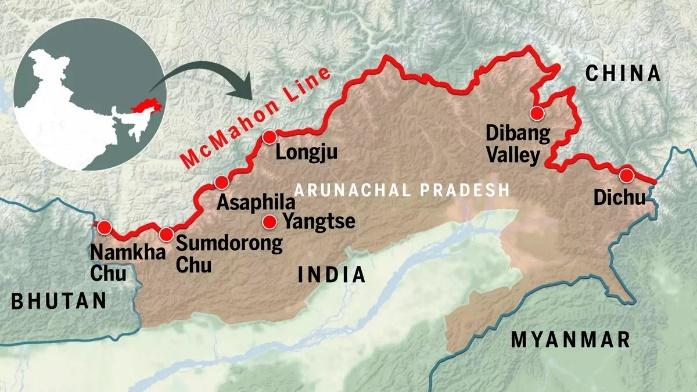
  • Although China refuses to recognize the McMahon Line, citing that Tibet could not legally sign the 1914 Shimla Convention, India and much of the international community recognize it as the legitimate boundary, consistent with the principle of uti possidetis juris.

Use of Cartographic Evidence and Its Legal Standing

China also attempts to validate its claims through maps, such as the infamous nine-dash line in the South China Sea or the publication of revised maps in Arunachal Pradesh. However, international law is clear on the limited legal value of maps:

  • In the Frontier Dispute (1986), the ICJ ruled that maps are merely “information” and cannot constitute a territorial title by themselves. They may only be considered as supplementary evidence, and their reliability varies depending on context and corroboration.

Solution

  • India must continue to assert its position using diplomatic and legal tools within the framework of international law.
  • International forums and courts must remain vigilant against attempts to unilaterally alter boundaries.
  • Upholding the rule-based global order is essential to maintaining peace, stability, and cooperation in the region.

Conclusion:

China’s assertive renaming of locations in Arunachal Pradesh and its expansive maritime claims in the South China Sea reflect a unilateral approach rooted in sovereignty and historical interpretation. However, such claims do not align with established principles of international law, including:

  • Rejection of historical consolidation as a legal title,
  • Recognition of colonial-era boundaries under uti possidetis juris, and
  • Limited evidentiary value of cartographic materials.

These moves challenge international norms and threaten regional stability. India, while firmly rejecting such unilateral acts, continues to uphold the sanctity of its territorial integrity as per international legal standards and bilateral agreements.

relevance of gandhian principles in modern terrorism

Economic Implications

For Indian Exporters

  • These reforms reduce transaction costs and compliance hurdles
  • Encourage a more competitive and efficient export environment
  • Promote value addition in key sectors like leather

For Tamil Nadu

  • The reforms particularly benefit the state’s leather industry, a major contributor to employment and exports
  • Boost the marketability of GI-tagged E.I. leather, enhancing rural and traditional industries

For Trade Policy

  • These decisions indicate a shift from regulatory controls to policy facilitation

Reinforce the goals of Make in India, Atmanirbhar Bharat, and India’s ambition to become a leading export power

Recently, BVR Subrahmanyam, CEO of NITI Aayog, claimed that India has overtaken Japan to become the fourth-largest economy in the world, citing data from the International Monetary Fund (IMF). 

India’s rank as the world’s largest economy varies by measure—nominal GDP or purchasing power parity (PPP)—each with key implications for economic analysis.

Significance and Applications

One Response

Leave a Reply

Your email address will not be published. Required fields are marked *

Call Us Now !

Copyright © JICE ACADEMY FOR EXCELLENCE PRIVATE LIMITED