UPSC CURRENT AFFAIRS – 30th July 2025
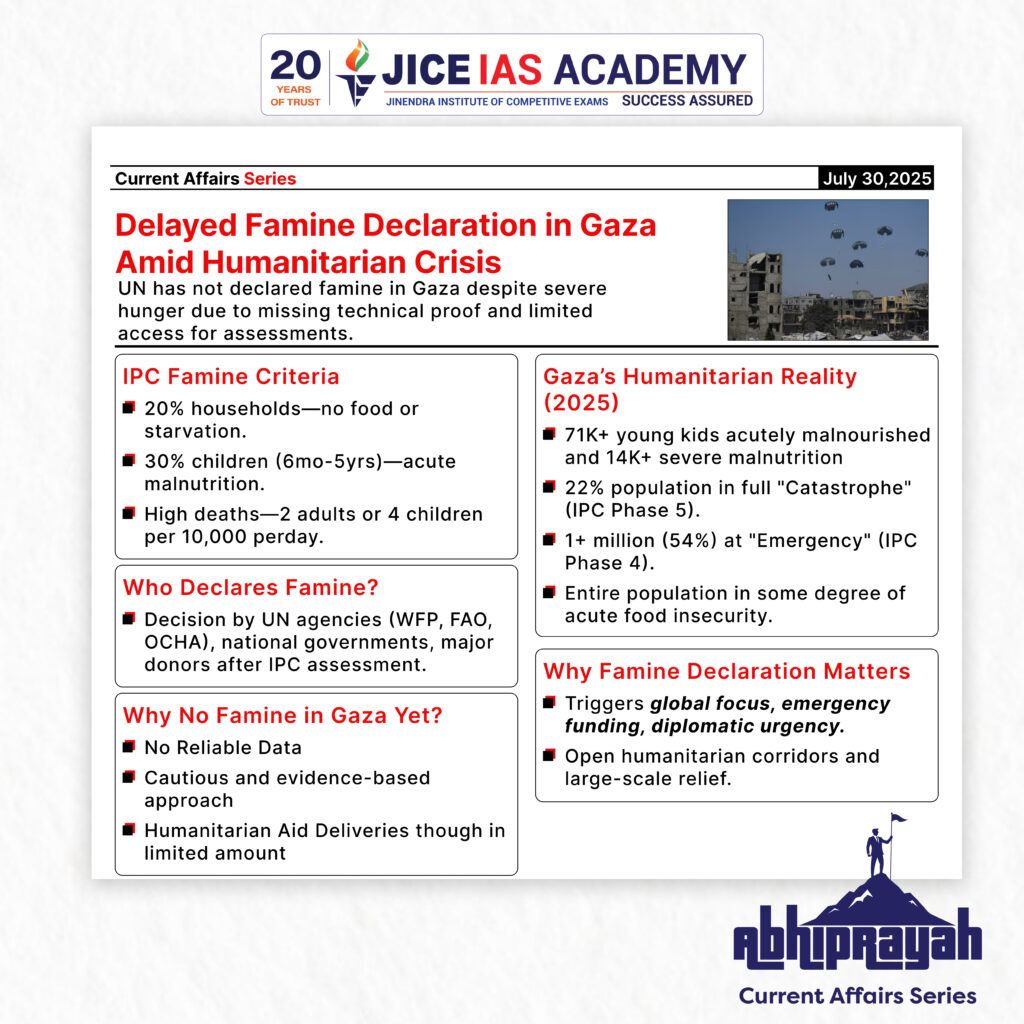
Delayed Famine Declaration in Gaza Amid Humanitarian Crisis
Why in News?
- The United Nations has not declared a famine in Gaza, despite alarming food insecurity, due to unmet technical thresholds and lack of access for verification.
Introduction
- Since early 2025, the humanitarian situation in the Gaza Strip has worsened dramatically. The region is witnessing widespread hunger, acute malnutrition, and rising civilian deaths.
- International concern is growing over the catastrophic food insecurity faced by the population. However, the United Nations has not yet formally declared a famine in Gaza.
What Is a Famine and Who Declares It?
- Famine is not merely a condition of widespread hunger. It is an officially recognised humanitarian disaster that must meet specific, measurable criteria.
- The Integrated Food Security Phase Classification (IPC) is the global standard used to determine famine conditions.
- It was developed to bring consistency and technical rigour to the classification of food crises worldwide.
Conditions Required for a Famine Declaration
According to the IPC, all three of the following conditions must be confirmed for a famine to be declared:
- Extreme Food Shortages: At least 20 percent of households must be facing an extreme lack of food or effectively starving.
- High Levels of Acute Malnutrition: At least 30 percent of children aged between six months and five years must be suffering from acute malnutrition (also known as wasting, where children are dangerously underweight for their height).
- Elevated Mortality Rates: At least two adults or four children per 10,000 people must be dying every day due to starvation or the combined effects of malnutrition and disease.
- The IPC uses a five-phase scale to classify food security conditions:
- Phase 1 – Normal (Acceptable)
- Phase 2 – Stressed (Alert)
- Phase 3 – Crisis (Serious)
- Phase 4 – Emergency (Critical)
- Phase 5 – Catastrophe/Famine (Extremely Critical)
Who Has the Authority to Declare a Famine?
- While the IPC provides the technical assessments, the actual declaration of famine usually involves a coordinated statement from multiple international actors, including:
- United Nations agencies such as the World Food Programme (WFP), the Food and Agriculture Organization (FAO), and the Office for the Coordination of Humanitarian Affairs (OCHA)
- National governments
- Major donor governments and international relief organisations
Why a Famine Has Not Been Declared in Gaza?
Despite compelling signs of a humanitarian catastrophe, Gaza has not yet been formally classified as being in a state of famine. This is due to several key factors:
- Lack of Access and Data Collection
- Due to the ongoing military conflict in Gaza, food security experts are unable to safely and comprehensively access large portions of the region.
- Critical infrastructure, including health clinics and monitoring systems, has been severely damaged.
- As a result, the data required to verify famine conditions cannot be reliably collected.
- The IPC demands strong evidence to justify such a grave declaration, and without verified data, the criteria for a formal famine declaration remain unmet.
- Caution in Issuing a Famine Declaration
- A famine declaration carries serious political, legal, and humanitarian consequences.
- It can shift the narrative of a conflict, invoke international intervention, and hold parties accountable.
- Therefore, the IPC follows a highly cautious and evidence-based approach to prevent the misuse or politicisation of the term.
- Declaring famine without robust, on-the-ground data could undermine the credibility of the system and complicate humanitarian operations.
- Ongoing but Limited Humanitarian Aid Deliveries
- Although highly restricted, some aid is still reaching Gaza. Approximately 4,500 aid trucks, facilitated by Israel and the UN, have entered the region since May 2025.
- In recent days, Israel has also allowed humanitarian air-drops and announced 10-hour pauses in military operations in some areas to enable aid distribution.
- While these measures are inadequate in scale, they indicate that there is not a complete absence of aid, which may affect the formal classification of famine.
The Humanitarian Situation in Gaza
Findings from IPC and UN Agencies
The most recent analysis by the IPC and UN agencies paints a grim picture of Gaza’s food security:
- Approximately 71,000 children under the age of five are expected to be acutely malnourished between April 2025 and March 2026.
- Of these, around 14,100 children are projected to suffer from severe acute malnutrition.
- Nearly 17,000 pregnant and breastfeeding women will require treatment for acute malnutrition.
- Around 470,000 people—22 percent of Gaza’s population—are currently classified under IPC Phase 5 (Catastrophe).
- Over one million people, or 54 percent, are in IPC Phase 4 (Emergency).
- The remaining 24 percent of the population is in IPC Phase 3 (Crisis).
- This means the entire population of Gaza is projected to be in a state of acute food insecurity, ranging from Crisis to Catastrophe.
Reports from UNRWA
The United Nations Relief and Works Agency (UNRWA) has highlighted alarming details:
- One in every five children in Gaza City is suffering from malnutrition.
- UNRWA staff themselves are surviving on extremely limited food—sometimes only a bowl of lentils per day—causing many to faint while working.
- Over 6,000 aid trucks filled with food and medical supplies are waiting at the borders in Jordan and Egypt but are unable to enter due to access restrictions.
Significance of Declaring Famine
A formal declaration of famine has significant implications:
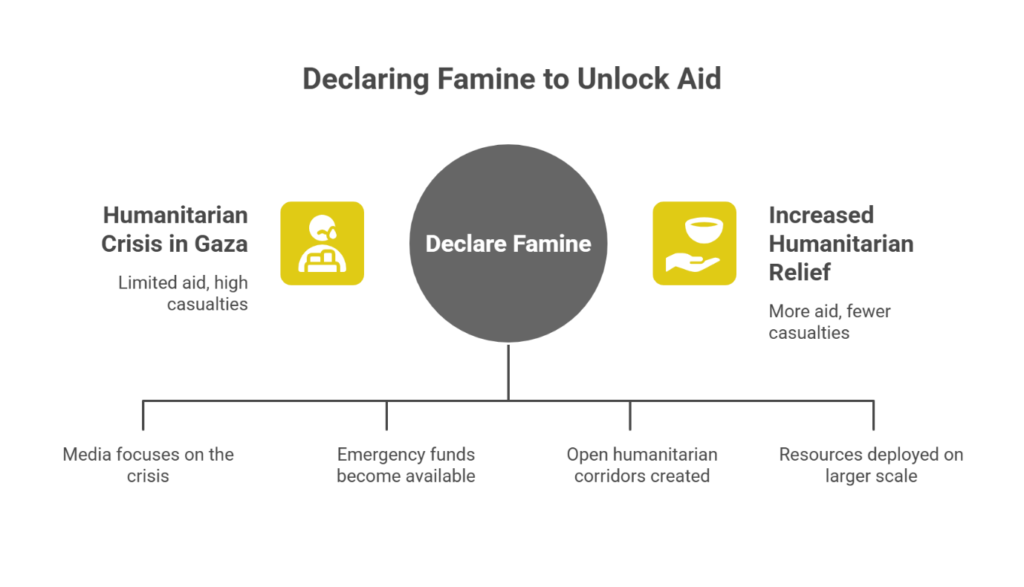
- It brings global attention and media focus to the crisis.
- It can unlock emergency funding and humanitarian aid from international donors.
- It forces international diplomatic engagement to open humanitarian corridors.
- It may lead to the deployment of relief teams and resources on a much larger scale.
- Despite the clear humanitarian emergency in Gaza, the absence of verified data and safe access for assessments has stalled this critical step.
Current Obstacles to Humanitarian Relief
- From March to May 2025, Israel completely blocked all supplies into Gaza for 11 weeks.
- Since the blockade was partially lifted, aid trucks have resumed, but in limited numbers. As of July 2025, only about 250 trucks per week are entering Gaza, compared to 600 trucks per day during the ceasefire period before March.
- Over 900 Gazans have died while trying to access aid at distribution points.
- Aid convoys face attacks, insecurity, bureaucratic hurdles, and coordination challenges.

3rd UN conference on landlocked countries
UPSC CURRENT AFFAIRS – 08th August 2025 Home / 3rd UN conference on landlocked countries Why in News? At the
Issue of soapstone mining in Uttarakhand’s Bageshwar
UPSC CURRENT AFFAIRS – 08th August 2025 Home / Issue of soapstone mining in Uttarakhand’s Bageshwar Why in News? Unregulated
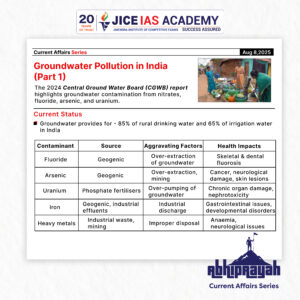
Groundwater Pollution in India – A Silent Public Health Emergency
UPSC CURRENT AFFAIRS – 08th August 2025 Home / Groundwater Pollution in India – A Silent Public Health Emergency Why
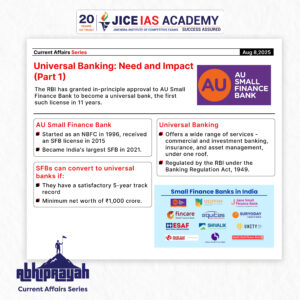
Universal banking- need and impact
UPSC CURRENT AFFAIRS – 08th August 2025 Home / Universal banking- need and impact Why in News? The Reserve Bank
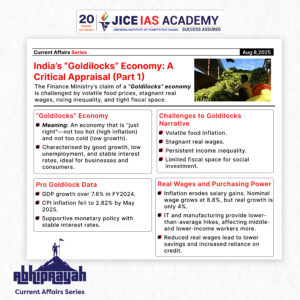
India’s “Goldilocks” Economy: A Critical Appraisal
UPSC CURRENT AFFAIRS – 08th August 2025 Home / India’s “Goldilocks” Economy: A Critical Appraisal Why in News? The Finance
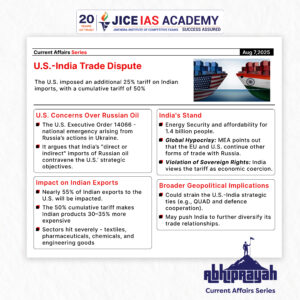
U.S.-India Trade Dispute: Trump’s 50% Tariffs and India’s Oil Imports from Russia
UPSC CURRENT AFFAIRS – 07th August 2025 Home / U.S.-India Trade Dispute: Trump’s 50% Tariffs and India’s Oil Imports from
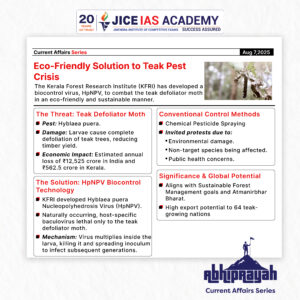
Eco-Friendly Solution to Teak Pest Crisis: KFRI’s HpNPV Technology
UPSC CURRENT AFFAIRS – 07th August 2025 Home / Eco-Friendly Solution to Teak Pest Crisis: KFRI’s HpNPV Technology Why in

New Species of Non-Venomous Rain Snake Discovered in Mizoram
UPSC CURRENT AFFAIRS – 07th August 2025 Home / New Species of Non-Venomous Rain Snake Discovered in Mizoram Why in

Introduction
Economic Implications
For Indian Exporters
- These reforms reduce transaction costs and compliance hurdles
- Encourage a more competitive and efficient export environment
- Promote value addition in key sectors like leather
For Tamil Nadu
- The reforms particularly benefit the state’s leather industry, a major contributor to employment and exports
- Boost the marketability of GI-tagged E.I. leather, enhancing rural and traditional industries
For Trade Policy
- These decisions indicate a shift from regulatory controls to policy facilitation
Reinforce the goals of Make in India, Atmanirbhar Bharat, and India’s ambition to become a leading export power
Recently, BVR Subrahmanyam, CEO of NITI Aayog, claimed that India has overtaken Japan to become the fourth-largest economy in the world, citing data from the International Monetary Fund (IMF).
India’s rank as the world’s largest economy varies by measure—nominal GDP or purchasing power parity (PPP)—each with key implications for economic analysis.