
UPSC CURRENT AFFAIRS – 10th July 2025
Rollback of Overage Vehicle Ban in Delhi and India's Air Pollution Fight
Why in News?
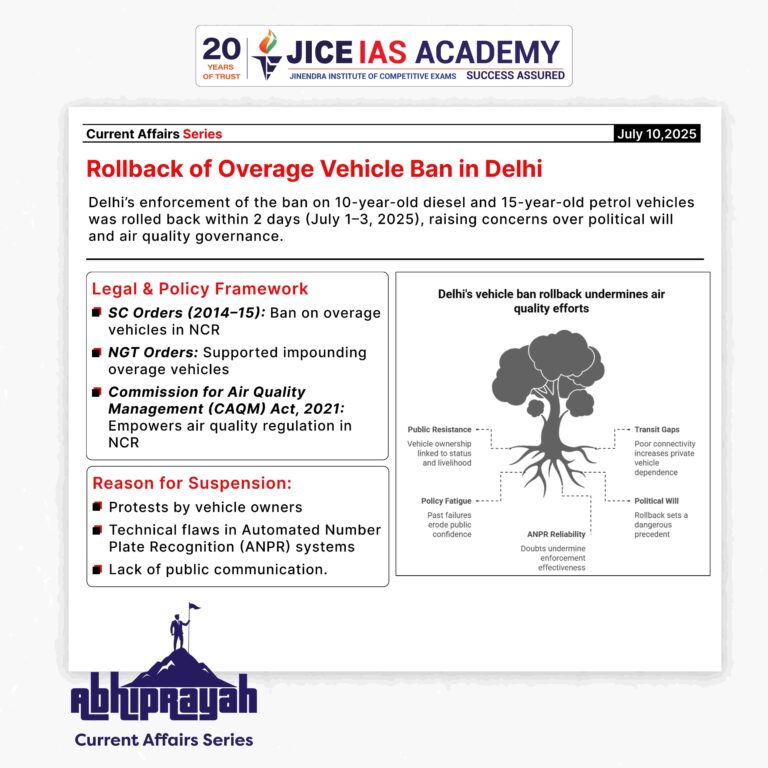
Delhi’s attempt to enforce a decade-old ban on overage vehicles was rolled back within two days due to public protests, raising concerns over political will and environmental governance.
Introduction
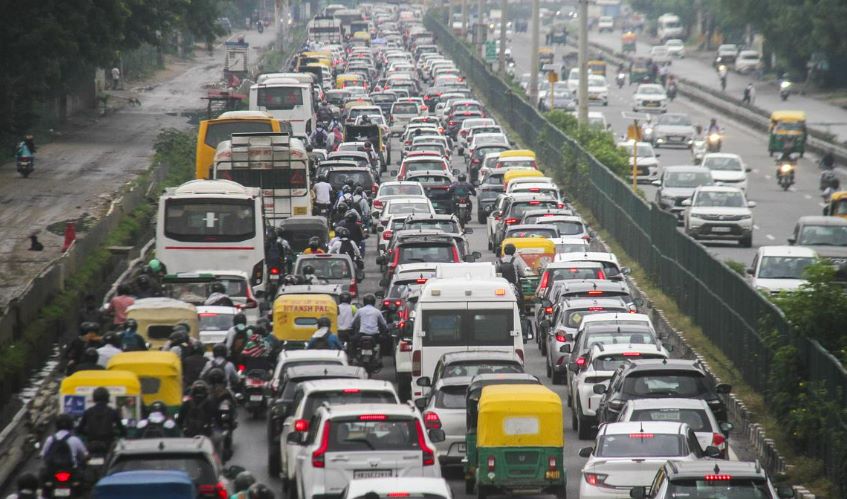
- Air pollution in Delhi and the National Capital Region (NCR) has reached alarming levels in recent years, causing severe health, environmental, and economic damage. One of the major contributors to this pollution is vehicular emissions, particularly from old and outdated vehicles.
- In this context, Delhi’s attempt to enforce a long-standing ban on 10-year-old diesel and 15-year-old petrol vehicles starting July 1, 2025, was a significant step.
- However, the sudden rollback of this enforcement within two days raises important questions about political will, administrative preparedness, and public accountability in the fight against air pollution.
Background: The Legal and Policy Framework
- Supreme Court Orders (2014-2015): Mandated deregistration and ban on 15-year-old petrol and 10-year-old diesel vehicles in Delhi to curb pollution.
- National Green Tribunal (NGT): Reinforced similar directives; ordered impounding of such vehicles.
- Commission for Air Quality Management (CAQM): Empowered under the Air Quality Management in NCR and Adjoining Areas Act, 2021, to coordinate pollution-control efforts across states.
The Recent Enforcement Attempt and Rollback
- Dates: Enforcement began on July 1, 2025, but was rolled back by July 3 due to protests and political pressure.
- Reason for Suspension: Protests by vehicle owners, alleged technical flaws in Automated Number Plate Recognition (ANPR) systems, and lack of public communication.
- Political Factor: BJP-led Delhi government’s decision to temporarily halt the campaign, despite earlier strong intent and announcements by Environment Minister M.S. Sirsa.
The Role and Importance of ANPR Technology
- Automated Number Plate Recognition (ANPR): Key tech tool to enforce bans without manual policing; integrated with pollution and registration databases.
- Success Indicator: Detected 35,000 vehicles with expired Pollution-Under-Control (PUC) certificates and imposed fines totaling ₹178 crore.
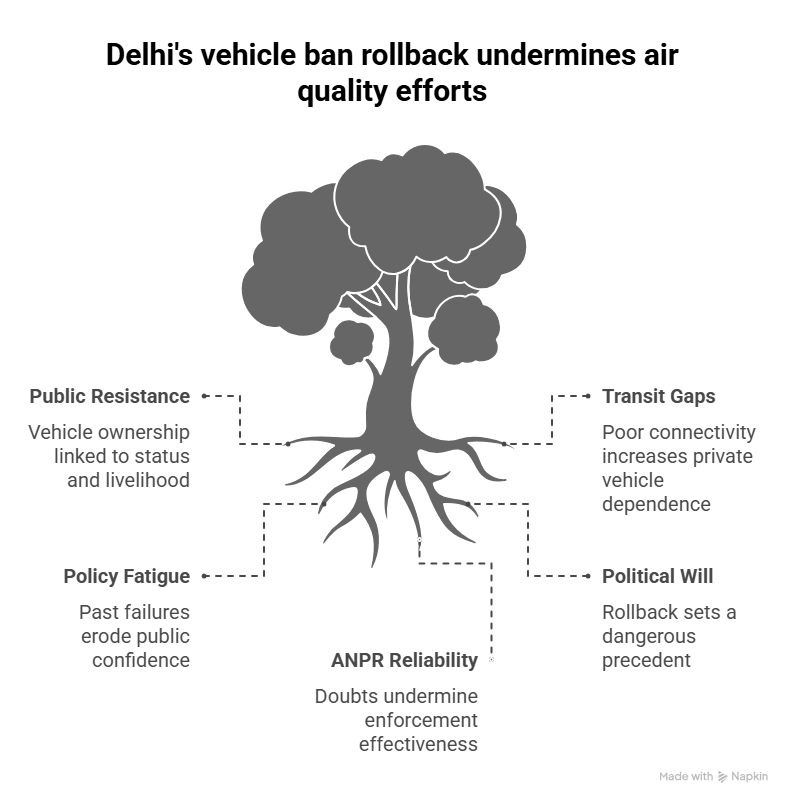
- Concerns Raised: Questions on its reliability by the Delhi government were contradicted by earlier endorsements and CAQM’s defense of the system.
Air Pollution: A Multi-Sectoral Challenge
While protestors argue that other pollution sources are more significant (e.g., construction, industry, biomass burning), vehicular emissions are direct, constant, and largely preventable.
- ICCT Study: Older BS-II, BS-III, and BS-IV vehicles emit 5–10 times more pollutants than BS-VI vehicles.
- Nature Journal Study (2024): Links ambient air pollution to lung cancer in non-smokers, underlining the health risk from vehicular emissions.
- CAQM Estimate: End-of-life vehicles are a significant contributor to PM2.5 and NOx in NCR air.
Socio-Political Constraints
- Public Resistance: Vehicle ownership is associated with mobility, status, and livelihood, particularly among middle-income groups.
- Public Transit Gaps: Despite a strong Metro and electric bus network, last-mile connectivity remains poor; cycling and walking infrastructure is insufficient.
- Policy Fatigue: Past failures (e.g., AAP’s smog towers) have undermined public confidence in pollution-control policies.
Implications of the Rollback
- Bad Precedence
- The rollback undermines the credibility of the CAQM and reflects weak political resolve, despite court orders and scientific evidence.
- Sets a dangerous precedent that policy can be reversed under public pressure, even if it serves the greater good.
- Health and Environment
- The delay exposes millions to prolonged toxic air, particularly children, elderly, outdoor workers, and traffic police.
- Economic Consequences
- Air pollution hurts investment and tourism.
- Cleaner air is essential for India’s goal of becoming a $30 trillion economy by 2047.
The Road Ahead: What Must Be Done
- Resume Enforcement with Transparency
- The enforcement must resume on November 1, as scheduled, across Delhi and five NCR cities.
- Public release of data on enforcement effectiveness, number of impounded vehicles, and pollution reduction.
- Improve Public Transit and Urban Design
- Augment last-mile connectivity, safety, and infrastructure for buses, Metro, walking, and cycling.
- Reduce dependence on private vehicles by making public transport the default choice.
- Address Other Pollution Sources
- Continue crackdown on construction dust, open burning, thermal plants, and industrial pollution.
- Implement pollution audit systems, strict monitoring, and enforcement against violators across sectors.
- Better Policy Advocacy
- Use social media, public campaigns, and local influencers to explain the health impact of air pollution and benefits of reducing overage vehicles.
- Monitor ANPR System Performance
- Strengthen and calibrate the ANPR system with independent verification.
- Ensure legal and data protection frameworks for its operation.
Conclusion
- The rollback of the overage vehicle ban in Delhi is not merely a bureaucratic hiccup; it is a litmus test for the seriousness with which India approaches one of its gravest urban crises — air pollution. With technology in place, court orders backing the action, and ample scientific evidence, there is little excuse for inaction.
- This episode must not mark the defeat of a promising enforcement initiative but serve as a wake-up call for more robust, people-centric, and politically committed environmental governance.

3rd UN conference on landlocked countries
UPSC CURRENT AFFAIRS – 08th August 2025 Home / 3rd UN conference on landlocked countries Why in News? At the

Issue of soapstone mining in Uttarakhand’s Bageshwar
UPSC CURRENT AFFAIRS – 08th August 2025 Home / Issue of soapstone mining in Uttarakhand’s Bageshwar Why in News? Unregulated
Groundwater Pollution in India – A Silent Public Health Emergency
UPSC CURRENT AFFAIRS – 08th August 2025 Home / Groundwater Pollution in India – A Silent Public Health Emergency Why
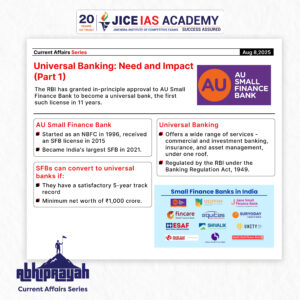
Universal banking- need and impact
UPSC CURRENT AFFAIRS – 08th August 2025 Home / Universal banking- need and impact Why in News? The Reserve Bank
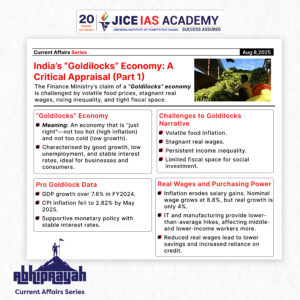
India’s “Goldilocks” Economy: A Critical Appraisal
UPSC CURRENT AFFAIRS – 08th August 2025 Home / India’s “Goldilocks” Economy: A Critical Appraisal Why in News? The Finance

U.S.-India Trade Dispute: Trump’s 50% Tariffs and India’s Oil Imports from Russia
UPSC CURRENT AFFAIRS – 07th August 2025 Home / U.S.-India Trade Dispute: Trump’s 50% Tariffs and India’s Oil Imports from
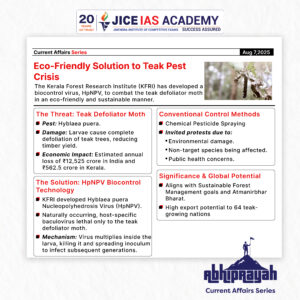
Eco-Friendly Solution to Teak Pest Crisis: KFRI’s HpNPV Technology
UPSC CURRENT AFFAIRS – 07th August 2025 Home / Eco-Friendly Solution to Teak Pest Crisis: KFRI’s HpNPV Technology Why in

New Species of Non-Venomous Rain Snake Discovered in Mizoram
UPSC CURRENT AFFAIRS – 07th August 2025 Home / New Species of Non-Venomous Rain Snake Discovered in Mizoram Why in

Economic Implications
For Indian Exporters
- These reforms reduce transaction costs and compliance hurdles
- Encourage a more competitive and efficient export environment
- Promote value addition in key sectors like leather
For Tamil Nadu
- The reforms particularly benefit the state’s leather industry, a major contributor to employment and exports
- Boost the marketability of GI-tagged E.I. leather, enhancing rural and traditional industries
For Trade Policy
- These decisions indicate a shift from regulatory controls to policy facilitation
Reinforce the goals of Make in India, Atmanirbhar Bharat, and India’s ambition to become a leading export power
Recently, BVR Subrahmanyam, CEO of NITI Aayog, claimed that India has overtaken Japan to become the fourth-largest economy in the world, citing data from the International Monetary Fund (IMF).
India’s rank as the world’s largest economy varies by measure—nominal GDP or purchasing power parity (PPP)—each with key implications for economic analysis.