Donald Trump Raises Tariffs on Chinese Imports to 125%, Pauses Tariffs on Others

Home / UPSC / Current Affairs / Donald Trump raises taxes on Chinese imports to 125%, pauses tariffs on most nations for 90 days

UPSC CURRENT AFFAIRS – 10th April 2025

Why in News?

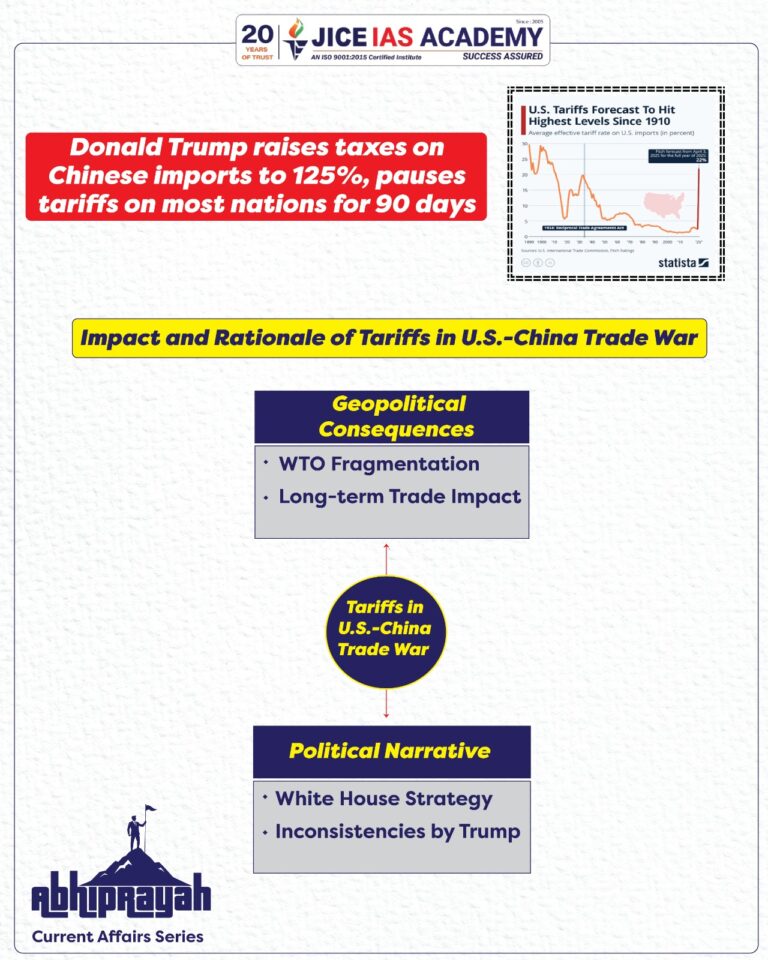
Recently, U.S. President Donald Trump paused global tariffs for 90 days amid market turmoil, while increasing tariffs on Chinese imports to 125%.

Introduction

  • Confronted with a global market sell-off and recession warnings, U.S. President Donald Trump changed direction on his tough tariff policy.
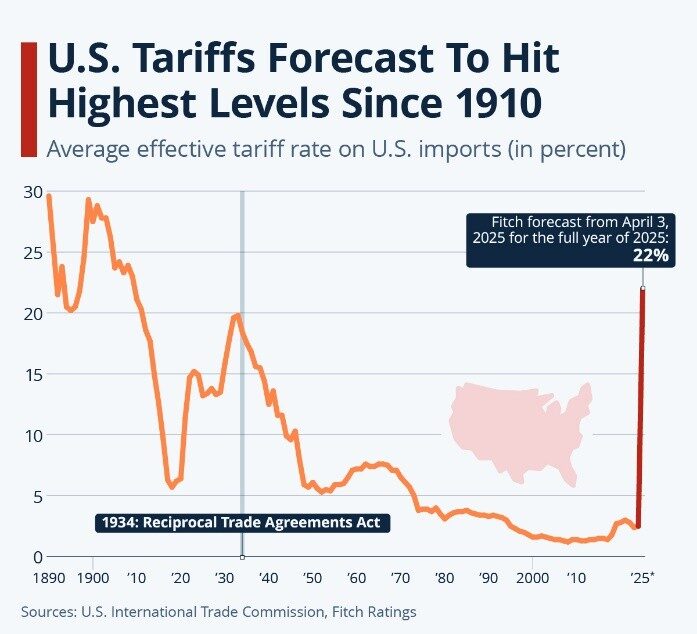
  • He instituted a 90-day reprieve on higher tariffs on most countries, lowering the tariff level to 10%, while increasing tariffs on Chinese imports to 125%.
  • It came as global investors flashed distress signals and nations called for negotiations.

Key Developments

  • Market Impact: S&P 500 jumped 9.5%; bond yields had been on the rise before stabilizing in the wake of the announcement.
  • Negotiation Phase: Treasury Secretary Scott Bessent proclaimed “bespoke” country-by-country negotiations in the next 90 days.
  • China Exception: Tariffs on Chinese imports were raised to 125%, isolating the trade war to a U.S.-China dispute.
  • Political Narrative: The White House positioned the timeout as strategic, despite inconsistencies by Trump and cabinet officials.
  • Geopolitical Consequences: WTO threatened long-term fragmentation of global trade on geopolitical grounds.

Economic Responses

  • Corporate level individuals such as Delta’s CEO threatened strategic disarray.
  • Experts predicted concurrent economic shocks could lead the U.S. into a recession.
  • Trump ally and hedge fund tycoon Bill Ackman termed the action as a strategic masterstroke.

What are tariffs and how do they work?

  • Tariffs are taxes charged on goods bought from other countries.
  • Typically, they are a percentage of a product’s value. For example, a 25% tariff on a $10 (£7.59) product would mean an additional $2.50 (£1.90) charge.
  • The 125% tariff on Chinese goods means that a $10 product would attract a $12.50 tax on top – driving the total cost up to $22.50.
  • The companies that bring the foreign goods into the country have to pay the tax to the government.
  • The money is collected when the imported goods clear US customs.
  • Firms can choose to pass on some or all of the increased cost to customers.

Why is Trump using tariffs?

  • For decades, Trump has argued the US should use tariffs to boost its economy.
  • He says they will encourage US consumers to buy more American-made goods, increase the amount of tax raised and lead to huge levels of investment in the country.
  • Trump wants to reduce the gap between the value of goods the US buys from other countries and the value of those it sells to them. He argues that America has been taken advantage of by “cheaters” and “pillaged” by foreigners.
  • The US president has also made other demands alongside tariffs. The first wave announced during his current term targeted China, Mexico and Canada, after he said he wanted them to do more to stop migrants and illegal drugs reaching the US.
  • Trump has strongly defended his tariff policy but a growing number of influential voices within his Republican Party have joined opposition Democrats and foreign leaders in attacking the measures.

What are Trump's 'reciprocal tariffs'?

  • Trump introduced a minimum 10% tariff on all imports to the US on 5 April.
  • The UK, Argentina, Australia, Brazil and Saudi Arabia are among the countries whose goods face this “baseline” charge.
  • Much higher tariffs were initially introduced against 60 other countries on 9 April.
  • These included 49% on Cambodian products, 46% on Vietnamese imports and 20% on goods from the EU.
  • Chinese imports were initially due to face 54% tariffs (34% on top of the 20% rate already in place).
  • Trump then increased the total to 104% after China vowed to “fight to the end” and refused to scrap its own retaliatory tariffs of 34% on the US.
  • Hours after the 104% tariff took effect, China announced it would introduce a significantly higher 84% tax on all US imports from 10 April.
  • Trump soon hit back, saying the US would increase tariffs on Chinese goods to 125% effective immediately.
  • For now, Chinese manufacturers – and American consumers – still benefit from a tariff exemption for goods in small parcels sent from China worth less than $800 (£624). However that exemption will also end on 2 May.

White House officials have described the higher tariffs as "reciprocal".

  • Reciprocal would mean they were based on the amount countries charge the US in the form of existing tariffs, plus the cost of meeting non-tariff barriers such as regulations.
  • However, the White House used a different calculation – setting each tariff rate at a level that would eliminate the US’s trade deficit in goods with each country.
  • And some countries, including the UK, have had tariffs applied even though they buy more from the US than they sell to it.

Leave a Reply

Your email address will not be published. Required fields are marked *

Call Us Now !

Copyright © JICE ACADEMY FOR EXCELLENCE PRIVATE LIMITED