
UPSC CURRENT AFFAIRS – 06th July 2025
Early Earth: A Little Heat Could Have Led to More Complex Life
Why in News?
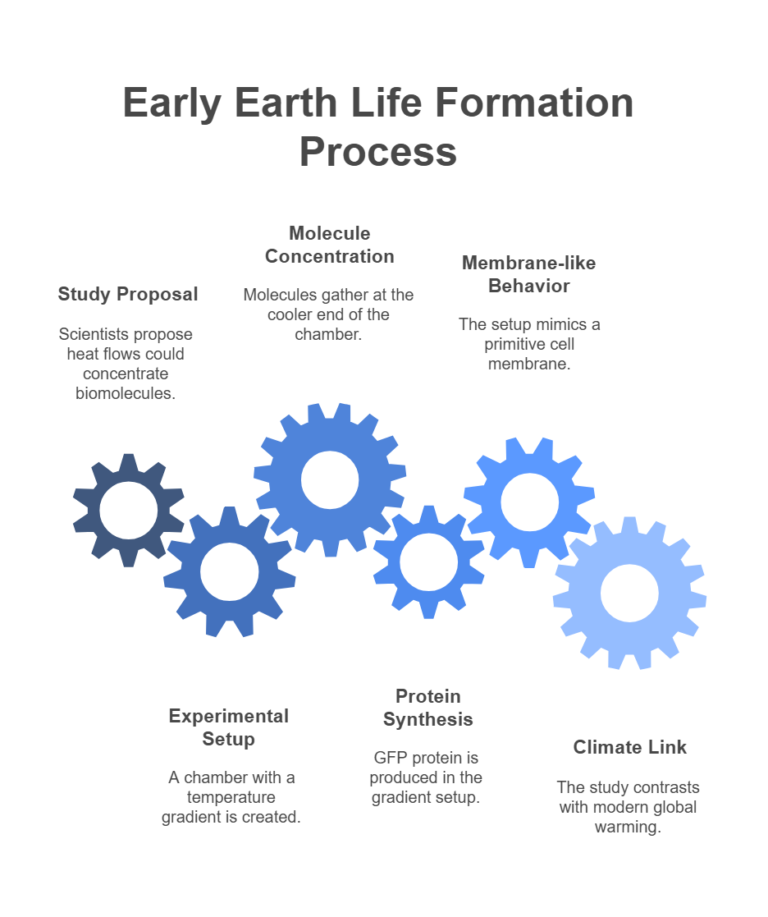
A recent study published in Nature Physics proposes that simple heat flows from volcanic rocks or rock cracks on early Earth could have concentrated essential biomolecules, enabling primitive protein synthesis and supporting theories of how life may have originated before true cell membranes evolved.
Key Findings
- Before true cells existed, organic molecules like RNA, amino acids, and DNA floated freely but needed to stay close together for complex reactions.
- Scientists recreated a tiny chamber with a temperature gradient — the top plate at 40°C and the bottom at 27°C — to mimic heat differences found near volcanic fissures.
- Using a diluted PURExpress kit (which contains E. coli’s protein-making machinery), they added DNA that coded for green fluorescent protein (GFP). GFP fluoresces green under a microscope, acting as a visible marker to check if protein synthesis occurs.
- Only in the chamber with the temperature gradient did molecules like DNA, RNA building blocks, amino acids, and ions gather at the cooler end, becoming concentrated enough to trigger protein synthesis.
- The protein GFP was produced only in the gradient setup, not in the control, showing that natural heat flows could mimic a primitive cell membrane’s role by trapping useful molecules while letting waste diffuse out — demonstrating membrane-like behaviour without a real lipid membrane.
Scientific Concepts
- DNA (Deoxyribonucleic Acid) carries the genetic blueprint for making proteins. It stores hereditary information in the form of nucleotide sequences (A, T, C, G).
- RNA (Ribonucleic Acid) acts as the messenger that copies instructions from DNA and helps build proteins. It is single-stranded and essential for the process of gene expression.
- GFP (Green Fluorescent Protein) is a naturally glowing protein originally discovered in jellyfish. Scientists use GFP as a reporter protein to visibly track when and where gene expression and protein synthesis occur in experiments.
How It Worked
- The setup worked on basic convection: warm liquid rises, cool liquid sinks, and molecules drift towards cooler regions, concentrating them.
- This created a natural compartment that acted like a primitive protocell, showing how early biomolecules could have been brought together long before true lipid membranes evolved.
- Over time, real cell membranes and ion gradients likely formed, powering the first molecular machines of life.
Modern Climate Link: Global Warming and the Paris Agreement
- Unlike the natural, localised heat flows that may have helped life begin, today’s human-driven global warming is widespread and dangerous due to excessive greenhouse gas emissions.
- The 2015 Paris Agreement under the UNFCCC aims to limit global temperature rise to well below 2°C, and ideally to 1.5°C, compared to pre-industrial levels to prevent irreversible climate impacts.
- This contrast highlights how controlled, local heat once enabled life to emerge, while unchecked global warming now threatens ecosystems and human well-being worldwide.
Broader Context
- Hydrothermal vents and rock cracks on early Earth could have naturally provided stable temperature gradients, supporting theories like the “RNA World Hypothesis” that RNA molecules may have been key to life’s beginnings.
- Other experiments, such as spraying neutral water to create oppositely charged microdroplets, also show that simple physical processes could spark prebiotic chemical reactions.
- This suggests that the origin of life may have relied more on ordinary, abundant conditions than rare or extreme ones.

3rd UN conference on landlocked countries
UPSC CURRENT AFFAIRS – 08th August 2025 Home / 3rd UN conference on landlocked countries Why in News? At the

Issue of soapstone mining in Uttarakhand’s Bageshwar
UPSC CURRENT AFFAIRS – 08th August 2025 Home / Issue of soapstone mining in Uttarakhand’s Bageshwar Why in News? Unregulated
Groundwater Pollution in India – A Silent Public Health Emergency
UPSC CURRENT AFFAIRS – 08th August 2025 Home / Groundwater Pollution in India – A Silent Public Health Emergency Why

Universal banking- need and impact
UPSC CURRENT AFFAIRS – 08th August 2025 Home / Universal banking- need and impact Why in News? The Reserve Bank

India’s “Goldilocks” Economy: A Critical Appraisal
UPSC CURRENT AFFAIRS – 08th August 2025 Home / India’s “Goldilocks” Economy: A Critical Appraisal Why in News? The Finance

U.S.-India Trade Dispute: Trump’s 50% Tariffs and India’s Oil Imports from Russia
UPSC CURRENT AFFAIRS – 07th August 2025 Home / U.S.-India Trade Dispute: Trump’s 50% Tariffs and India’s Oil Imports from

Eco-Friendly Solution to Teak Pest Crisis: KFRI’s HpNPV Technology
UPSC CURRENT AFFAIRS – 07th August 2025 Home / Eco-Friendly Solution to Teak Pest Crisis: KFRI’s HpNPV Technology Why in

New Species of Non-Venomous Rain Snake Discovered in Mizoram
UPSC CURRENT AFFAIRS – 07th August 2025 Home / New Species of Non-Venomous Rain Snake Discovered in Mizoram Why in

Economic Implications
For Indian Exporters
- These reforms reduce transaction costs and compliance hurdles
- Encourage a more competitive and efficient export environment
- Promote value addition in key sectors like leather
For Tamil Nadu
- The reforms particularly benefit the state’s leather industry, a major contributor to employment and exports
- Boost the marketability of GI-tagged E.I. leather, enhancing rural and traditional industries
For Trade Policy
- These decisions indicate a shift from regulatory controls to policy facilitation
Reinforce the goals of Make in India, Atmanirbhar Bharat, and India’s ambition to become a leading export power
Recently, BVR Subrahmanyam, CEO of NITI Aayog, claimed that India has overtaken Japan to become the fourth-largest economy in the world, citing data from the International Monetary Fund (IMF).
India’s rank as the world’s largest economy varies by measure—nominal GDP or purchasing power parity (PPP)—each with key implications for economic analysis.