UPSC CURRENT AFFAIRS – 11th July 2025
Electoral Roll Accuracy and the Right to Vote in India
Why in News?
- The Supreme Court’s directive to include Aadhaar, voter ID, and ration cards in Bihar’s electoral roll revision highlights India’s commitment to inclusive universal adult suffrage and the need to balance electoral integrity with democratic inclusion.
Introduction
- The recent Supreme Court directive (July 10, 2025) to the Election Commission (EC) to accept Aadhaar, voter ID, and ration cards for the Special Intensive Revision (SIR) of electoral rolls in Bihar has reignited discourse on the robustness of India’s electoral framework.
- By remarking that the “right to vote goes to the very root of the functioning of our republic”, the Court emphasized the foundational importance of universal adult suffrage (UAS) in India’s democratic architecture.
- The ongoing legal debate over electoral roll revisions offers a prism through which to examine the legal status, historical roots, and contemporary challenges in safeguarding India’s democratic ethos.
The Genesis of Universal Adult Suffrage in India
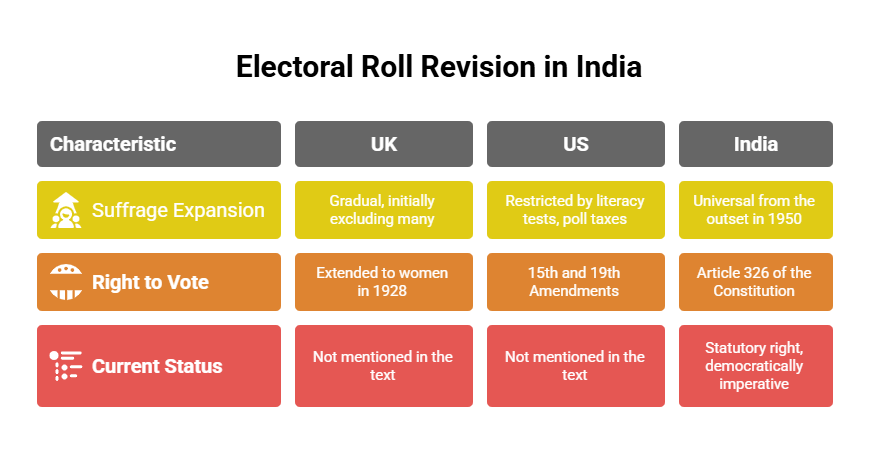
Unlike the gradual, exclusionary franchise expansion in Western democracies, India adopted universal adult suffrage from the outset of its republican journey in 1950.
- UK: Franchise extended gradually—from male property owners to women (1928).
- US: Despite the 15th and 19th Amendments, literacy tests and poll taxes restricted voting until the 1960s.
- India: Article 326 granted every adult citizen (21 years, later reduced to 18 in 1989) the right to vote, irrespective of caste, creed, gender, property, or literacy.
Operationalisation of UAS
Two key legislations ensured practical implementation:
- Representation of the People Act, 1950: Deals with the preparation and revision of electoral rolls.
- Representation of the People Act, 1951: Regulates conduct of elections, candidature, and election-related offences.
Sukumar Sen, the first Chief Election Commissioner, ensured inclusivity by introducing symbols for illiterate voters — a milestone in deepening participatory democracy.
Is Voting a Fundamental Right in India?
Constitutional Debates
- Despite proposals by B.R. Ambedkar and K.T. Shah to include the right to vote under Fundamental Rights, the Constituent Assembly rejected the idea, placing it instead under statutory provisions.
Judicial Interpretation
- Kuldip Nayar v. Union of India (2006): Declared the right to vote as a statutory right, not a fundamental one.
- Rajbala v. State of Haryana (2016): A two-judge bench called it a constitutional right, but this remains subordinate to Kuldip Nayar.
- Anoop Baranwal v. Union of India (2023): The majority declined to reopen the debate, while Justice Ajay Rastogi (in dissent) connected it to Articles 19(1)(a) and 21.
Statutory Yet Sacrosanct
Even though not a fundamental right, the courts recognize the vote as a democratic imperative central to the republic’s survival, echoing John Dewey’s vision of democracy as both a governmental and social ideal.
The Critical Role of Electoral Rolls
Legal Framework
Section 21 of the RPA, 1950 empowers the EC to revise electoral rolls, ensuring they reflect only eligible voters.
Why Accuracy Matters
- Inclusions of ineligible voters lead to impersonation and dilution of genuine votes.
- Exclusions of eligible voters undermine democratic participation.
- Duplications or outdated entries compromise electoral integrity.
Courts hold that only substantial, systemic errors that materially affect the election outcome can invalidate elections — not isolated errors.
The Debate in Bihar: Citizenship and the Burden of Proof
The Controversy
In the current Bihar SIR, concerns were raised over attempts to verify citizenship through EROs, risking the disenfranchisement of legitimate voters.
Judicial Safeguards
- Lal Babu Hussein v. ERO (1995): Struck down EC orders allowing District Collectors to unilaterally delete voters over suspicion of citizenship.
- The court emphasized natural justice, past voting records, and adherence to the Citizenship Act.
Recent Developments
- Md. Rahim Ali (2024) reiterated that mere suspicion or unsubstantiated claims cannot be grounds for exclusion from electoral rolls.
- The Supreme Court emphasized due process and quasi-judicial conduct by EROs.
Understanding “Ordinary Residence”
Statutory Definition
Under Section 19 of the RPA, 1950:
- Any Indian citizen aged 18 or above, not disqualified, and ordinarily resident in a constituency is entitled to be enrolled.
Judicial Interpretation
- Ordinary residence implies habitual and genuine presence, not a temporary or casual stay.
- Manmohan Singh case (1991): Clarified that a person must show regular presence and intent to reside, not merely use a nominal address.
Special Categories of Voters
- Postal Ballots: For service voters, armed forces, election staff.
- Overseas Voters: Covered under Section 20A of the RPA, 1950 but must vote in person (no postal/proxy voting yet).
The Role of Political Parties and Voter Awareness
Although electoral rolls are maintained by EC, the Lakshmi Charan Sen v. A.K.M. Hassan Uzzaman (1985) judgment emphasized that political parties, too, must help ensure proper inclusion and exclusion in electoral rolls — a necessity in a largely illiterate or unaware electorate.
Conclusion:
The Supreme Court’s Role
As the Supreme Court resumes hearings on July 28, it must balance vigilance with inclusion. Expanding the list of acceptable documents like Aadhaar and ration cards helps safeguard the democratic rights of the marginalized and migratory populations.
Shared Democratic Responsibility
Ensuring the sanctity of the vote is not the EC’s job alone:
- Citizens must verify and update their records.
- Parties must assist in inclusion efforts.
- Institutions must uphold transparency and natural justice.
As Winston Churchill aptly noted, democracy begins with the “little man making a little cross on a little bit of paper.” That simple act encapsulates the soul of a republic — and it must be preserved with diligence, inclusion, and care.

3rd UN conference on landlocked countries
UPSC CURRENT AFFAIRS – 08th August 2025 Home / 3rd UN conference on landlocked countries Why in News? At the

Issue of soapstone mining in Uttarakhand’s Bageshwar
UPSC CURRENT AFFAIRS – 08th August 2025 Home / Issue of soapstone mining in Uttarakhand’s Bageshwar Why in News? Unregulated

Groundwater Pollution in India – A Silent Public Health Emergency
UPSC CURRENT AFFAIRS – 08th August 2025 Home / Groundwater Pollution in India – A Silent Public Health Emergency Why
Universal banking- need and impact
UPSC CURRENT AFFAIRS – 08th August 2025 Home / Universal banking- need and impact Why in News? The Reserve Bank

India’s “Goldilocks” Economy: A Critical Appraisal
UPSC CURRENT AFFAIRS – 08th August 2025 Home / India’s “Goldilocks” Economy: A Critical Appraisal Why in News? The Finance

U.S.-India Trade Dispute: Trump’s 50% Tariffs and India’s Oil Imports from Russia
UPSC CURRENT AFFAIRS – 07th August 2025 Home / U.S.-India Trade Dispute: Trump’s 50% Tariffs and India’s Oil Imports from

Eco-Friendly Solution to Teak Pest Crisis: KFRI’s HpNPV Technology
UPSC CURRENT AFFAIRS – 07th August 2025 Home / Eco-Friendly Solution to Teak Pest Crisis: KFRI’s HpNPV Technology Why in

New Species of Non-Venomous Rain Snake Discovered in Mizoram
UPSC CURRENT AFFAIRS – 07th August 2025 Home / New Species of Non-Venomous Rain Snake Discovered in Mizoram Why in

Economic Implications
For Indian Exporters
- These reforms reduce transaction costs and compliance hurdles
- Encourage a more competitive and efficient export environment
- Promote value addition in key sectors like leather
For Tamil Nadu
- The reforms particularly benefit the state’s leather industry, a major contributor to employment and exports
- Boost the marketability of GI-tagged E.I. leather, enhancing rural and traditional industries
For Trade Policy
- These decisions indicate a shift from regulatory controls to policy facilitation
Reinforce the goals of Make in India, Atmanirbhar Bharat, and India’s ambition to become a leading export power
Recently, BVR Subrahmanyam, CEO of NITI Aayog, claimed that India has overtaken Japan to become the fourth-largest economy in the world, citing data from the International Monetary Fund (IMF).
India’s rank as the world’s largest economy varies by measure—nominal GDP or purchasing power parity (PPP)—each with key implications for economic analysis.