
UPSC CURRENT AFFAIRS – 06th July 2025
Employment-Linked Incentive (ELI) Scheme -Pros and Cons
Why in News?
- The Union Cabinet approved an Employment-Linked Incentive (ELI) scheme with an outlay of ₹99,446 crore for 2025–27 to create over 3.5 crore jobs, especially in the manufacturing sector.
- It was announced as part of the 2024–25 Union Budget under a five-pronged employment package.
Key Provisions
- The scheme will be operated by the Employees Provident Fund Organisation (EPFO).
- Newly recruited employees earning up to ₹1 lakh per month will get a one-month EPF wage benefit (up to ₹15,000) paid in two installments — 50 percent after six months and 50 percent after 12 months of continuous service.
- Establishments registered under EPFO will get up to ₹3,000 per month for each additional employee retained for at least six months, for two years.
- For the manufacturing sector, incentives extend to the third and fourth years to encourage sustained job creation.
- A part of the incentive is to be kept in a savings deposit account for a fixed period, promoting savings culture among new employees.
Who Benefits
- First-time job seekers will benefit as the incentives make it attractive for employers to hire fresh talent.
- Labour-intensive sectors such as manufacturing will receive support to reduce hiring costs.
- EPFO-registered establishments get wage subsidies to encourage sustained formal employment.
Pros
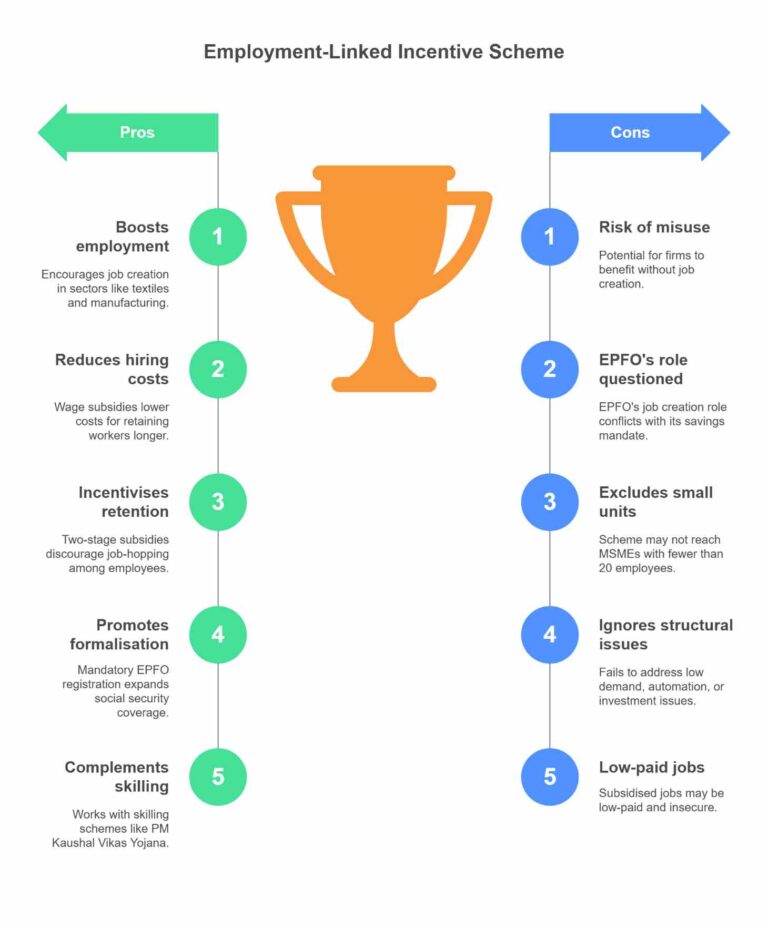
- Boosts formal employment by encouraging employers to create new jobs in sectors like textiles, MSMEs, and manufacturing.
- Reduces hiring costs through wage subsidies that help employers retain workers for longer.
- Incentivises retention of workers by paying subsidies in two stages to discourage job-hopping.
- Promotes formalisation of the workforce through mandatory EPFO registration, expanding the social security net.
- Complements existing skilling schemes like PM Kaushal Vikas Yojana and internship programmes.
Cons / Concerns
- There is a risk of misuse, echoing concerns raised during the Production-Linked Incentive (PLI) scheme where firms benefited without significant job creation.
- EPFO’s role as an implementing agency is questioned since its main mandate is to safeguard workers’ savings, not to create jobs.
- The scheme may not reach small units with fewer than 20 employees, which make up a large share of MSMEs.
- It does not address deeper structural issues like low domestic demand, automation, or sluggish private investment.
- There is a risk that subsidised jobs may be low-paid and insecure, leading to underemployment and poor working conditions.
Stakeholder Responses
- Industry bodies like CII and FICCI support the scheme as innovative but seek a simplified payroll reimbursement process.
- Small business associations want clear guidelines and the inclusion of micro units for wider impact.
- Most trade unions, except the Bharatiya Mazdoor Sangh, have raised concerns that the scheme may misuse workers’ savings and called for stronger social security measures.
- Experts caution that while the scheme may help in the short term, it should not distract from fixing long-term structural weaknesses in India’s job market.
Way Forward
- Ensure a transparent audit mechanism and link incentives to actual payroll additions verified through digital labour portals to prevent misuse.
- Include micro units with fewer than 20 employees to broaden coverage.
- Consider creating an independent agency or portal to implement the scheme instead of relying solely on EPFO.
- Focus on improving the quality of jobs by combining wage subsidies with skilling, upskilling, and workplace safety measures.
- Combine the scheme with broader macroeconomic steps to boost MSME credit, increase demand, and strengthen industrial competitiveness.

3rd UN conference on landlocked countries
UPSC CURRENT AFFAIRS – 08th August 2025 Home / 3rd UN conference on landlocked countries Why in News? At the

Issue of soapstone mining in Uttarakhand’s Bageshwar
UPSC CURRENT AFFAIRS – 08th August 2025 Home / Issue of soapstone mining in Uttarakhand’s Bageshwar Why in News? Unregulated

Groundwater Pollution in India – A Silent Public Health Emergency
UPSC CURRENT AFFAIRS – 08th August 2025 Home / Groundwater Pollution in India – A Silent Public Health Emergency Why

Universal banking- need and impact
UPSC CURRENT AFFAIRS – 08th August 2025 Home / Universal banking- need and impact Why in News? The Reserve Bank

India’s “Goldilocks” Economy: A Critical Appraisal
UPSC CURRENT AFFAIRS – 08th August 2025 Home / India’s “Goldilocks” Economy: A Critical Appraisal Why in News? The Finance

U.S.-India Trade Dispute: Trump’s 50% Tariffs and India’s Oil Imports from Russia
UPSC CURRENT AFFAIRS – 07th August 2025 Home / U.S.-India Trade Dispute: Trump’s 50% Tariffs and India’s Oil Imports from

Eco-Friendly Solution to Teak Pest Crisis: KFRI’s HpNPV Technology
UPSC CURRENT AFFAIRS – 07th August 2025 Home / Eco-Friendly Solution to Teak Pest Crisis: KFRI’s HpNPV Technology Why in

New Species of Non-Venomous Rain Snake Discovered in Mizoram
UPSC CURRENT AFFAIRS – 07th August 2025 Home / New Species of Non-Venomous Rain Snake Discovered in Mizoram Why in

Economic Implications
For Indian Exporters
- These reforms reduce transaction costs and compliance hurdles
- Encourage a more competitive and efficient export environment
- Promote value addition in key sectors like leather
For Tamil Nadu
- The reforms particularly benefit the state’s leather industry, a major contributor to employment and exports
- Boost the marketability of GI-tagged E.I. leather, enhancing rural and traditional industries
For Trade Policy
- These decisions indicate a shift from regulatory controls to policy facilitation
Reinforce the goals of Make in India, Atmanirbhar Bharat, and India’s ambition to become a leading export power
Recently, BVR Subrahmanyam, CEO of NITI Aayog, claimed that India has overtaken Japan to become the fourth-largest economy in the world, citing data from the International Monetary Fund (IMF).
India’s rank as the world’s largest economy varies by measure—nominal GDP or purchasing power parity (PPP)—each with key implications for economic analysis.