UPSC CURRENT AFFAIRS – 21th May 2025

Home / UPSC / Current Affairs / Energy Sufficiency in India and Its States

Energy Sufficiency in India and Its States

energy sufficiency in india and its states

Why in News?

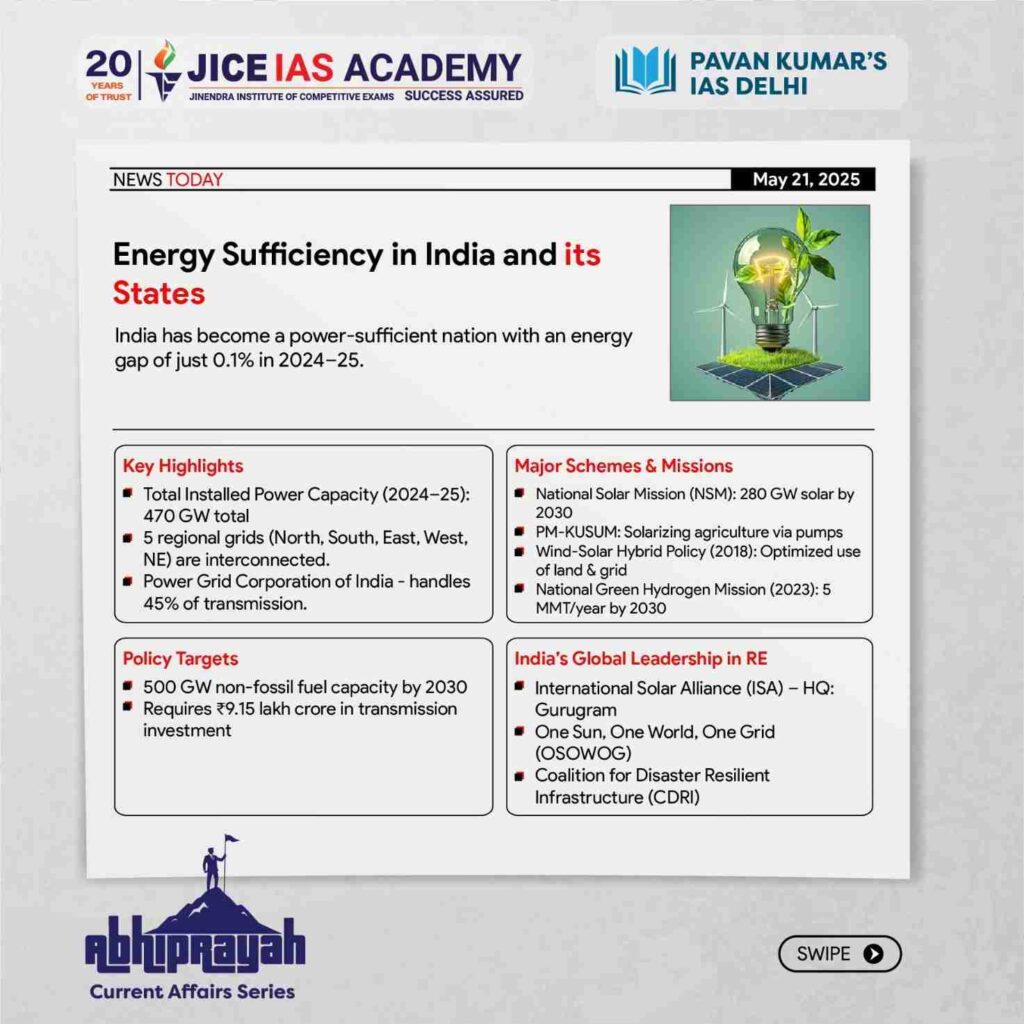
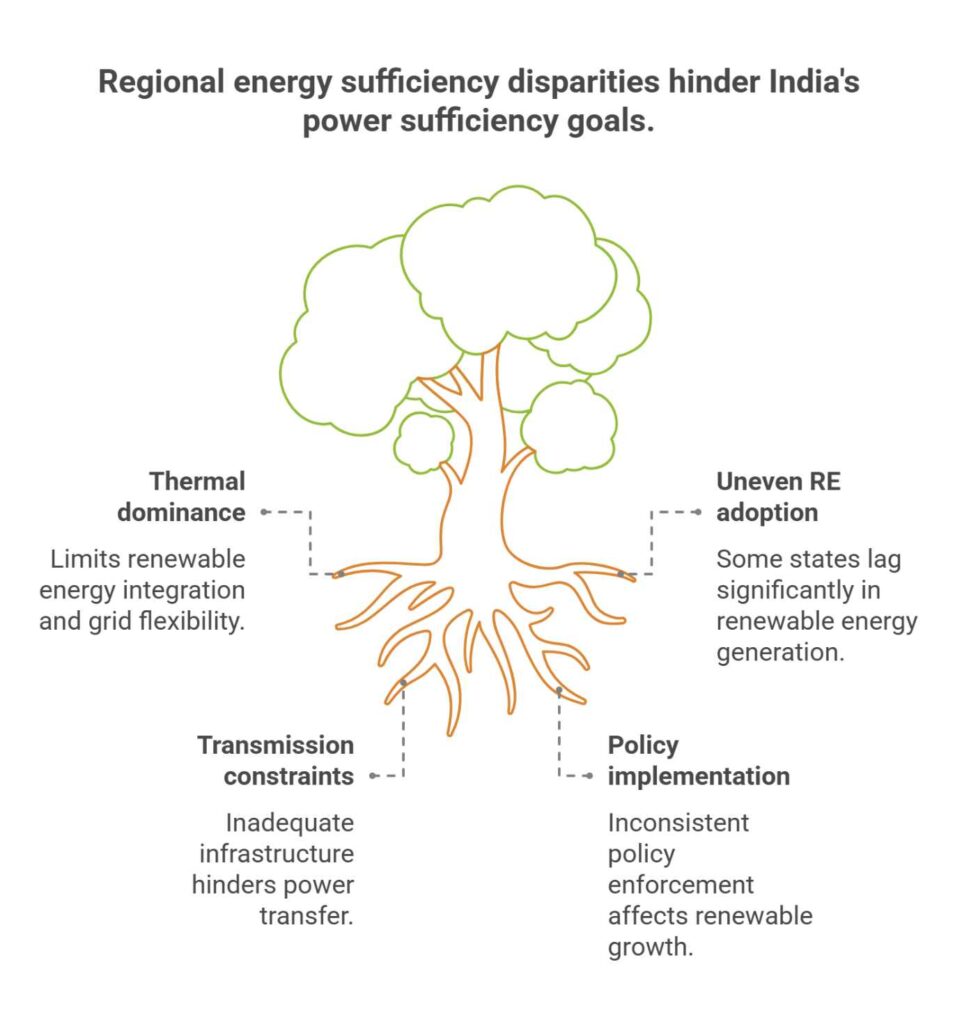
India has officially transformed into a power-sufficient nation, with an energy gap of only 0.1% in 2024–25, while regional disparities persist, especially in East and North-East India.

Key Highlights:

  • Installed Power Capacity:
    As of 2024–25, India’s total installed power capacity is 470 GW, with thermal sources contributing the majority and renewables at 13.78% of total production.


  • Transmission Network:
    • India’s National Power Grid interlinks 5 regional grids (North, South, East, West, North-East), operating at 50 Hz frequency.
    • Managed by Power Grid Corporation of India Ltd. (PGCIL).
    • PGCIL handles 45% of India’s power transmission and integrates private players.


  • Renewable Energy Growth:
    • Renewable production rose from 1.7 lakh MU in 2021–22 to 2.3 lakh MU in 2024–25.
    • Rajasthan doubled renewable capacity; Gujarat also made significant gains.
    • States like Tripura, Jharkhand, Goa, Puducherry, Chandigarh have negligible renewable generation (<40 MU).


  • State-wise Energy Gaps:
    • South & West: Minimal or 0% gap (e.g., Tamil Nadu, Gujarat, Maharashtra).
    • North: Improved performance; J&K cut gap from 7.6% to 0.5%; Rajasthan fluctuated.
    • East: Bihar (0.4%) and Jharkhand (0.5%) still show notable gaps.
    • North-East: Volatile gaps; Meghalaya’s gap dropped from 7.6% to 0% in 2024–25.


  • Policy Push:
    • Goal: 500 GW non-fossil energy capacity by 2030.
    • ₹9.15 lakh crore investment needed in transmission.
    • Infrastructure planned for Green Hydrogen hubs at Mundra, Vizag, etc.

Major Government Schemes & Initiatives:

  • National Solar Mission (NSM)
    • Launched under the National Action Plan on Climate Change (NAPCC)
    • Target: 280 GW solar capacity by 2030
  • PM-KUSUM Scheme
    • Solar pumps for agriculture
    • Components A, B, C for grid-connected, standalone, and pump replacement
  • Solar Park Scheme
    • Ultra Mega Renewable Energy Parks (UMREPs) across states
  • Wind-Solar Hybrid Policy (2018)
    • Promotes hybrid systems to utilize land and transmission optimally
  • Green Energy Corridor
    • Dedicated transmission lines for evacuating renewable energy
  • National Green Hydrogen Mission (2023)
    • Target: 5 MMT per annum green hydrogen production by 2030
    • Promotes electrolyzers and hydrogen hubs
  • Rooftop Solar Programme
    • Focused on residential and institutional sectors
    • Solarization of cities and panchayats

India’s Global Leadership in RE:

  • International Solar Alliance (ISA)
    • HQ: Gurugram
    • India-led initiative to mobilize $1 trillion in solar investments globally
  • One Sun, One World, One Grid (OSOWOG)
    • Vision for transnational solar grid connectivity
  • Coalition for Disaster Resilient Infrastructure (CDRI)
    • India-backed initiative for sustainable energy infrastructure
  • Decreased oxygen-carrying capacity of RBCs.
  • Increased fragility and cell stiffness.
  • Vascular blockage, causing pain and organ injury.
  • Increased susceptibility to infections, anemia, and stroke.

Past Illegal Allotments Invalid

Leave a Reply

Your email address will not be published. Required fields are marked *

Call Us Now !

Copyright © JICE ACADEMY FOR EXCELLENCE PRIVATE LIMITED