
UPSC CURRENT AFFAIRS – 18th May 2025

Home / UPSC / Current Affairs / Understanding Failure Modes in Solid-State Lithium-Ion Batteries

Understanding Failure Modes in Solid-State Lithium-Ion Batteries

failure modes in solid-state lithium-ion batteries

Why in News?

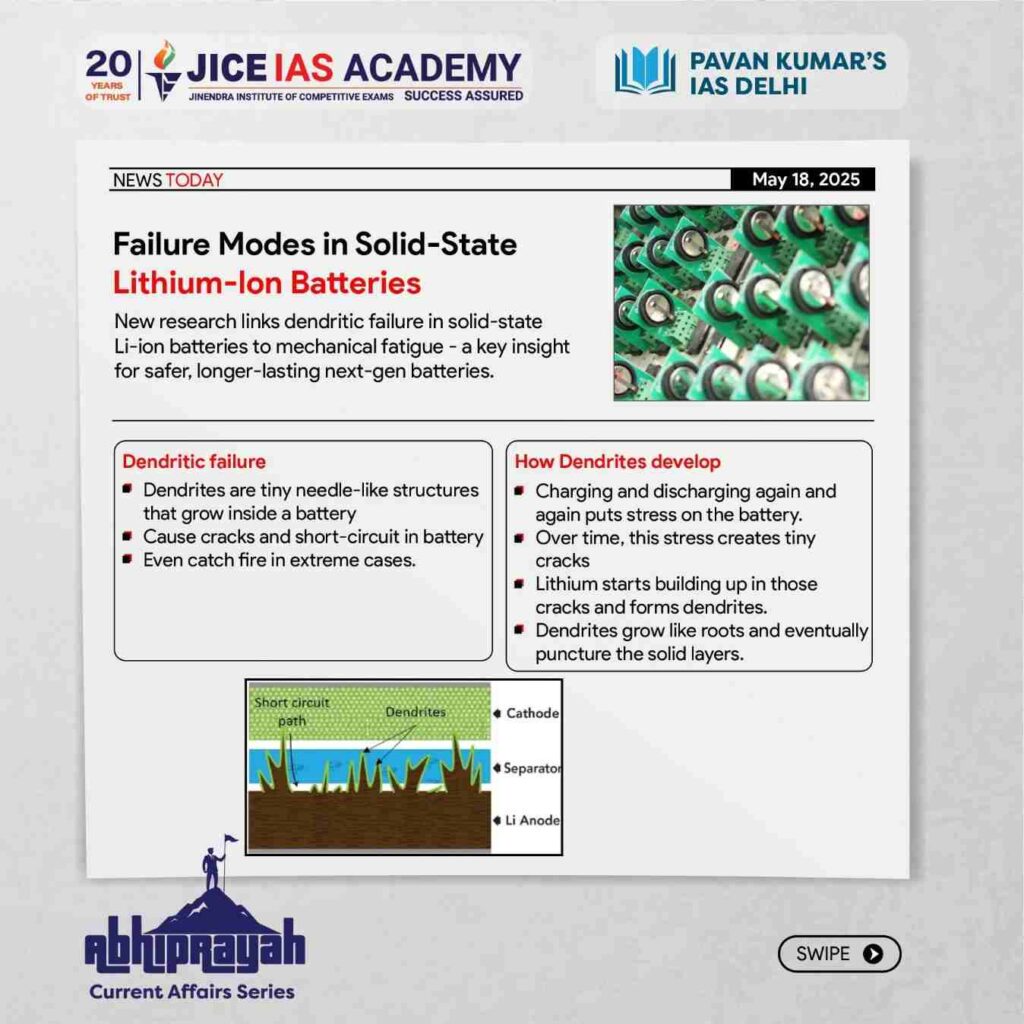
A new study published in Science reveals that dendritic failure in solid-state Li-ion batteries (SSBs) is linked to mechanical fatigue, a principle long known in material science. This finding is significant for improving the longevity, safety, and reliability of next-generation batteries.

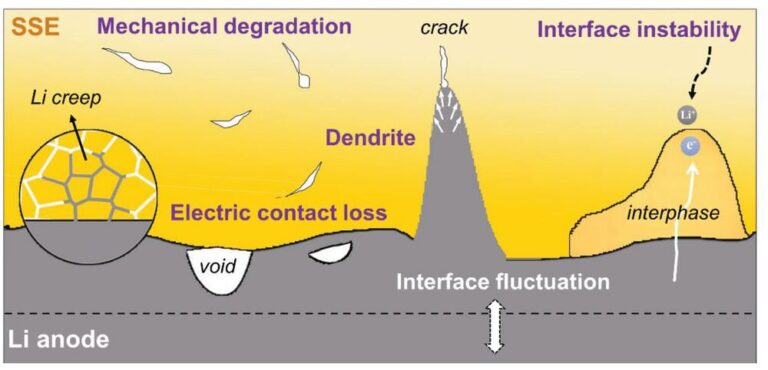
diagram interface between solid-state electrolyte and lithium anode batteries

Key Highlights

  • Solid-state batteries (SSBs) use a solid electrolyte instead of a liquid, offering higher energy density and safety.
  • Researchers observed that microscopic lithium dendrites, resembling plant roots, grow into the solid electrolyte during repeated charging/discharging cycles.
  • The failure arises not from high current but from mechanical fatigue due to cyclic stress on the lithium anode.
  • Operando scanning electron microscopy helped visualize dendrite formation in real-time.
  • The battery short-circuited at the 145th cycle due to void formation and electrolyte fracture—even under minimal current.
  • Implications include more sophisticated battery failure models and better design for durable energy storage systems.

What Are Solid-State Li-ion Batteries?

  • SSBs use ceramic or solid polymer electrolytes in place of flammable liquid electrolytes.
  • Used in pacemakers, smartwatches, and under development for electric vehicles (EVs) and grid storage.
  • Advantages:
    • Safer (non-flammable).
    • Lighter and more energy dense.
    • Lower risk of leakage or thermal runaway.

Key Failure Mechanism: Dendritic Growth

  • Lithium ions get deposited unevenly at the anode during charging.
  • Filament-like dendrites grow and penetrate the solid electrolyte.
  • Result: Internal short-circuit, leading to rapid failure of the cell.
  • Fatigue caused by repeated cycling even at low currents causes structural weaknesses.

Challenges Identified

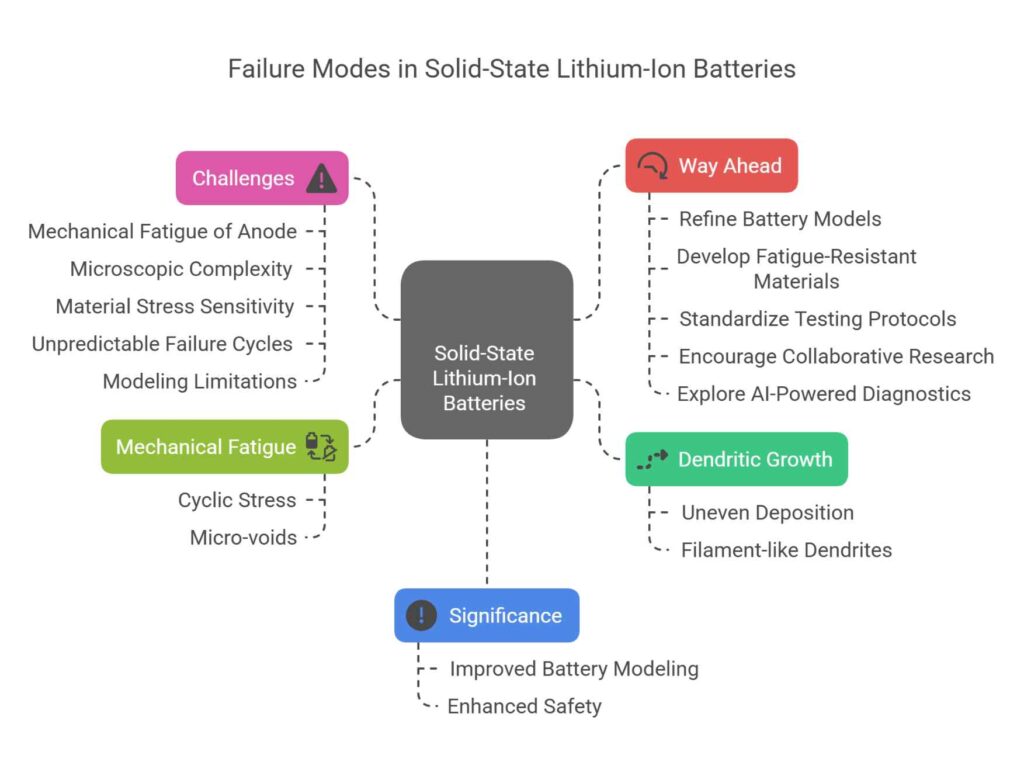
  1. Mechanical Fatigue of Anode:
    • Analogous to bending a wire until it breaks.
    • Lithium stripping and plating cycles cause micro-voids, slip bands, and cracks.
  2. Microscopic Complexity:
    • Dendrites are invisible to the naked eye, making early detection difficult.
    • Operando microscopy is needed to observe real-time interface evolution.
  3. Material Stress Sensitivity:
    • Solid electrolytes are brittle and crack under volume changes or stress.
    • No standard method yet to counter lithium’s stress-strain behavior under varied temperatures.
  4. Unpredictable Failure Cycles:
    • Short-circuiting can occur without warning even under safe current limits.
  5. Modeling Limitations:
    • Existing battery degradation models do not fully account for mechanical fatigue effects.
    • Lack of integrated electro-chemo-mechanical models limits predictive capability.
failure modes in solid-state lithium-ion battery

Significance

  • A breakthrough in understanding why SSBs fail even at low power settings.
  • Will guide next-generation battery modeling, design, and predictive diagnostics.
  • Can boost the safety and adoption of SSBs in sectors like EVs and aerospace.

India-Specific Impact

  1. Boost to EV and Energy Storage R&D
    • India is pushing battery innovation under FAME-II, PLI Scheme for Advanced Chemistry Cell Batteries, and National Electric Mobility Mission Plan.
    • Indian institutions like IISc Bengaluru and IITs are actively involved in SSB research.
    • The findings can help Indian startups and research centres develop more durable batteries, reducing EV recall and performance issues.
  1. Local Manufacturing and Make-in-India Goals
    • With plans for gigafactories, understanding failure mechanisms is critical for local cell assembly.
    • Can reduce dependency on imported battery designs that may not suit India’s temperature and usage conditions.
  1. Improved Battery Standards and Certification
    • BIS and other regulatory bodies can revise battery certification norms based on fatigue-informed models.
    • Critical for applications in high-risk environments like defense and aviation.
  1. Grid-Scale Renewable Integration
    • India’s solar and wind sectors need reliable, long-life storage solutions.
    • Fatigue-resistant SSBs can enable off-grid and hybrid mini-grid projects in rural and remote regions.

Way Ahead

  • Refine battery models to incorporate lithium’s fatigue behavior under cyclic stress and temperature variation.
  • Develop fatigue-resistant electrode materials and flexible electrolytes.
  • Standardize microscopy-based testing protocols during SSB design.
  • Encourage collaborative research in electro-mechanical modeling of batteries.
  • Explore AI-powered diagnostics for early detection of dendritic growth and fatigue damage.

Conclusion

The discovery linking dendritic failure in SSBs to mechanical fatigue marks a paradigm shift in battery research. While manufacturing changes may remain limited, this insight is crucial for building longer-lasting, safer, and more efficient solid-state batteries—critical for India’s push toward EV adoption, renewable storage, and energy security.

Leave a Reply

Your email address will not be published. Required fields are marked *

Call Us Now !

Copyright © JICE ACADEMY FOR EXCELLENCE PRIVATE LIMITED