
UPSC CURRENT AFFAIRS – 18 March 2025
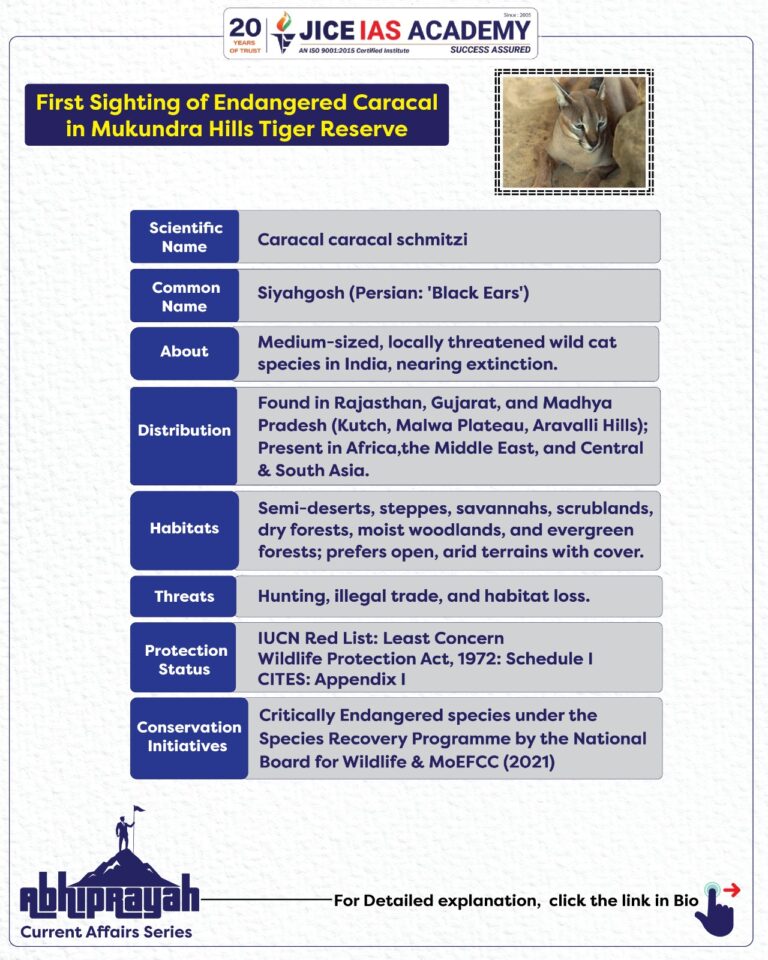
First Sighting of Endangered Caracal in Mukundra Hills Tiger Reserve
Why in News:
Recent sighting of a caracal in Mukundra Hills Tiger Reserve underscores the importance of strong conservation measures
About Caracal
- The caracal (Caracal caracal) is a medium-sized, primarily nocturnal wild cat known for its distinctive black-tipped, pointy ears.
- The name ‘caracal’ originates from the Turkish word karakulak, meaning ‘black ears’.
- Caracals are small wild cats characterized by their long, tufted ears and reddish-tan or sandy-brown fur. Known as Siya Gosh in India, these nocturnal predators primarily hunt small mammals, birds, and rodents.
- They are naturally found in northwestern India, as well as in regions across Africa, the Middle East, and Central Asia.
- Their preferred habitats include the Aravalli hill range, semi-deserts, savannahs, scrublands, and dry forests.
- Although caracals once thrived across Central India and the Indo-Gangetic plains, they have not been sighted in these regions for the past four decades.
Distribution and Population Decline in India
- Historically, caracals inhabited 13 Indian states across nine of the 26 biotic provinces. However, their population has suffered a sharp decline, with the current estimate being fewer than 50 individuals.
- Native to Africa, the Middle East, Central Asia, and South Asia, these agile hunters were historically valued in medieval India for their ability to catch birds mid-flight.
- Descriptions of caracals appear in historical texts such as Khamsa-e-Nizami, Shahnameh, and Tutinama.
- Their presence is now restricted mainly to Rajasthan and Gujarat, with their known habitat covering only 16,709 sq km—less than 5% of the area they occupied between 1948 and 2000.
- Pre-1947 to 2000: Population declined by 50%.
- 2001 to 2020: Over 95% decline observed.
- 2021: Declared ‘Critically Endangered’ by the National Board for Wildlife and the Union Ministry of Environment, Forest and Climate Change.
Conservation Status
- Globally, caracals are classified as ‘Least Concern’ on the IUCN Red List due to their widespread presence in Africa and parts of Asia.
- In India, they are categorized as ‘Near Threatened’, reflecting their declining population and restricted habitat.
- Under Indian law, caracals are protected under Schedule-I of the Wildlife (Protection) Act, 1972, granting them the highest level of legal protection.
Protection Efforts
- In 2021, the National Board for Wildlife (NBWL) and the Ministry of Environment, Forest and Climate Change (MoEFCC) initiated a species recovery program targeting 22 endangered species, including the caracal.
- Potential habitats for conservation have been identified in Kutch, the Aravalli mountain range, the Malwa plateau, and the Bundelkhand region.
- The Ranthambore-Kuno Landscape has been recognized as a critical conservation site to support caracal population recovery.
Threats to Caracal Population
Several factors have contributed to the dramatic decline of caracals in India:
- Habitat Loss: Rapid urbanization and land-use changes have severely impacted the caracal’s ability to find prey, such as small ungulates and rodents.
- Wasteland Classification: The Chambal ravines, a key natural habitat, have been designated as wastelands, leading to ecological neglect and degradation.
- Illegal Trade: Increasing cases of caracals being captured for sale as exotic pets further threaten their survival.
Conservation Efforts and the Role of Mukundra Hills Tiger Reserve
- The recent sighting of a caracal in Mukundra Hills Tiger Reserve underscores the importance of strong conservation measures.
- The reserve’s protection regime serves as an umbrella to safeguard not only tigers but also lesser-known species like the caracal.
- Continued monitoring, habitat restoration, and anti-poaching efforts are critical to preventing further decline.

3rd UN conference on landlocked countries
UPSC CURRENT AFFAIRS – 08th August 2025 Home / 3rd UN conference on landlocked countries Why in News? At the

Issue of soapstone mining in Uttarakhand’s Bageshwar
UPSC CURRENT AFFAIRS – 08th August 2025 Home / Issue of soapstone mining in Uttarakhand’s Bageshwar Why in News? Unregulated

Groundwater Pollution in India – A Silent Public Health Emergency
UPSC CURRENT AFFAIRS – 08th August 2025 Home / Groundwater Pollution in India – A Silent Public Health Emergency Why

Universal banking- need and impact
UPSC CURRENT AFFAIRS – 08th August 2025 Home / Universal banking- need and impact Why in News? The Reserve Bank

India’s “Goldilocks” Economy: A Critical Appraisal
UPSC CURRENT AFFAIRS – 08th August 2025 Home / India’s “Goldilocks” Economy: A Critical Appraisal Why in News? The Finance

U.S.-India Trade Dispute: Trump’s 50% Tariffs and India’s Oil Imports from Russia
UPSC CURRENT AFFAIRS – 07th August 2025 Home / U.S.-India Trade Dispute: Trump’s 50% Tariffs and India’s Oil Imports from
Eco-Friendly Solution to Teak Pest Crisis: KFRI’s HpNPV Technology
UPSC CURRENT AFFAIRS – 07th August 2025 Home / Eco-Friendly Solution to Teak Pest Crisis: KFRI’s HpNPV Technology Why in

New Species of Non-Venomous Rain Snake Discovered in Mizoram
UPSC CURRENT AFFAIRS – 07th August 2025 Home / New Species of Non-Venomous Rain Snake Discovered in Mizoram Why in