

UPSC CURRENT AFFAIRS – 14th July 2025

Home / UPSC / Current Affairs / Policy Reversal on Flue Gas Desulphurisation (FGD)

Policy Reversal on Flue Gas Desulphurisation (FGD)

current affairs document policy reversal on flue gas desulphurisation

Why in News?

  • The Union Environment Ministry has recently exempted most coal-fired power plants from installing Flue Gas Desulphurisation (FGD) systems.
flue gas desulphurisation

Introduction

  • In a significant policy reversal, the Ministry of Environment, Forest and Climate Change (MoEFCC) has exempted the majority of India’s coal-fired thermal power plants from mandatorily installing Flue Gas Desulphurisation (FGD) systems — technology designed to curb Sulphur Dioxide (SO₂) emissions
  • This move undercuts its own 2015 directive that mandated all coal-fired plants to install FGDs to mitigate air pollution and its health impacts.

2015 Mandate and Non-Compliance

  • In 2015, all coal-fired power plants in India (around 180 plants with approximately 600 units) were ordered to install FGD systems by 2017.
  • As of 2025, only 8% of the units have complied, most of them run by NTPC (National Thermal Power Corporation).
  • The repeated extension of deadlines, including the most recent one in 2024, signals weak enforcement and regulatory laxity.

Why FGD Is Important: Understanding Sulphur Dioxide (SO₂)

  • SO₂ is a key air pollutant regulated by the Central Pollution Control Board (CPCB).
  • Chronic exposure leads to respiratory ailments, acid rain, and ecosystem degradation.
  • Critically, SO₂ converts to sulphates in the atmosphere, contributing to Particulate Matter (PM 2.5), which is a leading cause of premature deaths due to air pollution.

While ground-level SO₂ readings in India have largely remained within permissible limits, this does not negate the cumulative and indirect impacts of its transformation into fine particulate pollutants.

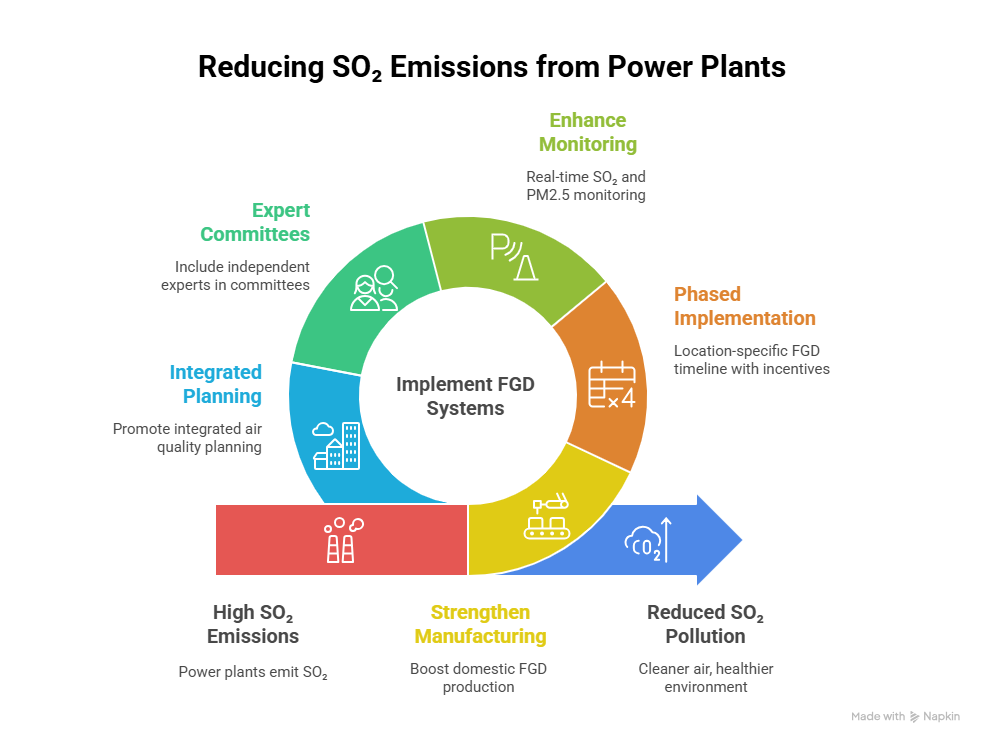
reducing so2 emissions from power plants

Critical Evaluation of the Justifications

1. Science vs. Selective Science

  • While the Intergovernmental Panel on Climate Change (IPCC) acknowledges the cooling effect of sulphates, it does not advocate increased sulphur emissions as a mitigation strategy.
  • The net harm to health and environment outweighs any short-term climatic benefit of sulphates.

2. Uneven Standards and Environmental Inequality

  • Now, only a minority (~20%) of plants located:
    • Within 10 km of the National Capital Region (NCR),
    • In cities with over 1 million population, or
    • In designated pollution hotspots

This introduces spatially variable environmental norms, raising concerns about equity and public health justice. Rural or remote populations may face higher exposure with fewer protections.

3. Lack of Public Consultation

  • A decision of this magnitude affecting air quality and public health was taken without adequate public debate or transparency.
  • This undermines India’s commitment to evidence-based environmental policymaking and democratic governance.

Implications for Environmental Governance

  1. Regulatory Credibility at Stake:
    • The rollback questions the credibility of environmental regulations and the capacity of enforcement agencies.
  2. Contradictions with Global Commitments:
    • India’s international commitments under the Paris Agreement and national missions like the National Clean Air Programme (NCAP) are weakened.
  3. Setting a Precedent of Dilution:
    • Exemptions to one pollutant might set a precedent for similar dilution of other environmental norms, particularly when aligned with industry interests.

Way Forward

  • India’s coal-fired power sector, a major contributor to air pollution and carbon emissions, needs technological modernization rather than regulatory exemptions
  • While revisiting environmental policies based on new evidence is valid, such actions must be grounded in transparent scientific consensus and public participation.
  • Recommendations:
    • Strengthen domestic FGD manufacturing under “Make in India” to reduce installation costs.
    • Implement a phased and location-specific FGD timeline, backed by incentives.
    • Enhance real-time monitoring of SO₂ and PM2.5 and make data publicly accessible.
    • Ensure that scientific committees include independent experts, not only ministry-nominated officials.
    • Promote integrated air quality planning, especially in pollution-prone areas.

Economic Implications

For Indian Exporters

  • These reforms reduce transaction costs and compliance hurdles
  • Encourage a more competitive and efficient export environment
  • Promote value addition in key sectors like leather

For Tamil Nadu

  • The reforms particularly benefit the state’s leather industry, a major contributor to employment and exports
  • Boost the marketability of GI-tagged E.I. leather, enhancing rural and traditional industries

For Trade Policy

  • These decisions indicate a shift from regulatory controls to policy facilitation

Reinforce the goals of Make in India, Atmanirbhar Bharat, and India’s ambition to become a leading export power

Recently, BVR Subrahmanyam, CEO of NITI Aayog, claimed that India has overtaken Japan to become the fourth-largest economy in the world, citing data from the International Monetary Fund (IMF). 

India’s rank as the world’s largest economy varies by measure—nominal GDP or purchasing power parity (PPP)—each with key implications for economic analysis.

Significance and Applications

Leave a Reply

Your email address will not be published. Required fields are marked *

Call Us Now !

Copyright © JICE ACADEMY FOR EXCELLENCE PRIVATE LIMITED