UPSC CURRENT AFFAIRS – 03rd August 2025
Forestland Evictions in Assam and Their Regional Impact
Why in News?
- The Assam government’s eviction drive targeting encroachments on forestlands has triggered strong administrative and civil reactions across the Northeast.
- The Gauhati High Court on July 30, 2025, directed Assam and four neighboring States to constitute a high-level committee for coordinating forestland clearance and border settlement issues.
Key Highlights
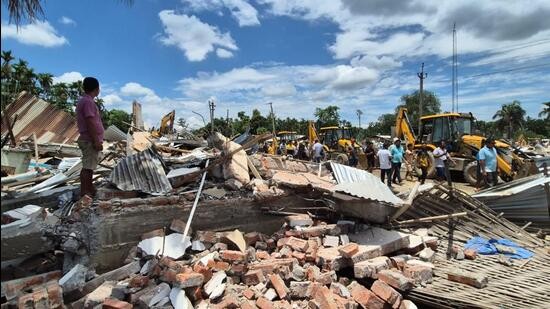
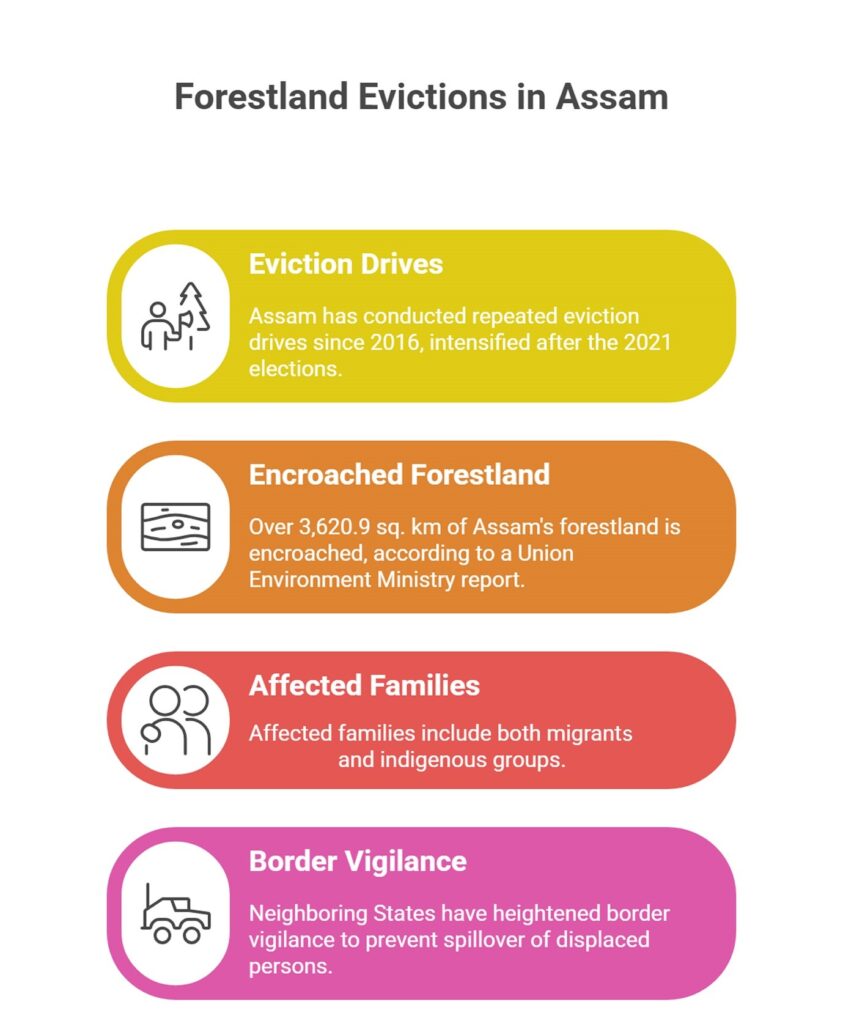
- Assam has conducted repeated eviction drives since 2016, intensified after the 2021 elections. In June–July 2025, over 1,000 families were evicted from Paikan Reserve Forest.
- A Union Environment Ministry report stated that over 3,620.9 sq. km of Assam’s forestland is encroached.
- Affected families include both migrant and indigenous groups, although the State government clarified that tribal people covered under the Forest Rights Act (FRA), 2006 would be protected.
- Neighboring States—Nagaland, Meghalaya, Mizoram, Arunachal Pradesh, and Manipur—have heightened border vigilance to prevent spillover of displaced persons.
Constitutional and Legal Framework
- Article 48A (DPSP) obligates the State to protect forests and wildlife.
- The Forest (Conservation) Act, 1980 and the Indian Forest Act, 1927 restrict unauthorized land use in designated forest areas.
- The Forest Rights Act, 2006 (FRA) safeguards the rights of Scheduled Tribes and traditional forest dwellers, provided their claims are verified and documented.
- Article 21 ensures the Right to Life, interpreted by the Supreme Court to include dignified rehabilitation during evictions.
6th Schedule
- The 6th Schedule, is crucial in the Northeast, especially in Meghalaya, Mizoram, Tripura, and Assam, as it provides constitutional protection to tribal land, culture, and autonomy.
Impact of the 6th Schedule:
- Autonomous District Councils (ADCs) established under the 6th Schedule can make laws on land, forest, and customary practices.
- Many areas claimed by Assam’s neighbors fall under these ADCs. Disputes often arise when eviction drives affect land claimed by ADCs across undefined borders.
- Tribal populations under ADCs often resist State-led evictions, claiming autonomy and protection under the Schedule.
- The lack of clear coordination between State Forest Departments and ADCs can lead to inter-agency conflict, affecting eviction legitimacy and forest conservation.
Example:
- The Meghalaya ADCs have opposed Assam’s actions in border zones, arguing that evictions disrupt tribal settlements protected by the 6th Schedule.
- Assam’s Karbi Anglong and Dima Hasao districts, which are 6th Schedule areas, are also affected by such eviction operations and cross-border claims.
Regional Concerns and Border Vigilance
- Neighboring States initiated strict border checks, citing risks of demographic changes and land conflict.
- In Nagaland, local NGOs and even extremist groups activated “border monitoring” mechanisms fearing influx.
- The reaction reflects the sensitivity around ethnic identity and land rights in the hill States, rooted in long-standing inter-ethnic mistrust.
Policy and Administrative Implications
- A national-level protocol is required to balance environmental protection, forest rights, and humanitarian safeguards.
- There is a need for mandatory Environmental and Social Impact Assessments (ESIA) before large-scale evictions.
- States must verify FRA compliance, uphold tribal rights under the 6th Schedule, and ensure rehabilitation under the National Rehabilitation and Resettlement Policy, 2007.
- Cooperative mechanisms, such as interstate commissions and joint cadastral surveys, must be institutionalized to resolve border and land disputes peacefully.

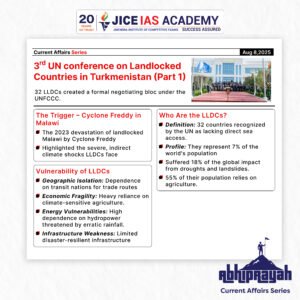
3rd UN conference on landlocked countries
UPSC CURRENT AFFAIRS – 08th August 2025 Home / 3rd UN conference on landlocked countries Why in News? At the
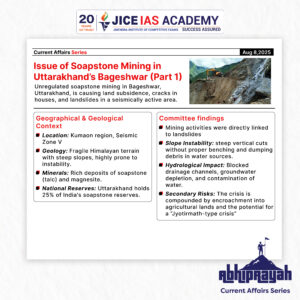
Issue of soapstone mining in Uttarakhand’s Bageshwar
UPSC CURRENT AFFAIRS – 08th August 2025 Home / Issue of soapstone mining in Uttarakhand’s Bageshwar Why in News? Unregulated

Groundwater Pollution in India – A Silent Public Health Emergency
UPSC CURRENT AFFAIRS – 08th August 2025 Home / Groundwater Pollution in India – A Silent Public Health Emergency Why

Universal banking- need and impact
UPSC CURRENT AFFAIRS – 08th August 2025 Home / Universal banking- need and impact Why in News? The Reserve Bank

India’s “Goldilocks” Economy: A Critical Appraisal
UPSC CURRENT AFFAIRS – 08th August 2025 Home / India’s “Goldilocks” Economy: A Critical Appraisal Why in News? The Finance

U.S.-India Trade Dispute: Trump’s 50% Tariffs and India’s Oil Imports from Russia
UPSC CURRENT AFFAIRS – 07th August 2025 Home / U.S.-India Trade Dispute: Trump’s 50% Tariffs and India’s Oil Imports from
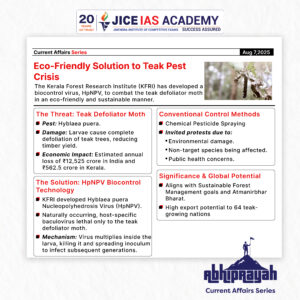
Eco-Friendly Solution to Teak Pest Crisis: KFRI’s HpNPV Technology
UPSC CURRENT AFFAIRS – 07th August 2025 Home / Eco-Friendly Solution to Teak Pest Crisis: KFRI’s HpNPV Technology Why in

New Species of Non-Venomous Rain Snake Discovered in Mizoram
UPSC CURRENT AFFAIRS – 07th August 2025 Home / New Species of Non-Venomous Rain Snake Discovered in Mizoram Why in

Introduction
Economic Implications
For Indian Exporters
- These reforms reduce transaction costs and compliance hurdles
- Encourage a more competitive and efficient export environment
- Promote value addition in key sectors like leather
For Tamil Nadu
- The reforms particularly benefit the state’s leather industry, a major contributor to employment and exports
- Boost the marketability of GI-tagged E.I. leather, enhancing rural and traditional industries
For Trade Policy
- These decisions indicate a shift from regulatory controls to policy facilitation
Reinforce the goals of Make in India, Atmanirbhar Bharat, and India’s ambition to become a leading export power
Recently, BVR Subrahmanyam, CEO of NITI Aayog, claimed that India has overtaken Japan to become the fourth-largest economy in the world, citing data from the International Monetary Fund (IMF).
India’s rank as the world’s largest economy varies by measure—nominal GDP or purchasing power parity (PPP)—each with key implications for economic analysis.