
UPSC CURRENT AFFAIRS – 26th March 2025
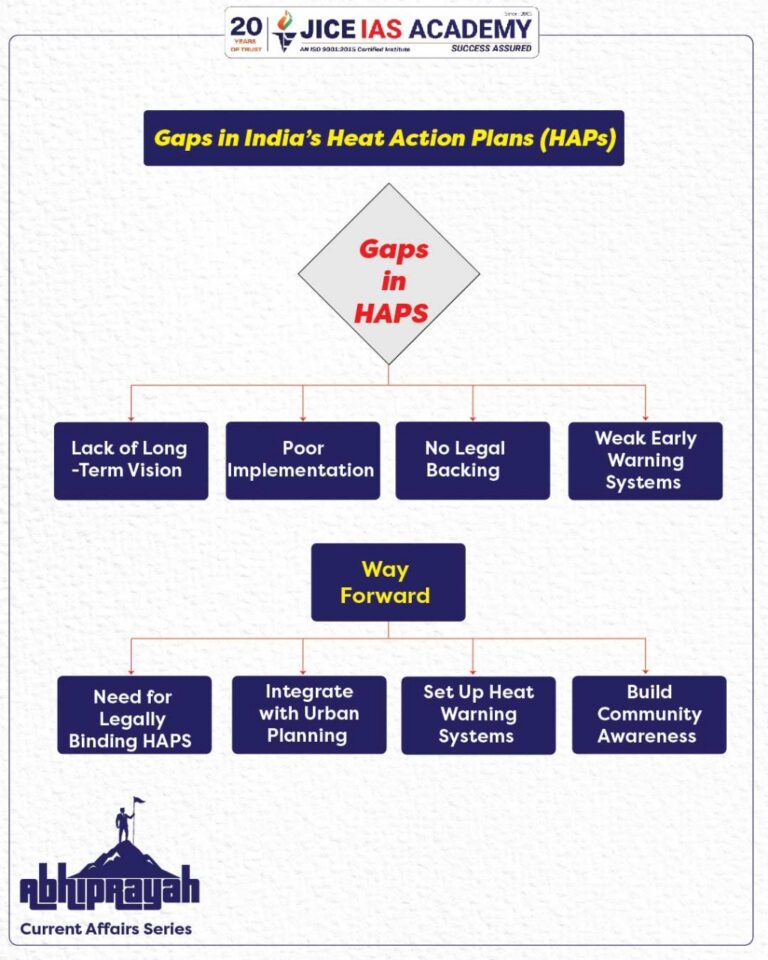
Gaps in India’s Heat Action Plans (HAPs)
Why in News?
India is increasingly vulnerable to extreme heat events due to climate change. According to a 2025 study, most Indian cities either lack Heat Action Plans (HAPs) or have ones that are short-term and weakly implemented. Despite the growing intensity of heatwaves, HAPs remain peripheral in mainstream urban planning and disaster governance.
Why Heat Action Plans Matter:
- Heatwaves have become silent disasters—not as visible as floods or cyclones, but with high mortality.
- As per NCRB, heatstroke deaths rose from 530 in 2020 to 730 in 2022.
- Successful models like Ahmedabad’s HAP (2013) show that targeted interventions can significantly reduce mortality.
- HAPs support public health preparedness, protect vulnerable populations, and are aligned with SDG 3 (Health) and SDG 13 (Climate Action).
Key Gaps in India’s Heat Action Plans:
- Absence of Long-Term Vision:
- Most HAPs are reactive, designed for seasonal crisis management.
- Lack integration with urban planning, housing, and infrastructure development.
- No provisions for future heat scenarios projected by IPCC and NDMA.
- Weak Implementation Mechanisms:
- Many HAPs exist only on paper, with poor coordination among health, disaster management, and municipal departments.
- No clear budget allocation, timeline, or monitoring system.
- No Legal or Institutional Mandate:
- HAPs are not backed by legislation—unlike cyclone or flood preparedness.
- Without legal status under the Disaster Management Act, there is no accountability for enforcement or outcomes.
- Inadequate Early Warning and Public Outreach:
- Most districts lack localised, real-time alerts.
- Awareness campaigns are urban-centric, underfunded, and fail to reach rural and informal sectors.
- Communities lack knowledge on hydration, rest timings, or access to cooling spaces.
Implications for Governance and Development
- Social Equity: The poor, elderly, and informal workers face disproportionate risks due to inadequate cooling and healthcare access.
- Urban Sustainability: Cities lack climate-resilient infrastructure (e.g., cool roofs, shaded walkways), increasing urban heat island effects.
- Public Health Burden: Unprepared hospitals face surges in heat-related illnesses without adequate staff or cooling facilities.
- Economic Productivity: Heatwaves reduce outdoor work hours, impacting agriculture, construction, and informal sectors.
Way Forward
- Legal Institutionalisation of HAPs:
- Make HAPs mandatory under the Disaster Management Act or state-specific urban planning laws.
- Assign implementation responsibility to municipal bodies with regular audits and public accountability.
- Integrate HAPs into Developmental Schemes:
- Align HAPs with Smart Cities Mission, AMRUT, and State Action Plans on Climate Change (SAPCCs).
- Include heat resilience in building codes and housing schemes.
- Strengthen Forecasting and Early Warning Systems:
- Collaborate with IMD and ISRO for hyper-local heat alerts using AI and remote sensing.
- Disseminate information in local languages via Panchayats, ASHA workers, and urban ward committees.
- Build Heat-Resilient Infrastructure:
- Promote urban greening, cool roofs, hydration stations, and public shade zones.
- Encourage community participation in climate-resilient planning.
Conclusion
As India urbanizes and warms simultaneously, Heat Action Plans must evolve from reactive checklists to legally mandated, climate-resilient governance tools. The need is to institutionalize HAPs, empower local bodies, and mainstream heat resilience in India’s public health, infrastructure, and urban development frameworks. Only then can India be truly prepared for the rising thermal risks of the 21st century.

3rd UN conference on landlocked countries
UPSC CURRENT AFFAIRS – 08th August 2025 Home / 3rd UN conference on landlocked countries Why in News? At the

Issue of soapstone mining in Uttarakhand’s Bageshwar
UPSC CURRENT AFFAIRS – 08th August 2025 Home / Issue of soapstone mining in Uttarakhand’s Bageshwar Why in News? Unregulated
Groundwater Pollution in India – A Silent Public Health Emergency
UPSC CURRENT AFFAIRS – 08th August 2025 Home / Groundwater Pollution in India – A Silent Public Health Emergency Why

Universal banking- need and impact
UPSC CURRENT AFFAIRS – 08th August 2025 Home / Universal banking- need and impact Why in News? The Reserve Bank

India’s “Goldilocks” Economy: A Critical Appraisal
UPSC CURRENT AFFAIRS – 08th August 2025 Home / India’s “Goldilocks” Economy: A Critical Appraisal Why in News? The Finance

U.S.-India Trade Dispute: Trump’s 50% Tariffs and India’s Oil Imports from Russia
UPSC CURRENT AFFAIRS – 07th August 2025 Home / U.S.-India Trade Dispute: Trump’s 50% Tariffs and India’s Oil Imports from
Eco-Friendly Solution to Teak Pest Crisis: KFRI’s HpNPV Technology
UPSC CURRENT AFFAIRS – 07th August 2025 Home / Eco-Friendly Solution to Teak Pest Crisis: KFRI’s HpNPV Technology Why in

New Species of Non-Venomous Rain Snake Discovered in Mizoram
UPSC CURRENT AFFAIRS – 07th August 2025 Home / New Species of Non-Venomous Rain Snake Discovered in Mizoram Why in