
UPSC CURRENT AFFAIRS – 29th June 2025
Large Genetic Map of Indians Flags Hidden Disease Risks
Why in News?
- A landmark study published in Cell has produced the most detailed genomic map of India to date, sequencing the genomes of 2,762 individuals across 23 States and Union Territories. It highlights India’s complex population history, the impact of endogamy on genetic health risks, and underscores how underrepresentation in global genome databases limits the potential of precision medicine for Indians.
Key Highlights of the Study
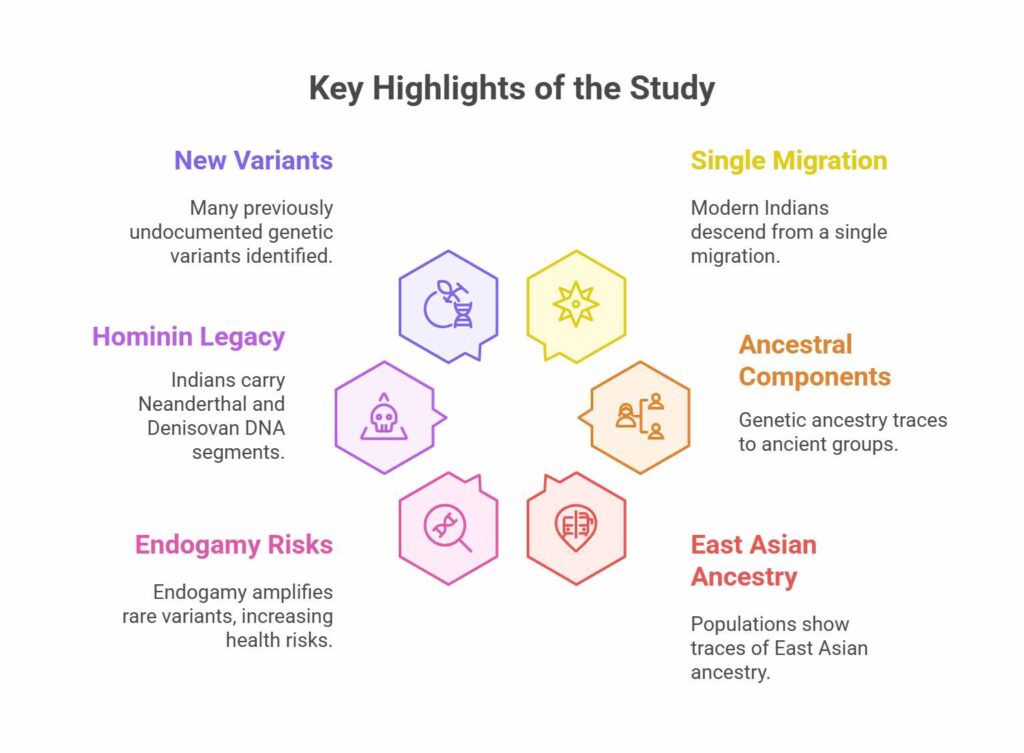
- Single Out-of-Africa Migration:
The study reconfirms that modern Indians primarily descend from a single human migration out of Africa around 50,000 years ago, despite archaeological signs of earlier human presence in the subcontinent. - Three Major Ancestral Components:
The genetic ancestry of Indians is traced to Ancient Ancestral South Indians (hunter-gatherers), Iranian-related Neolithic farmers, and Eurasian Steppe pastoralists linked to the spread of Indo-European languages. - Additional East Asian Ancestry:
Populations in East, Northeast, and parts of Central India show traces of East Asian ancestry, likely due to historical migration waves, including the spread of rice farming and movements after the Gupta Empire’s decline. - Endogamy and Health Risks:
India’s long-standing social practice of marriage within communities (endogamy) has caused strong founder effects—amplifying certain rare variants. This makes Indians, especially in South India, more prone to recessive disorders such as thalassemia and metabolic syndromes. Homozygosity levels are 2–9 times higher than in Europeans or East Asians. - Ancient Hominin Legacy:
Like all non-Africans, Indians carry Neanderthal and Denisovan DNA segments, which in India are especially diverse and linked to immune system genes. Some of these archaic segments may have conferred survival advantages, including resistance to viral infections. - New Genetic Variants Discovered:
Over 2.6 crore previously undocumented genetic variants were identified, with more than 1.6 lakh protein-altering variants absent from global datasets. These include markers linked to diseases such as congenital deafness, cystic fibrosis, and severe anaesthetic reactions (e.g., BCHE variant found in Telangana).
Key Concepts and Broader Context
- Founder Effect:
A phenomenon where small founding populations amplify rare variants due to limited gene pools—common in India due to caste and community-based endogamy. - Precision Medicine:
An emerging approach that tailors medical treatment to individual genetic profiles. Its success depends on diverse and representative genomic data, which India currently lacks in global reference databases. - Immune System Implications:
Neanderthal and Denisovan DNA segments enrich regions linked to immunity (e.g., MHC, TRIM, BTNL2 genes). For example, a Neanderthal-derived region on chromosome 3 is associated with severe COVID-19 outcomes and is common in East and Northeast India. - Policy Relevance:
The study highlights the urgent need for India-specific genetic databases and public health screening programs that account for local population structures. It aligns with the National Digital Health Mission’s vision of personalized healthcare.
Challenges and Issues
- Limited representation of Indian genomes in global databases hinders accurate disease risk prediction and therapeutic development.
- Social endogamy continues to perpetuate health risks by increasing the frequency of recessive disorders.
- Regional and community-level rare variants require targeted research and local genetic counselling efforts.
- Ethical challenges exist around community consent, privacy, and data sovereignty for large-scale genomic projects.
Way Forward
- Expand genome mapping efforts to include more genetically isolated and marginalised communities.
- Integrate genomic research into public health planning and disease prevention strategies.
- Build local capacity for genetic counselling and diagnostics to manage inherited disorders.
- Ensure community participation and ethical safeguards in genomic data collection.
- Foster global collaborations that recognise India’s genetic diversity in precision medicine research.

3rd UN conference on landlocked countries
UPSC CURRENT AFFAIRS – 08th August 2025 Home / 3rd UN conference on landlocked countries Why in News? At the

Issue of soapstone mining in Uttarakhand’s Bageshwar
UPSC CURRENT AFFAIRS – 08th August 2025 Home / Issue of soapstone mining in Uttarakhand’s Bageshwar Why in News? Unregulated

Groundwater Pollution in India – A Silent Public Health Emergency
UPSC CURRENT AFFAIRS – 08th August 2025 Home / Groundwater Pollution in India – A Silent Public Health Emergency Why

Universal banking- need and impact
UPSC CURRENT AFFAIRS – 08th August 2025 Home / Universal banking- need and impact Why in News? The Reserve Bank

India’s “Goldilocks” Economy: A Critical Appraisal
UPSC CURRENT AFFAIRS – 08th August 2025 Home / India’s “Goldilocks” Economy: A Critical Appraisal Why in News? The Finance

U.S.-India Trade Dispute: Trump’s 50% Tariffs and India’s Oil Imports from Russia
UPSC CURRENT AFFAIRS – 07th August 2025 Home / U.S.-India Trade Dispute: Trump’s 50% Tariffs and India’s Oil Imports from

Eco-Friendly Solution to Teak Pest Crisis: KFRI’s HpNPV Technology
UPSC CURRENT AFFAIRS – 07th August 2025 Home / Eco-Friendly Solution to Teak Pest Crisis: KFRI’s HpNPV Technology Why in

New Species of Non-Venomous Rain Snake Discovered in Mizoram
UPSC CURRENT AFFAIRS – 07th August 2025 Home / New Species of Non-Venomous Rain Snake Discovered in Mizoram Why in

Economic Implications
For Indian Exporters
- These reforms reduce transaction costs and compliance hurdles
- Encourage a more competitive and efficient export environment
- Promote value addition in key sectors like leather
For Tamil Nadu
- The reforms particularly benefit the state’s leather industry, a major contributor to employment and exports
- Boost the marketability of GI-tagged E.I. leather, enhancing rural and traditional industries
For Trade Policy
- These decisions indicate a shift from regulatory controls to policy facilitation
Reinforce the goals of Make in India, Atmanirbhar Bharat, and India’s ambition to become a leading export power
Recently, BVR Subrahmanyam, CEO of NITI Aayog, claimed that India has overtaken Japan to become the fourth-largest economy in the world, citing data from the International Monetary Fund (IMF).
India’s rank as the world’s largest economy varies by measure—nominal GDP or purchasing power parity (PPP)—each with key implications for economic analysis.