UPSC CURRENT AFFAIRS – 17th July 2025

Home / UPSC / Current Affairs / Genocide, International Law, and the Banality of Evil

Genocide, International Law, and the Banality of Evil

Why in News?

  • UN Special Rapporteur Francesca Albanese has called Israel’s actions in Gaza a form of genocide linked to settler colonialism.

Introduction

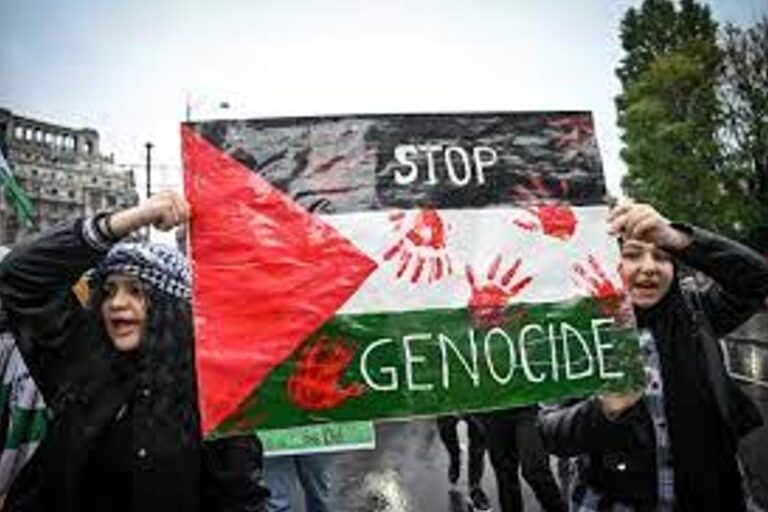
  • The ongoing conflict in Gaza has drawn serious international scrutiny, with UN Special Rapporteur Francesca Albanese calling it a stage of a “settler colonial process of erasure” and labeling Israeli actions as potential genocide.
  • This raises urgent legal, moral, and philosophical questions about how the international community defines, responds to, and prevents such atrocities.

Understanding Origins of Genocide:

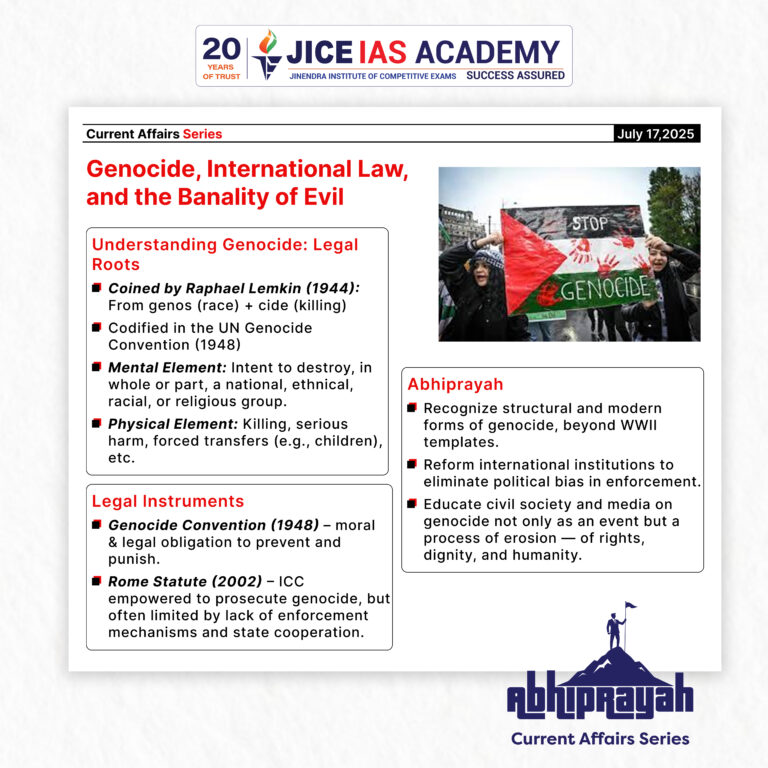
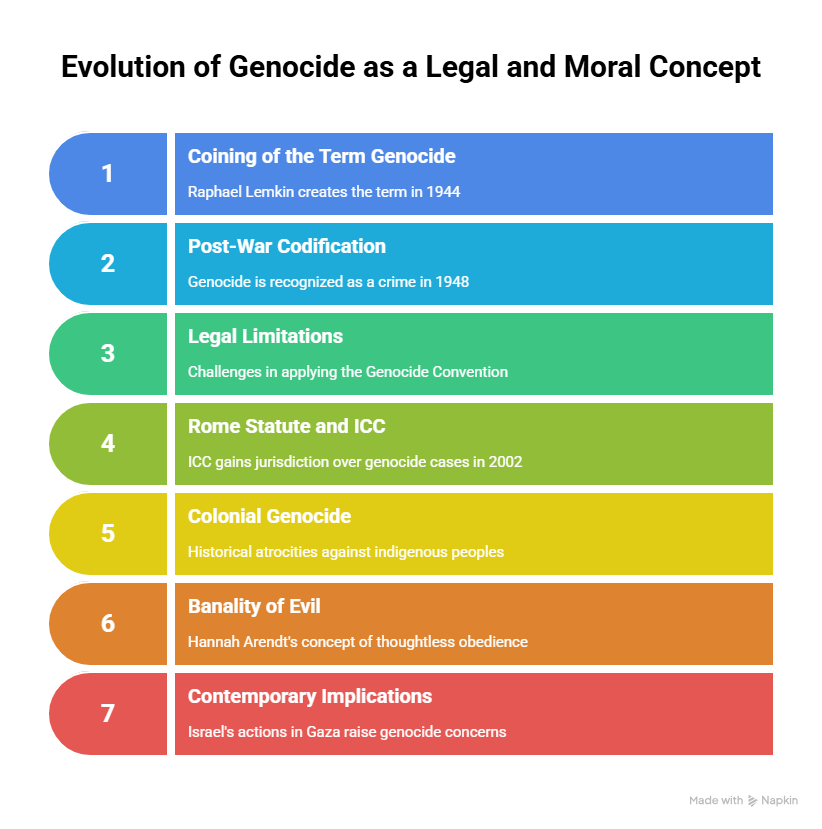
  • The term genocide was coined by Raphael Lemkin, a Polish-Jewish lawyer, in his 1944 work Axis Rule in Occupied Europe.
  • He formed the word using the Greek genos (race or tribe) and Latin cide (killing).
  • Lemkin’s personal loss during the Holocaust — where he lost 49 family members — intensified his efforts to codify genocide into international law.

Post-War Codification

  • After World War II, Lemkin advocated for genocide to be recognized as a unique and prosecutable crime.
  • His efforts culminated in the 1948 UN Convention on the Prevention and Punishment of the Crime of Genocide.
  • The Convention defines genocide using two elements:
    • Mental element: Intent to destroy, in whole or in part, a national, ethnical, racial, or religious group.
    • Physical element: Acts like killing, inflicting serious harm, or forcibly transferring children.

Challenges in Application and Jurisprudence

Legal Limitations

  • The Genocide Convention excludes political and social groups from its definition — a limitation criticized by genocide scholars.
  • Proving genocidal intent is difficult, as perpetrators rarely declare such intent openly.
  • Nonetheless, patterns of systematic action have been accepted in jurisprudence, notably in the Rwanda (1994) and Srebrenica (1995) genocides.

Rome Statute and the ICC

  • The 2002 Rome Statute gives the International Criminal Court (ICC) jurisdiction over genocide cases.
  • However, geopolitical biases and power imbalances have led to selective enforcement, undermining justice.

Colonial Genocide and Unacknowledged Atrocities

  • Historical and ongoing atrocities against indigenous peoples — such as the Aboriginal child removals in Australia — remain under-recognized.
  • The colonial erasure of populations through slavery, forced deportation, and cultural destruction remains inadequately addressed in international legal discourse.

Moral Responsibility and the Role of Thinking

Hannah Arendt and the Banality of Evil

  • Philosopher Hannah Arendt introduced the concept of the “banality of evil” in her report on the trial of Adolf Eichmann, a Nazi bureaucrat.
  • Arendt argued that evil can be perpetrated by ordinary people who suspend their capacity to think and reflect morally.
  • Eichmann’s crime was not monstrous intentions, but his thoughtless obedience to the Nazi regime for bureaucratic efficiency.

Judith Butler’s Reflection

  • Philosopher Judith Butler emphasized that Arendt’s critique extended beyond Eichmann to the systemic erosion of thinking.
  • When thinking disappears, mass violence becomes routinized and acceptable, as seen in the ongoing normalization of violence in Gaza.

Contemporary Implications: Gaza and Global Conscience

  • Francesca Albanese’s report asserts that Israel’s military actions in Gaza reflect a pattern of intent and destruction meeting the threshold of genocide.
  • The international community’s moral and legal obligation is not just to debate terminology but to prevent and act under the Genocide Convention.
  • The real challenge lies in overcoming political inertia and recognising evil when it disguises itself as national interest or routine policy.

Conclusion

  • The evolution of genocide as a legal and moral concept underscores humanity’s struggle to name and act against extreme violence.
  • From Lemkin’s legal framework to Arendt’s philosophical insights, the call is clear: it is not enough to condemn genocides of the past; one must think, act, and intervene against those unfolding in the present.
  • As Gaza burns under global gaze, the question is not whether it is genocide — but whether the world will respond to it as such.

Economic Implications

For Indian Exporters

  • These reforms reduce transaction costs and compliance hurdles
  • Encourage a more competitive and efficient export environment
  • Promote value addition in key sectors like leather

For Tamil Nadu

  • The reforms particularly benefit the state’s leather industry, a major contributor to employment and exports
  • Boost the marketability of GI-tagged E.I. leather, enhancing rural and traditional industries

For Trade Policy

  • These decisions indicate a shift from regulatory controls to policy facilitation

Reinforce the goals of Make in India, Atmanirbhar Bharat, and India’s ambition to become a leading export power

Recently, BVR Subrahmanyam, CEO of NITI Aayog, claimed that India has overtaken Japan to become the fourth-largest economy in the world, citing data from the International Monetary Fund (IMF). 

India’s rank as the world’s largest economy varies by measure—nominal GDP or purchasing power parity (PPP)—each with key implications for economic analysis.

Significance and Applications

Leave a Reply

Your email address will not be published. Required fields are marked *

Call Us Now !

Copyright © JICE ACADEMY FOR EXCELLENCE PRIVATE LIMITED