UPSC CURRENT AFFAIRS – 30th July 2025
Grassland Bird Census in Kaziranga
Why in News?
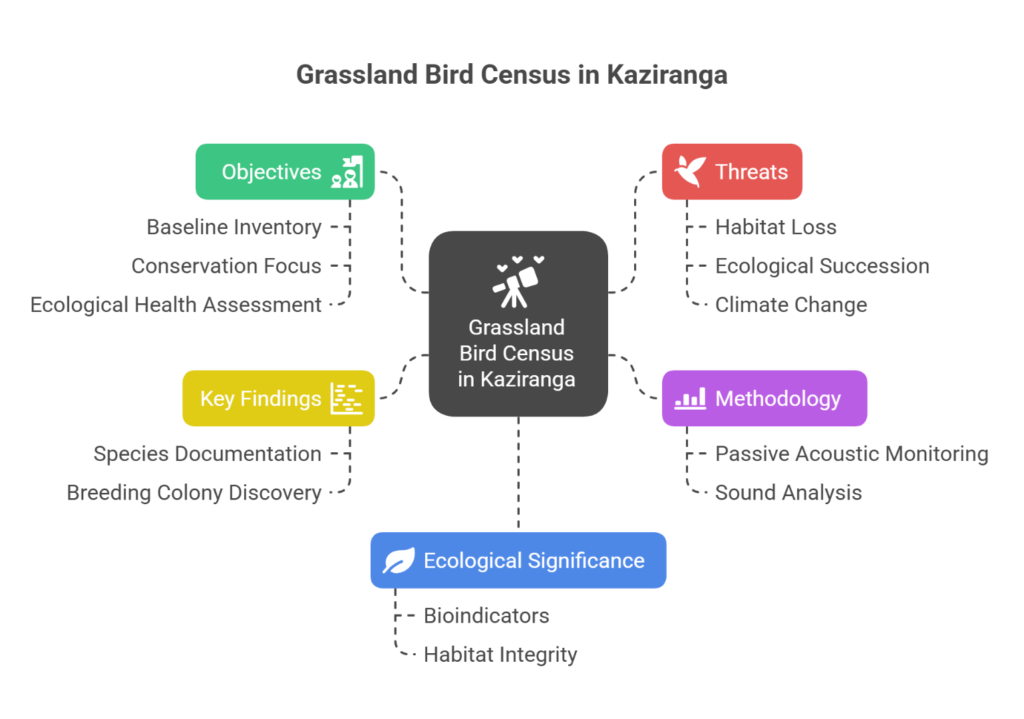
- The first-ever Grassland Bird Census in Kaziranga National Park (2025) used passive acoustic monitoring to document rare and endemic bird species.
Introduction
- In his Mann Ki Baat address, Prime Minister Narendra Modi highlighted a significant conservation initiative—the first-ever Grassland Bird Census conducted in Kaziranga National Park, Assam.
- The census is notable for its application of acoustic technology and its focus on recording and understanding the distribution of grassland-dependent bird species, many of which are threatened or endemic.
What is the Grassland Bird Census in Kaziranga?
- The census was conducted between March 18 and May 25, 2025, within the boundaries of Kaziranga National Park.
- It aimed to document the presence, diversity, and relative abundance of bird species that inhabit the park’s grassland ecosystems.
- The initiative was led by Chiranjib Bora, a doctoral scholar studying the Black-breasted Parrotbill, a threatened grassland species. Bora received the INSPIRE fellowship from the Department of Science and Technology, Government of India, which supported the use of passive acoustic monitoring technology in the field.
- Realizing the broader conservation potential, the research team expanded the effort to include a systematic survey of all grassland birds in the park. This was particularly relevant since approximately 70 percent of Kaziranga’s landscape consists of grasslands.
Objectives of the Census:
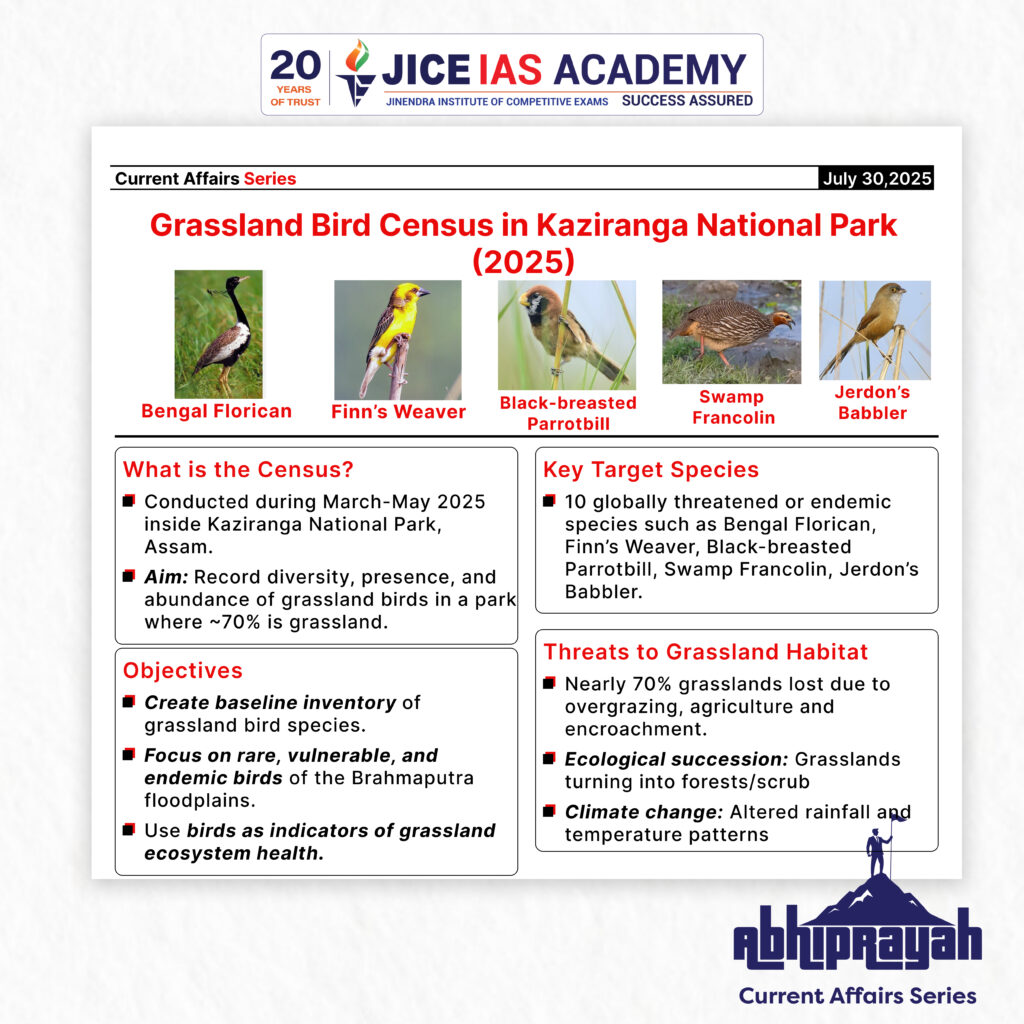
- To establish a baseline inventory of grassland bird species inhabiting the park.
- To focus conservation attention on rare and vulnerable species, particularly that endemic to the Brahmaputra floodplain.
- To assess the ecological health of the park’s grassland ecosystems through the presence or absence of indicator bird species.
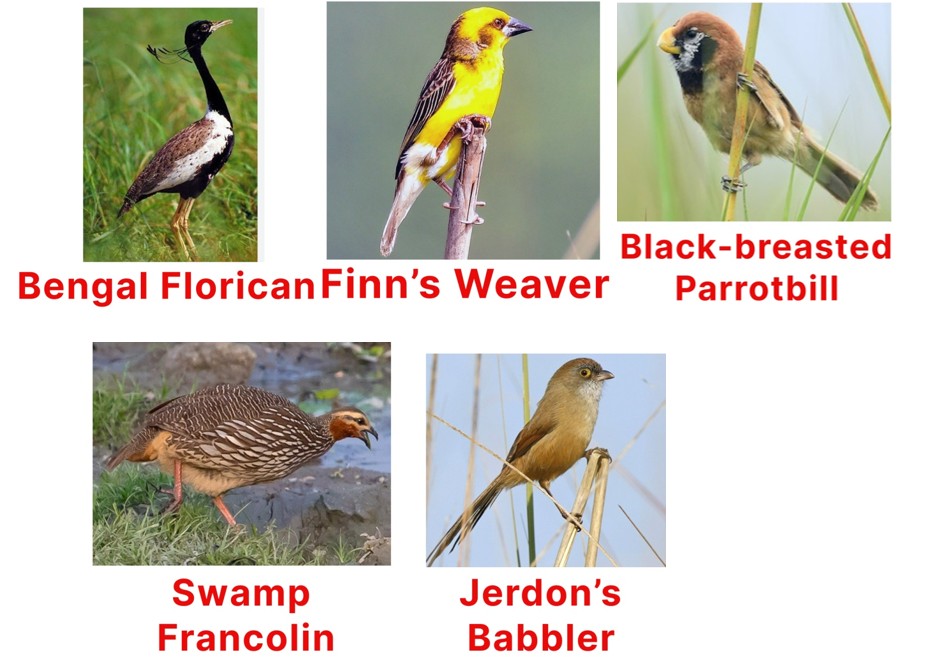
The census prioritized ten species considered globally threatened or endemic to the floodplain, including the Bengal Florican, Swamp Francolin, Finn’s Weaver, Swamp Grass Babbler, Jerdon’s Babbler, Slender-billed Babbler, Black-breasted Parrotbill, Marsh Babbler, Bristled Grassbird, and Indian Grassbird.
Key Findings:
The survey documented 43 species of grassland birds, including:
- 1 Critically Endangered species (Bengal Florican)
- 2 Endangered species
- 6 Vulnerable species (as per the IUCN Red List)
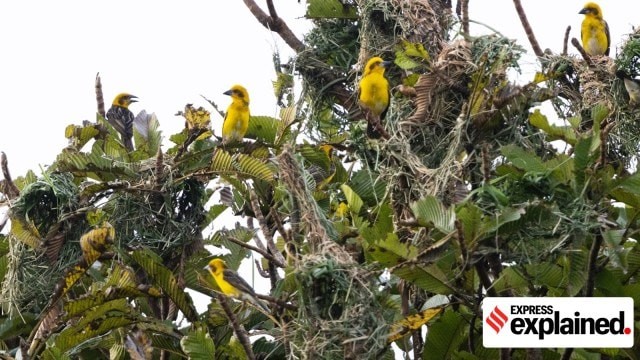
A particularly significant discovery was the identification of a breeding colony of over 85 nests of the Finn’s Weaver, a rare and endangered species endemic to the Brahmaputra floodplains. Prior to this survey, its nesting sites in the wild were largely undocumented.
Ecological Significance:
- Grassland birds serve as bioindicators of habitat quality. Their presence or absence can reveal much about the health and integrity of ecosystems.
- The continued survival of these birds signifies that the habitat is still supporting species with highly specialized ecological niches. Conversely, their decline signals deterioration or transformation of grassland habitats.
Threats to Grassland Birds and Their Habitats:
Habitat Loss:
Over the last four decades, Assam has lost nearly 70 percent of its grasslands. This is primarily due to:
- Overgrazing by domestic livestock
- Conversion of grasslands into agricultural fields
- Encroachment and land-use change
Ecological Succession:
- In the absence of active management, grasslands tend to naturally transition into woodlands or scrub forests, a process known as ecological succession.
- While this is a natural phenomenon, it poses a direct threat to grassland specialist species, which cannot survive in altered habitats.
Climate Change:
- Climate-related changes, including shifts in rainfall and temperature patterns, may be contributing to the decline of certain species.
- For instance, the Bengal Florican, once seen more frequently, was recorded only once or twice during this census.
- Further studies are required to determine the specific drivers of such population declines.

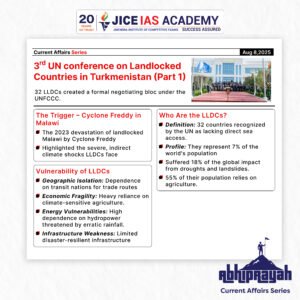
3rd UN conference on landlocked countries
UPSC CURRENT AFFAIRS – 08th August 2025 Home / 3rd UN conference on landlocked countries Why in News? At the
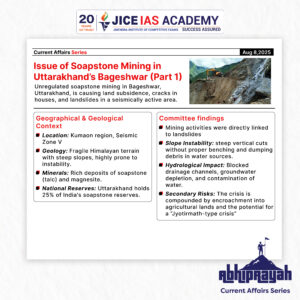
Issue of soapstone mining in Uttarakhand’s Bageshwar
UPSC CURRENT AFFAIRS – 08th August 2025 Home / Issue of soapstone mining in Uttarakhand’s Bageshwar Why in News? Unregulated

Groundwater Pollution in India – A Silent Public Health Emergency
UPSC CURRENT AFFAIRS – 08th August 2025 Home / Groundwater Pollution in India – A Silent Public Health Emergency Why

Universal banking- need and impact
UPSC CURRENT AFFAIRS – 08th August 2025 Home / Universal banking- need and impact Why in News? The Reserve Bank

India’s “Goldilocks” Economy: A Critical Appraisal
UPSC CURRENT AFFAIRS – 08th August 2025 Home / India’s “Goldilocks” Economy: A Critical Appraisal Why in News? The Finance

U.S.-India Trade Dispute: Trump’s 50% Tariffs and India’s Oil Imports from Russia
UPSC CURRENT AFFAIRS – 07th August 2025 Home / U.S.-India Trade Dispute: Trump’s 50% Tariffs and India’s Oil Imports from
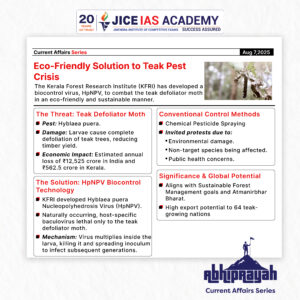
Eco-Friendly Solution to Teak Pest Crisis: KFRI’s HpNPV Technology
UPSC CURRENT AFFAIRS – 07th August 2025 Home / Eco-Friendly Solution to Teak Pest Crisis: KFRI’s HpNPV Technology Why in

New Species of Non-Venomous Rain Snake Discovered in Mizoram
UPSC CURRENT AFFAIRS – 07th August 2025 Home / New Species of Non-Venomous Rain Snake Discovered in Mizoram Why in

Introduction
Economic Implications
For Indian Exporters
- These reforms reduce transaction costs and compliance hurdles
- Encourage a more competitive and efficient export environment
- Promote value addition in key sectors like leather
For Tamil Nadu
- The reforms particularly benefit the state’s leather industry, a major contributor to employment and exports
- Boost the marketability of GI-tagged E.I. leather, enhancing rural and traditional industries
For Trade Policy
- These decisions indicate a shift from regulatory controls to policy facilitation
Reinforce the goals of Make in India, Atmanirbhar Bharat, and India’s ambition to become a leading export power
Recently, BVR Subrahmanyam, CEO of NITI Aayog, claimed that India has overtaken Japan to become the fourth-largest economy in the world, citing data from the International Monetary Fund (IMF).
India’s rank as the world’s largest economy varies by measure—nominal GDP or purchasing power parity (PPP)—each with key implications for economic analysis.