UPSC CURRENT AFFAIRS – 15th June 2025
IAEA Non-Compliance Resolution Against Iran: Implications for Tehran and Global Security
Why in News?
On June 12, 2025, the IAEA Board of Governors passed a non-compliance resolution against Iran, citing its failure to meet obligations under the 1974 Comprehensive Safeguards Agreement (CSA). This marks the first formal declaration of breach—paving the way for potential referral to the U.N. Security Council.
Key Highlights
- The resolution declares Iran in breach of CSA obligations.
- 35-member Board vote:
- In favour: Majority
- Against: China, Russia, Venezuela
- Abstentions: 11 countries
- Israel launched preliminary military strikes on Iranian nuclear sites on June 13, citing security concerns.
- Iran dismissed the resolution as “political” and announced counter-measures including:
- A new underground enrichment complex
- Centrifuge upgrades at Fordow
- Increased air defence readiness
- Alleged deployment of drones
2015 JCPOA (Joint Comprehensive Plan of Action)
- The JCPOA was signed on July 14, 2015, between Iran and the P5+1 countries (U.S., U.K., France, Russia, China, and Germany) along with the European Union.
- The main objective of the deal was to limit Iran’s nuclear program and ensure it remained peaceful, in exchange for lifting international sanctions.
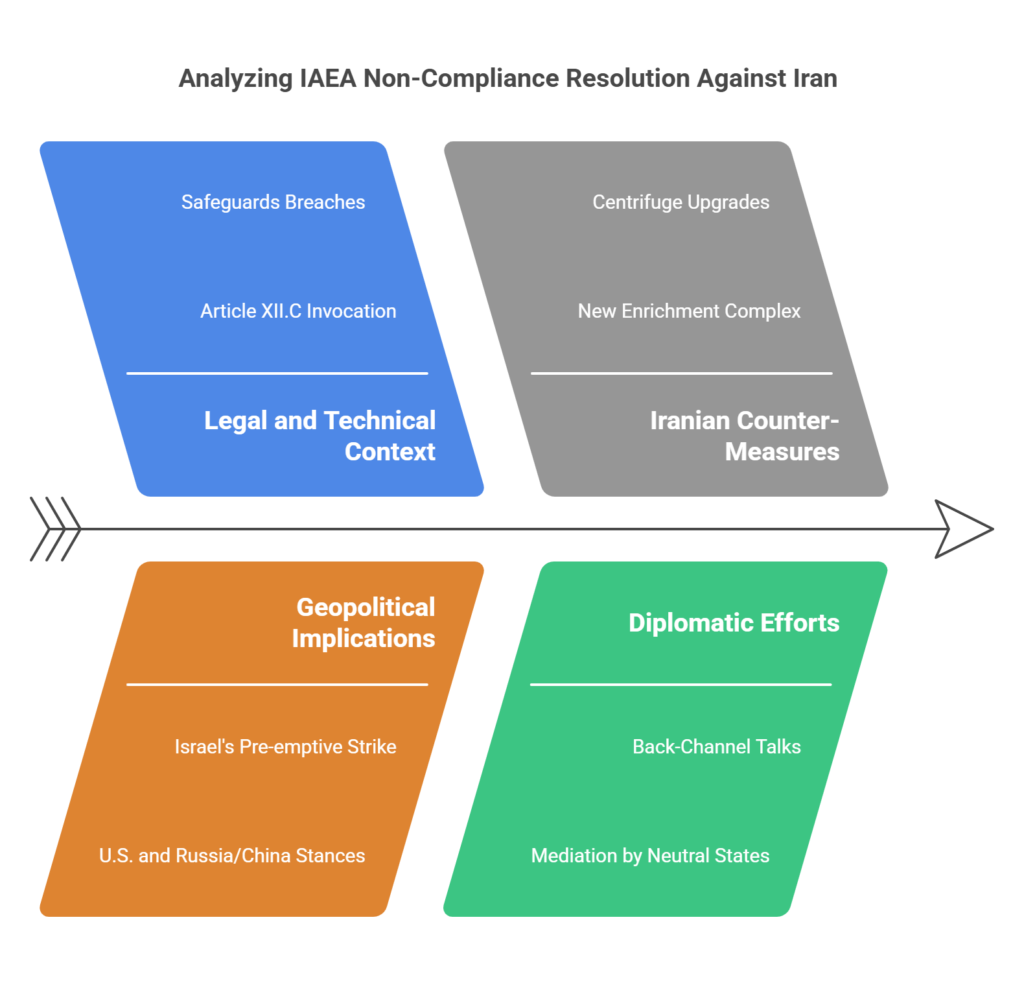
Legal and Technical Context
- Article XII.C of IAEA Statute invoked—previously used against Iraq (1991), Libya (2004), Syria (2011), etc.
- Under this, IAEA can:
- Recommend remedial actions
- Suspend technical cooperation
- Report to U.N. Security Council
- Iran is accused of withholding explanations for enriched uranium traces at Lavisan-Shian, Varamin, Turquzabad.
Safeguards Breaches
Iran failed to:
- Declare nuclear materials and facilities as required.
- Permit routine and ad hoc inspections.
- Maintain surveillance systems at declared sites.
The IAEA said it cannot verify that nuclear material has not been diverted for weapons use.
Next Steps
- Iran was given a “reasonable” window to respond.
- If unsatisfactory, Board may escalate issue to U.N. Security Council, which could:
- Demand compliance
- Impose or restore sanctions (especially after October 18, 2025, when 2015 deal waivers expire)
A follow-up report expected in September 2025
Geopolitical Implications
- Israel’s pre-emptive strike raises fears of wider regional conflict.
- U.S. backs special inspections; Russia and China may oppose escalation.
- IAEA chief Grossi has offered technical dialogue but remains cautious.
Significance
- Highlights the erosion of the 2015 JCPOA nuclear deal.
- Reflects growing distrust between Iran and the international community.
- Tests the credibility and enforcement capacity of multilateral nuclear governance.
Way Forward
- Diplomacy via back-channel talks (e.g., Oman) must be revived to prevent escalation.
- A balanced approach is essential: upholding non-proliferation norms while avoiding armed confrontation.
- India and other neutral states can play a constructive mediating role in de-escalation.

3rd UN conference on landlocked countries
UPSC CURRENT AFFAIRS – 08th August 2025 Home / 3rd UN conference on landlocked countries Why in News? At the
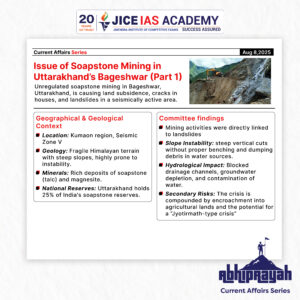
Issue of soapstone mining in Uttarakhand’s Bageshwar
UPSC CURRENT AFFAIRS – 08th August 2025 Home / Issue of soapstone mining in Uttarakhand’s Bageshwar Why in News? Unregulated
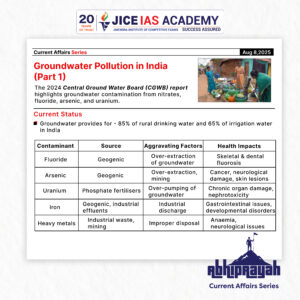
Groundwater Pollution in India – A Silent Public Health Emergency
UPSC CURRENT AFFAIRS – 08th August 2025 Home / Groundwater Pollution in India – A Silent Public Health Emergency Why
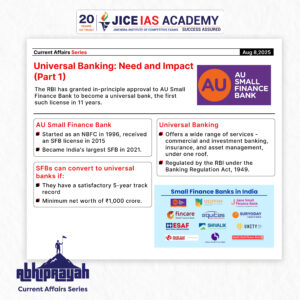
Universal banking- need and impact
UPSC CURRENT AFFAIRS – 08th August 2025 Home / Universal banking- need and impact Why in News? The Reserve Bank
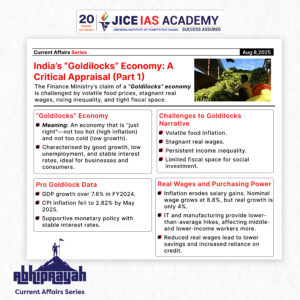
India’s “Goldilocks” Economy: A Critical Appraisal
UPSC CURRENT AFFAIRS – 08th August 2025 Home / India’s “Goldilocks” Economy: A Critical Appraisal Why in News? The Finance
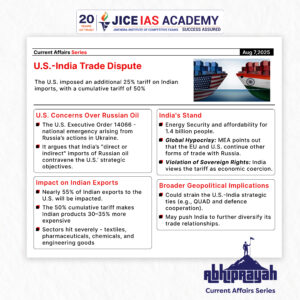
U.S.-India Trade Dispute: Trump’s 50% Tariffs and India’s Oil Imports from Russia
UPSC CURRENT AFFAIRS – 07th August 2025 Home / U.S.-India Trade Dispute: Trump’s 50% Tariffs and India’s Oil Imports from
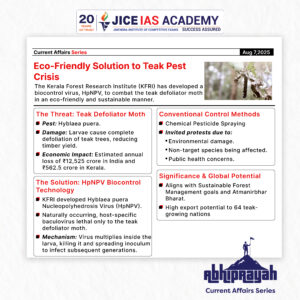
Eco-Friendly Solution to Teak Pest Crisis: KFRI’s HpNPV Technology
UPSC CURRENT AFFAIRS – 07th August 2025 Home / Eco-Friendly Solution to Teak Pest Crisis: KFRI’s HpNPV Technology Why in

New Species of Non-Venomous Rain Snake Discovered in Mizoram
UPSC CURRENT AFFAIRS – 07th August 2025 Home / New Species of Non-Venomous Rain Snake Discovered in Mizoram Why in

Economic Implications
For Indian Exporters
- These reforms reduce transaction costs and compliance hurdles
- Encourage a more competitive and efficient export environment
- Promote value addition in key sectors like leather
For Tamil Nadu
- The reforms particularly benefit the state’s leather industry, a major contributor to employment and exports
- Boost the marketability of GI-tagged E.I. leather, enhancing rural and traditional industries
For Trade Policy
- These decisions indicate a shift from regulatory controls to policy facilitation
Reinforce the goals of Make in India, Atmanirbhar Bharat, and India’s ambition to become a leading export power
Recently, BVR Subrahmanyam, CEO of NITI Aayog, claimed that India has overtaken Japan to become the fourth-largest economy in the world, citing data from the International Monetary Fund (IMF).
India’s rank as the world’s largest economy varies by measure—nominal GDP or purchasing power parity (PPP)—each with key implications for economic analysis.