


UPSC CURRENT AFFAIRS – 02nd August 2025

Home / UPSC / Current Affairs / ICJ’s Landmark Advisory Opinion on Climate Change

ICJ’s Landmark Advisory Opinion on Climate Change

Why in News?

  • On July 23, 2024, the International Court of Justice (ICJ) issued a landmark advisory opinion reaffirming states’ legal obligations to mitigate climate change and support vulnerable nations.

Introduction

  • On July 23, 2024, the International Court of Justice (ICJ) delivered a historic advisory opinion that reaffirmed the legal obligations of states to mitigate climate change, reduce greenhouse gas (GHG) emissions, and support vulnerable nations. Although advisory and non-binding in nature, the ruling has significant legal, political, and symbolic implications in the global fight against climate change.

Background Context

  • The opinion came in response to a request led by Vanuatu and backed by over 130 countries.
  • It builds upon international legal instruments like the Paris Agreement (2015) and UNFCCC (1992).
  • It seeks to clarify the legal responsibilities of states under international environmental law, human rights law, and customary international law in the face of the climate crisis.

Key Highlights of the Ruling

  • Reaffirms the duty of states to prevent environmental harm beyond their borders (transboundary principle).
  • Asserts that climate change mitigation is a shared global obligation, but also recognizes differentiated responsibilities.
  • Supports the 1.5°C target from the Paris Agreement as a critical threshold to avoid catastrophic impacts.
  • Emphasizes intergenerational equity, linking climate action to human rights frameworks.

Debate Over the Ruling: Key Voices and Issues

  1. Ted Nordhaus (Environmental Policy Analyst, Ecomodernist)

Critical of the ruling’s practical enforceability:

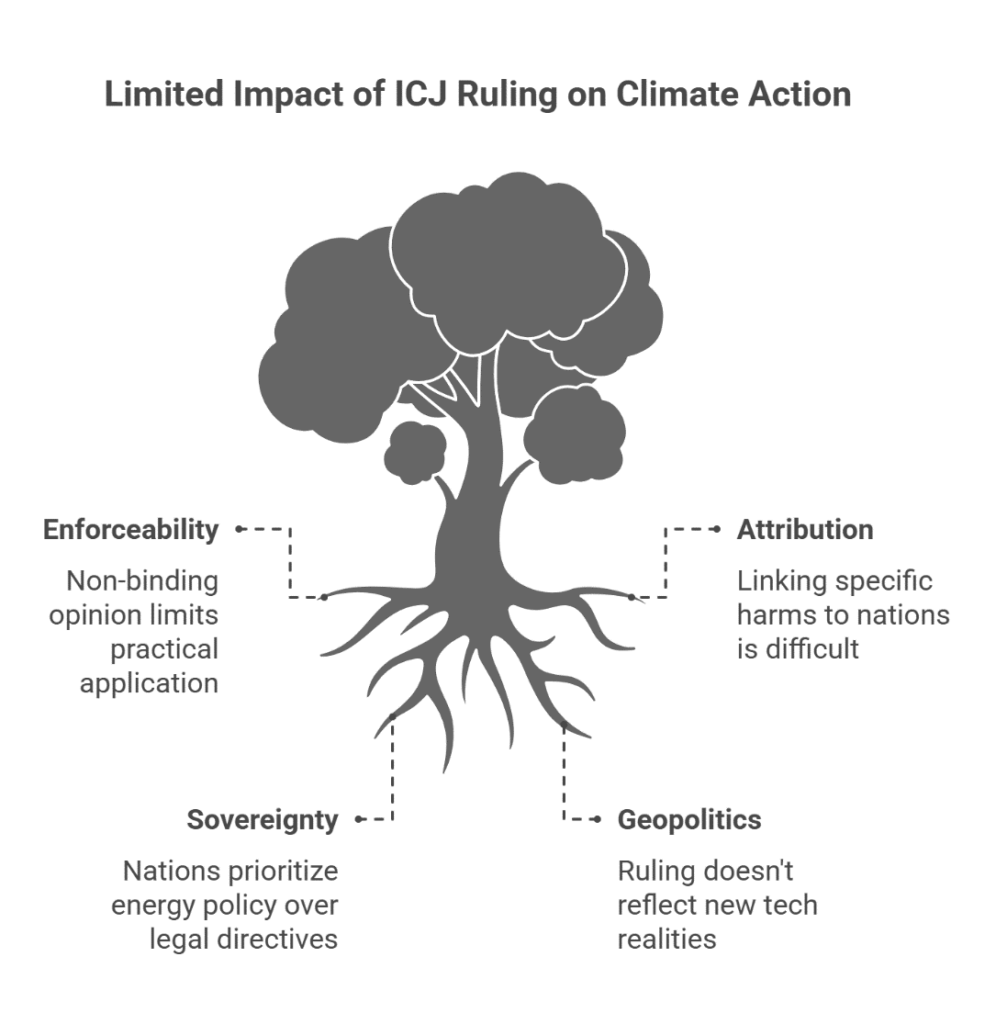
  • Points to the scientific attribution challenge: Difficult to attribute specific extreme events or harms directly to the failure of a single nation.
  • Questions the ability of international law to enforce liability or compel reparations.
  • Notes that global warming at 1–1.5°C amplifies existing phenomena, not necessarily creating new ones — making litigation complex.
  • Stresses national sovereignty: Major emitters like the US, China, and India are unlikely to comply with international legal directives that interfere with energy policy.

On Historical Emissions:

  • Historical responsibility has symbolic weight but lacks legal teeth or enforceability.
  • Sovereign nations will not overhaul energy systems due to external legal pressures.
  1. Anand Grover (Human Rights Lawyer and Former UN Special Rapporteur)

Sees legal and political value despite limitations:

  • Agrees that causality is hard to establish in court, making direct reparations unlikely.
  • But emphasizes that the ICJ opinion can strengthen domestic legal actions, especially in climate-vulnerable nations.
  • Believes the ruling can empower civil society and courts in the Global South to hold governments accountable.

On Sovereignty and Global Equity:

  • Criticizes the double standards of the Global North — e.g., the US backing out of the Paris Agreement while subsidizing fossil fuels.
  • Highlights that environmental justice norms are often used selectively by powerful states.

Implications for Climate Reparations

Can the ICJ Ruling Force Rich Nations to Pay?

  • No, according to both experts. The ruling:
    • Is non-binding and lacks enforcement mechanisms.
    • Does not prescribe specific emission targets or compensation mechanisms.
    • Cannot override the UN Security Council, where major powers have veto powers.
  • Loss and Damage Fund, established under COP27, also suffers from limited contributions and political will.
  • Developing countries hoping for large-scale reparations through international law are likely to be disappointed.

Legal vs. Political vs. Developmental Pathways

Legal:

  • ICJ’s ruling provides moral legitimacy and legal basis for national-level litigation.
  • Courts in countries with strong environmental jurisprudence (e.g., Netherlands, India pre-2015) may use it to pressure governments.
  • However, increasing politicisation of judiciary (e.g., in India and US) may undermine this potential.

Political:

  • The ruling may be seen as a symbolic nudge rather than a transformational moment.
  • Developed nations are unlikely to change their policies significantly due to this ruling.

Developmental:

  • Nordhaus argues that relying on reparations or international frameworks risks hindering domestic development goals.
  • Advocates for technological self-reliance, clean energy transitions driven by national interests — not international pressure.
  • Grover supports this but warns of corporate capture of energy transitions.

Changing Global Landscape: Shift from 1990s Frameworks

  • The UNFCCC framework of 1992, with its idea of common but differentiated responsibilities (CBDR) and technology transfer, is increasingly outdated.
  • Today, technology flows are multi-directional:
    • China is leading in clean technology exports.
    • India is emerging as a player.
  • Hence, the ICJ ruling, grounded in older paradigms, may not reflect new geopolitical and technological realities.

Future Outlook and Strategy for Developing Nations

  • Stop waiting for reparations; act in national self-interest to reduce emissions.
  • Focus on:
    • Domestic clean energy investment.
    • Urban air pollution control (e.g., Delhi winters).
    • Resilience-building for climate adaptation.
  • Use ICJ ruling as a legal resource, not a political crutch.

Conclusion

The ICJ’s July 2024 advisory opinion is a significant symbolic and legal milestone, reaffirming the global responsibility to combat climate change. However, its lack of enforceability, the challenges of attribution, and geopolitical power dynamics limit its transformative potential. As both Ted Nordhaus and Anand Grover conclude, the real leverage lies within nations — in domestic courts, policy reforms, and technological innovations — not in the hope of legal enforcement or financial reparations from historical polluters.

Introduction

Economic Implications

For Indian Exporters

  • These reforms reduce transaction costs and compliance hurdles
  • Encourage a more competitive and efficient export environment
  • Promote value addition in key sectors like leather

For Tamil Nadu

  • The reforms particularly benefit the state’s leather industry, a major contributor to employment and exports
  • Boost the marketability of GI-tagged E.I. leather, enhancing rural and traditional industries

For Trade Policy

  • These decisions indicate a shift from regulatory controls to policy facilitation

Reinforce the goals of Make in India, Atmanirbhar Bharat, and India’s ambition to become a leading export power

Recently, BVR Subrahmanyam, CEO of NITI Aayog, claimed that India has overtaken Japan to become the fourth-largest economy in the world, citing data from the International Monetary Fund (IMF). 

India’s rank as the world’s largest economy varies by measure—nominal GDP or purchasing power parity (PPP)—each with key implications for economic analysis.

Significance and Applications

Leave a Reply

Your email address will not be published. Required fields are marked *

Call Us Now !

Copyright © JICE ACADEMY FOR EXCELLENCE PRIVATE LIMITED