UPSC CURRENT AFFAIRS – 5th June 2025

Home / UPSC / Current Affairs / India and Australia Strengthen Counterterrorism Cooperation

India and Australia Strengthen Counterterrorism Cooperation

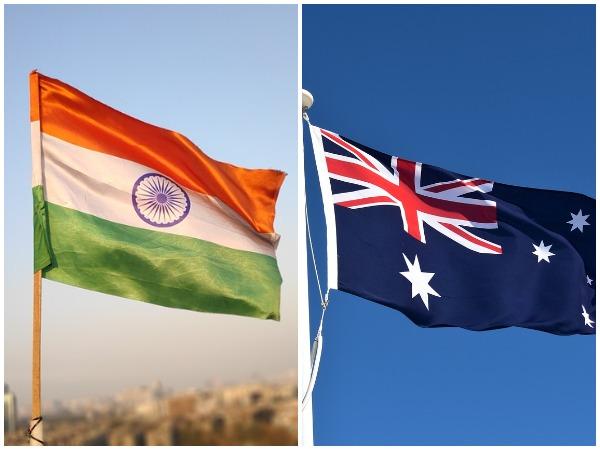
india and australia flags

Why in News?

  • India and Australia, on the occasion of the fifth anniversary of their Comprehensive Strategic Partnership (CSP), held a high-level bilateral meeting in New Delhi in June 2025. 

Background:

  • The India-Australia Comprehensive Strategic Partnership was launched in 2020 during a virtual summit between Prime Minister Narendra Modi and then Australian Prime Minister Scott Morrison. 
  • This partnership marked a significant elevation in bilateral relations and established new frameworks for cooperation in defence, economic engagement, education, maritime affairs, and climate action.

Key Areas of Defence and Strategic Cooperation

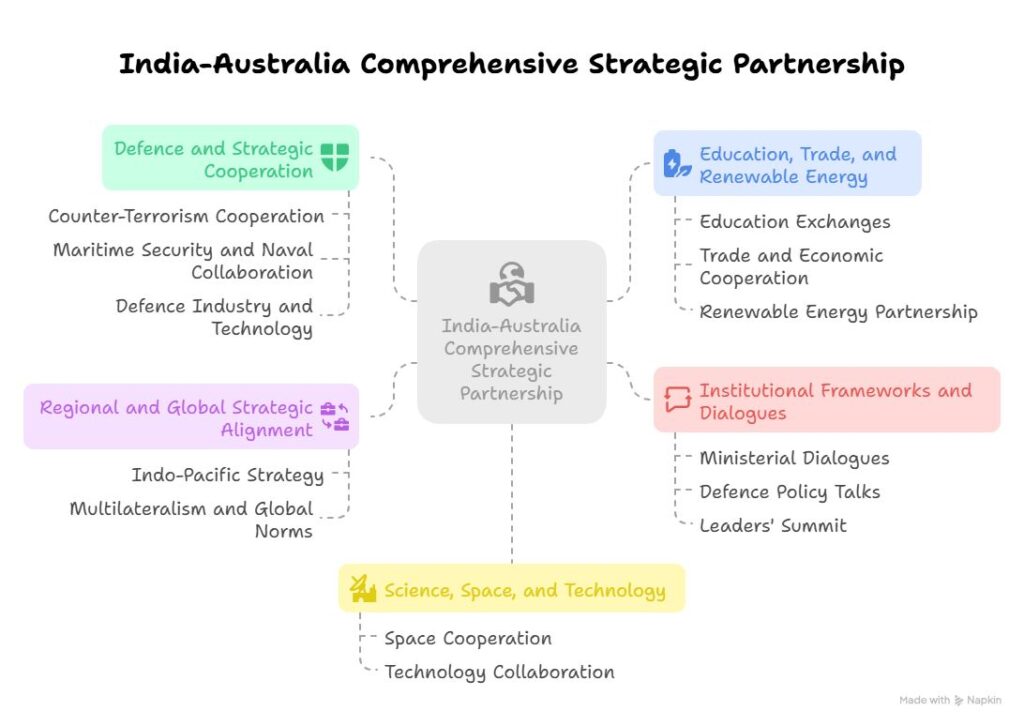
Counter-Terrorism Cooperation

  • Both countries unequivocally condemned the recent terror attack in Pahalgam, Jammu and Kashmir.
  • India reiterated its right to respond in self-defence against cross-border terrorism and highlighted its policy of making no distinction between terrorists and those who shelter them.
  • India conveyed concerns regarding any defence exports to Pakistan that might fall into the hands of terrorist entities.

Maritime Security and Naval Collaboration

  • Discussions focused on joint production of naval platforms and enhanced maritime cooperation.
  • India promoted its potential as a regional hub for ship repair and maintenance.
  • Both sides emphasized the importance of upholding freedom of navigation and the rule of law in the Indo-Pacific region.

Defence Industry and Technology

  • The two sides signed a new Australia-India Joint Research Project aimed at strengthening collaboration in defence science and technology.
  • The upcoming third India-Australia 2+2 Ministerial Dialogue, scheduled in Australia later in 2025, is expected to further these engagements.
  • Areas of cooperation include cyber security, hydrography, surveillance technologies, and new and emerging defence technologies.
india-australia comprehensive strategic partnership

Regional and Global Strategic Alignment

  • India and Australia share strategic convergence on maintaining a free, open, inclusive, and rules-based Indo-Pacific.
  • There was mutual agreement to collaborate in the Indian Ocean and Pacific Island regions to ensure peace, stability, and regional resilience.
  • Both nations reaffirmed their commitment to multilateralism and global norms-based order.

Developments in Science, Space and Technology

  • In February 2021, the Indian Space Research Organisation (ISRO) and the Australian Space Agency amended their earlier Memorandum of Understanding to broaden bilateral cooperation.
  • Key areas of space cooperation include satellite tracking, deep space missions, and joint research initiatives aligned with the Comprehensive Strategic Partnership framework.

Expansion of Cooperation in Education, Trade, and Renewable Energy

Education

  • Educational exchanges have grown substantially, with over 1.4 lakh Indian students enrolled in Australian universities in 2024.
  • Australian universities have established the first foreign branch campuses in India, signalling a major transformation in educational engagement.

Trade and Economic Cooperation

  • The signing of the India-Australia Economic Cooperation and Trade Agreement (ECTA) has provided momentum to bilateral trade and investment.
  • This agreement facilitates easier market access and strengthens economic interdependence.

Renewable Energy and Climate Cooperation

  • The India-Australia Renewable Energy Partnership supports India’s target of installing 10 million rooftop solar units by 2030.
  • Australia’s expertise in clean energy is expected to contribute significantly to India’s energy transition goals.

Institutional Frameworks and Dialogues

  • The second India-Australia 2+2 Ministerial Dialogue was held in November 2023, with the third expected in 2025.
  • The ninth round of India-Australia Defence Policy Talks took place in March 2025 in New Delhi.
  • The Annual Leaders’ Summit (November 2024) and Secretary-level inter-sessional consultations (October 2024) have ensured continuous engagement and review of progress across sectors.

Strategic Significance for India

Area

Strategic Implication

Defence Cooperation

Enhances India’s indigenous defence manufacturing capabilities and maritime presence

Counter-Terrorism

Strengthens India’s diplomatic efforts against global terrorism

Indo-Pacific Strategy

Reinforces India’s role as a key actor in maintaining regional stability

Education and Human Capital

Deepens people-to-people ties and facilitates skill development

Renewable Energy

Aids in achieving national targets for clean energy and sustainability

Way Forward

  • India and Australia should deepen joint defence production initiatives and increase military-to-military engagements.
  • Both sides must institutionalize collaboration in cybersecurity and emerging technologies to counter new-age threats.
  • Enhanced coordination in Indo-Pacific maritime surveillance and humanitarian assistance missions can promote regional peace.
  • Expanding collaboration in the green economy, including green hydrogen and battery technologies, will benefit both nations.
  • Education and research partnerships should be broadened to include vocational training and digital education delivery.

Economic Implications

For Indian Exporters

  • These reforms reduce transaction costs and compliance hurdles
  • Encourage a more competitive and efficient export environment
  • Promote value addition in key sectors like leather

For Tamil Nadu

  • The reforms particularly benefit the state’s leather industry, a major contributor to employment and exports
  • Boost the marketability of GI-tagged E.I. leather, enhancing rural and traditional industries

For Trade Policy

  • These decisions indicate a shift from regulatory controls to policy facilitation

Reinforce the goals of Make in India, Atmanirbhar Bharat, and India’s ambition to become a leading export power

Recently, BVR Subrahmanyam, CEO of NITI Aayog, claimed that India has overtaken Japan to become the fourth-largest economy in the world, citing data from the International Monetary Fund (IMF). 

India’s rank as the world’s largest economy varies by measure—nominal GDP or purchasing power parity (PPP)—each with key implications for economic analysis.

Significance and Applications

Leave a Reply

Your email address will not be published. Required fields are marked *

Call Us Now !

Copyright © JICE ACADEMY FOR EXCELLENCE PRIVATE LIMITED