
UPSC CURRENT AFFAIRS – 04th July 2025
India–Australia Joint Research Project
Why in News?
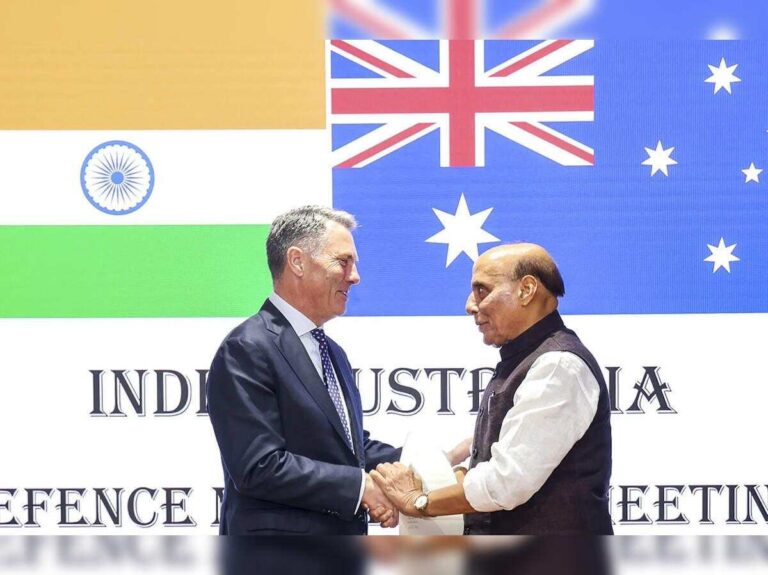
India and Australia have launched a three-year joint research project to enhance undersea surveillance technologies.
Introduction
- India and Australia have launched a three-year joint research project to enhance undersea surveillance technologies.
- It marks a significant step in bolstering maritime domain awareness and strategic defence cooperation between the two Indo-Pacific nations.
Key Objectives of the Project
- Early detection and tracking of submarines and autonomous underwater vehicles (AUVs).
- Development and refinement of Towed Array Target Motion Analysis (TMA) technologies.
- Enhancement of interoperability, efficiency, and reliability of current undersea surveillance systems.
Stakeholders Involved
- Defence Science and Technology Group (DSTG) – Australia’s defence research agency.
- Defence Research and Development Organisation (DRDO) – India’s apex defence R&D body.
- Specifically, the Naval Physical and Oceanographic Laboratory (NPOL) under DRDO.
Technological Components Involved
1. Target Motion Analysis (TMA):
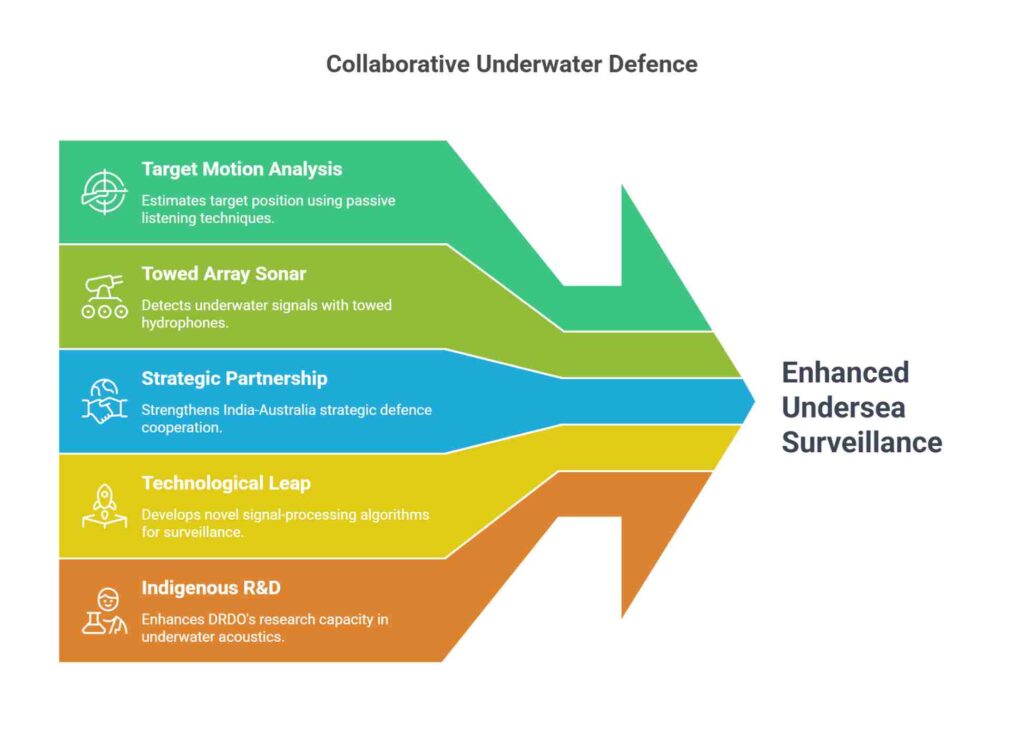
- A method to estimate the position, speed, and course of moving targets using passive listening techniques.
- Especially crucial when active sonar cannot be used due to stealth requirements.
- Involves sophisticated algorithms that analyse acoustic data to detect and track targets without revealing the host platform’s location.
2. Towed Array Sonar Systems:
- Consist of a long linear array of hydrophones (underwater microphones) towed behind a ship or submarine.
- These hydrophones detect acoustic signals from submarines, torpedoes, and underwater drones.
- The data is processed using signal processors to identify and classify threats.
The project uniquely combines TMA algorithms with towed array technology to address challenges such as noise corruption and to enhance the detection capabilities of passive sonar systems.
Benefits of the Project
- Operational Advantage: Strengthens Underwater Domain Awareness (UDA) critical for monitoring the increasingly crowded and contested undersea environment.
- Technological Leap: Joint development of novel signal-processing algorithms tailored for next-generation surveillance systems.
- Strategic Synergy: Builds on the growing India-Australia strategic partnership, especially in the Indo-Pacific region.
- Future Applications: Supports development of indigenous undersea combat systems by India with potential for co-production.
India-U.S. Parallel Developments
- In a related development, India and the U.S. have also identified Underwater Domain Awareness (UDA) technologies for co-production.
- This aligns with India’s efforts to build domestic capabilities through international technology collaboration.
Significance for India
- Boosts Indigenous R&D: Enhances DRDO’s research capacity in underwater acoustics.
- Supports Aatmanirbhar Bharat: Aids in self-reliance in defence technology by incorporating global best practices and innovation.
- Maritime Security: Enhances India’s ability to monitor adversary submarines and AUVs in the Indian Ocean Region (IOR).

3rd UN conference on landlocked countries
UPSC CURRENT AFFAIRS – 08th August 2025 Home / 3rd UN conference on landlocked countries Why in News? At the

Issue of soapstone mining in Uttarakhand’s Bageshwar
UPSC CURRENT AFFAIRS – 08th August 2025 Home / Issue of soapstone mining in Uttarakhand’s Bageshwar Why in News? Unregulated

Groundwater Pollution in India – A Silent Public Health Emergency
UPSC CURRENT AFFAIRS – 08th August 2025 Home / Groundwater Pollution in India – A Silent Public Health Emergency Why

Universal banking- need and impact
UPSC CURRENT AFFAIRS – 08th August 2025 Home / Universal banking- need and impact Why in News? The Reserve Bank

India’s “Goldilocks” Economy: A Critical Appraisal
UPSC CURRENT AFFAIRS – 08th August 2025 Home / India’s “Goldilocks” Economy: A Critical Appraisal Why in News? The Finance

U.S.-India Trade Dispute: Trump’s 50% Tariffs and India’s Oil Imports from Russia
UPSC CURRENT AFFAIRS – 07th August 2025 Home / U.S.-India Trade Dispute: Trump’s 50% Tariffs and India’s Oil Imports from

Eco-Friendly Solution to Teak Pest Crisis: KFRI’s HpNPV Technology
UPSC CURRENT AFFAIRS – 07th August 2025 Home / Eco-Friendly Solution to Teak Pest Crisis: KFRI’s HpNPV Technology Why in

New Species of Non-Venomous Rain Snake Discovered in Mizoram
UPSC CURRENT AFFAIRS – 07th August 2025 Home / New Species of Non-Venomous Rain Snake Discovered in Mizoram Why in

Economic Implications
For Indian Exporters
- These reforms reduce transaction costs and compliance hurdles
- Encourage a more competitive and efficient export environment
- Promote value addition in key sectors like leather
For Tamil Nadu
- The reforms particularly benefit the state’s leather industry, a major contributor to employment and exports
- Boost the marketability of GI-tagged E.I. leather, enhancing rural and traditional industries
For Trade Policy
- These decisions indicate a shift from regulatory controls to policy facilitation
Reinforce the goals of Make in India, Atmanirbhar Bharat, and India’s ambition to become a leading export power
Recently, BVR Subrahmanyam, CEO of NITI Aayog, claimed that India has overtaken Japan to become the fourth-largest economy in the world, citing data from the International Monetary Fund (IMF).
India’s rank as the world’s largest economy varies by measure—nominal GDP or purchasing power parity (PPP)—each with key implications for economic analysis.