UPSC CURRENT AFFAIRS – 18th May 2025

Home / UPSC / Current Affairs / India Curbs Bangladeshi Exports via Land Ports

India Curbs Bangladeshi Exports via Land Ports

india restricts bangladeshi exports via land ports

Why in News?

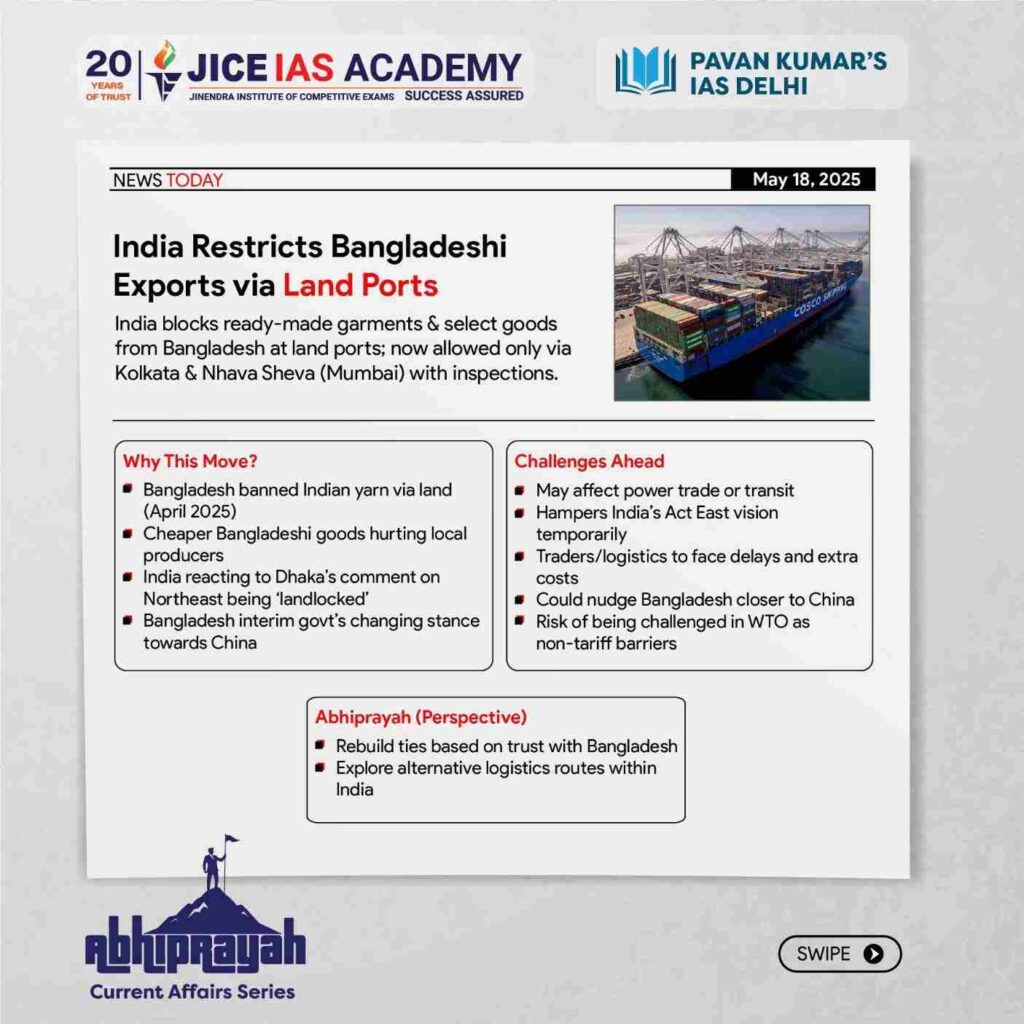
  • India has imposed restrictions on the import of ready-made garments and certain other items from Bangladesh through land ports. These commodities will now only be allowed through the sea ports of Kolkata and Nhava Sheva (Mumbai), with mandatory inspections.
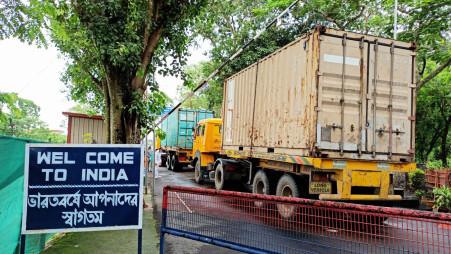
trucks on indian border

Key Highlights

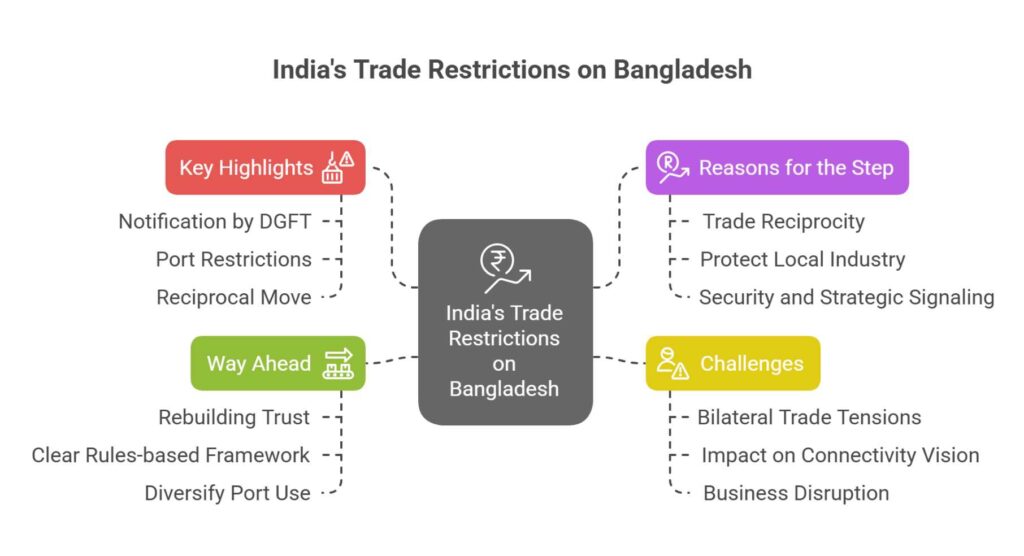
  • Notification issued by DGFT: All categories of Bangladeshi ready-made garments now restricted from entering via land customs stations (LCS) and integrated check posts (ICP).
  • Port restrictions extended: To products like plastics, wooden furniture, fruit drinks, confectionery, dyes, etc.
  • Reciprocal move: Comes after Bangladesh restricted Indian yarn imports via land ports (from April 13, 2025).
  • 93% impact: Nearly 93% of Bangladeshi ready-made garments enter India via land; the move directly affects major trade routes.
  • Geopolitical angle: Bangladesh’s new interim government remarks on Northeast India being “landlocked” and outreach to China triggered strategic concerns.

Background

  • Trade through Land Ports: India and Bangladesh had, especially under Sheikh Hasina (2009–2024), developed multiple land ports to enhance cross-border trade.
  • Textile Trade Tensions: Indian yarn exporters have faced hurdles due to sudden Bangladeshi restrictions at land ports.
  • Geostrategic Statements: Recent comments by interim Bangladeshi PM Muhammad Yunus have created concerns over India’s eastern regional connectivity and sovereignty.

Explaining the Changes

  • From Land to Sea: Export of ready-made garments (and other selected goods) from Bangladesh must now enter India only via Kolkata and Nhava Sheva ports.
  • Mandated Inspections: Sea-bound imports will be subject to additional checks.
  • Regional Focus: LCSs and ICPs in Assam, Tripura, Meghalaya, Mizoram, and northern West Bengal will no longer accept specified Bangladeshi imports.

Reasons for the Step

  1. Trade Reciprocity:
    • Bangladesh’s unilateral restriction on Indian yarn via land prompted a tit-for-tat move.
  2. Protect Local Industry:
    • Northeastern states raised concerns over competition from cheaper Bangladeshi goods like garments, juices, and furniture.
  3. Security and Strategic Signaling:
    • Comments undermining India’s access to the ocean via Northeast perceived as strategic provocation.
    • Desire to assert sovereignty and correct geopolitical narratives.
  4. Political Context in Bangladesh:
    • The interim regime has banned opposition and altered diplomatic alignments, affecting traditional India-Bangladesh trust.

Relevant Acts and Policies

  • Foreign Trade (Development and Regulation) Act, 1992: Empowers DGFT to regulate trade and issue notifications.
  • Make in India & Atmanirbhar Bharat Abhiyan: Indirect drivers of such protectionist trade recalibrations.
  • India–Bangladesh Border Management Framework (various MoUs): Affected due to unilateral steps by Dhaka.

Challenges

  • Bilateral Trade Tensions:
    • Risks retaliation from Dhaka, especially in other sectors like electricity or transit.
  • Impact on India’s Connectivity Vision:
    • NE India–Bangladesh trade corridors could suffer in short term.
  • Business Disruption:
    • Traders and logistics firms on both sides may face cost and time escalations.
  • Regional Diplomacy:
    • May push Bangladesh closer to China amid current political uncertainty.
  • Non-Tariff Barriers:
    • May invite WTO-related scrutiny if not managed within bilateral frameworks.

Way Ahead

  • Rebuilding Trust via Dialogue:
    • Reopen diplomatic channels post-elections in Bangladesh.
  • Clear Rules-based Framework:
    • Develop protocols for trade reciprocity and mutual inspections.
  • Diversify Port Use:
    • Modernize and shift some commerce to sea ports gradually to ensure long-term security and resilience.
  • Strengthen NE Infrastructure:
    • Invest in alternate logistics and supply chains within India’s Northeast.
  • Strategic Messaging:
    • India must assertively counter external narratives that question its access and status in the Indo-Pacific.

Conclusion

India’s decision to restrict Bangladeshi exports via land ports reflects a calibrated mix of economic self-interest, reciprocal trade diplomacy, and geostrategic signalling. While it aims to protect domestic industries and assert sovereignty, the move also highlights the delicate balancing act India must maintain with its neighbours in a changing regional order.

Leave a Reply

Your email address will not be published. Required fields are marked *

Call Us Now !

Copyright © JICE ACADEMY FOR EXCELLENCE PRIVATE LIMITED