UPSC CURRENT AFFAIRS – 21th May 2025

Home / UPSC / Current Affairs / India–Bangladesh Trade Tensions and Political Fallout

India–Bangladesh Trade Tensions and Political Fallout

india bangladesh trade tensions

Why in News?

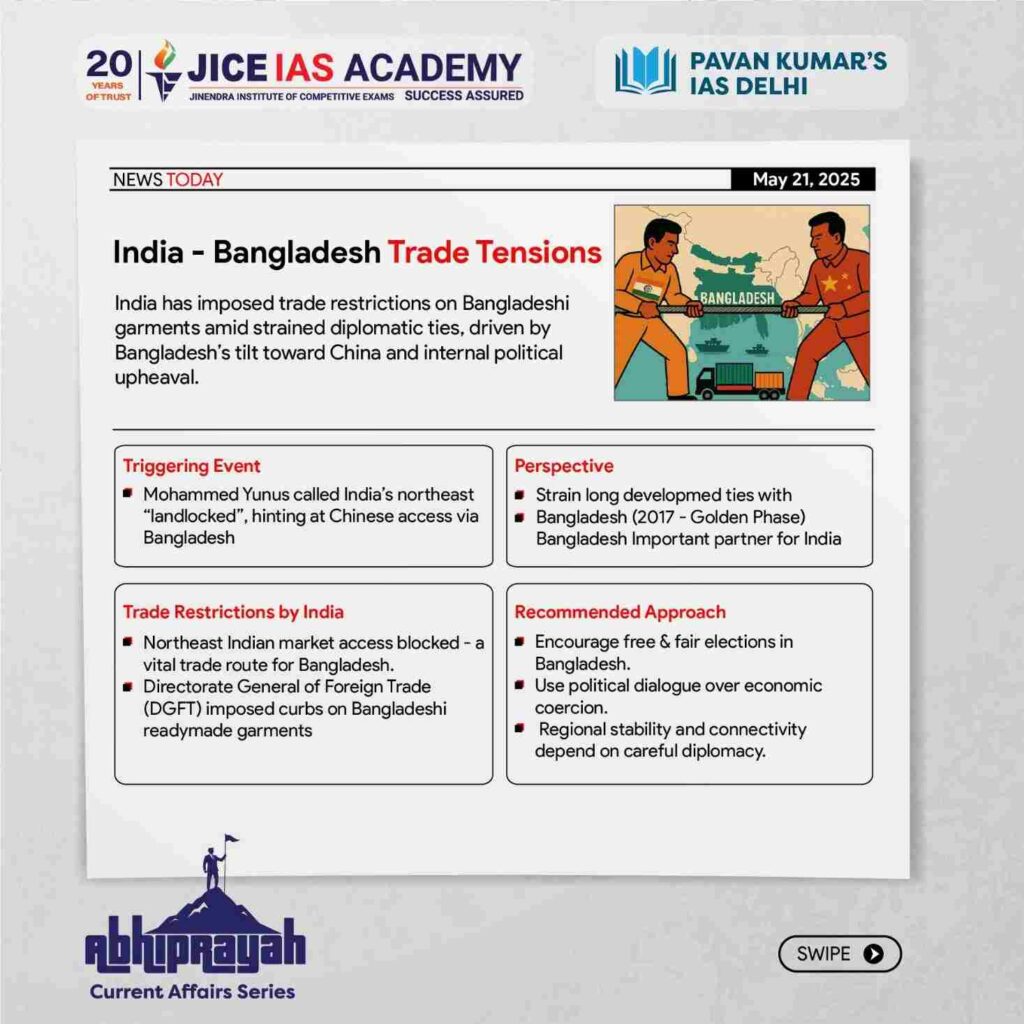
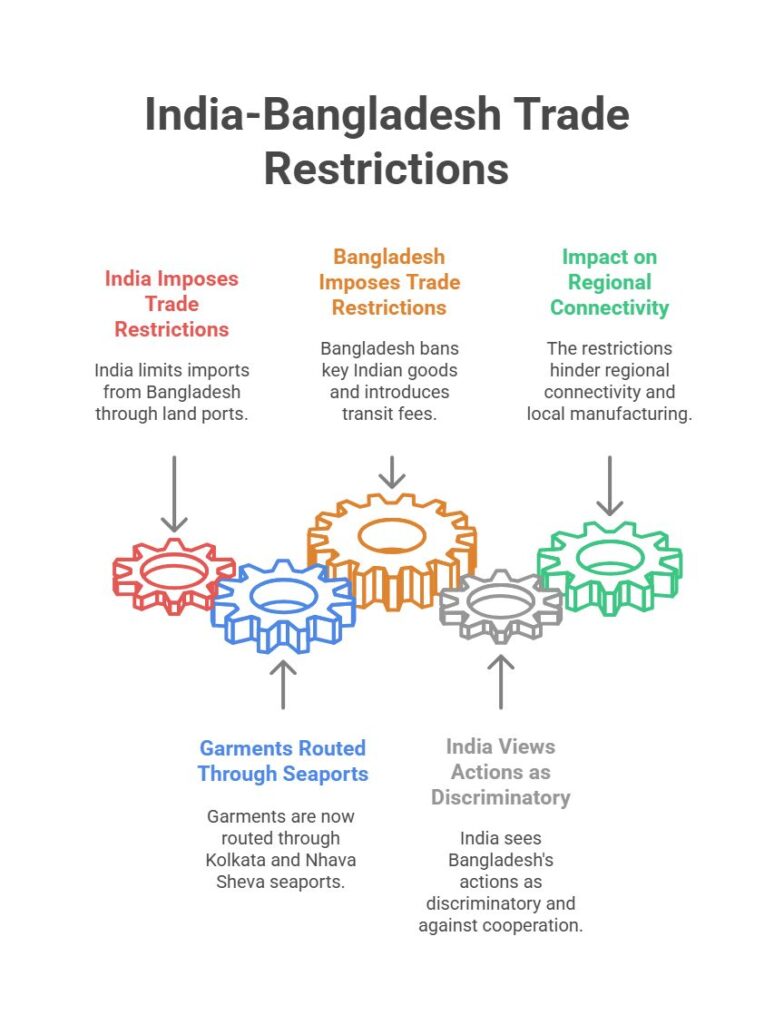
India has imposed trade restrictions on Bangladeshi garments and specific goods, signalling worsening bilateral relations following Dhaka’s increasing proximity to China and internal political instability.

india bangladesh trade tensions and political fallout

Key Highlights:

  1. Trade Restrictions:
    • The Directorate General of Foreign Trade (DGFT) imposed curbs on Bangladeshi readymade garments and specific commodities.
    • This move targets Bangladesh’s apparel export sector, a critical driver of its economy.
    • India also blocked access to the northeast market, a key outlet for Bangladeshi trade.


  1. Political Background:
    • The action followed interim Bangladeshi leader Mohammed Yunus’s March 2025 visit to China.
    • Yunus described India’s northeast as “landlocked”, suggesting Chinese access through Bangladesh — viewed as strategically provocative by India.


  1. Internal Political Shifts in Bangladesh:
    • Yunus’s interim government assumed power after anti-Awami League protests.
    • Its decisions — including banning the Awami League and increasing engagement with Pakistan and China — have strained ties with New Delhi.


  1. India’s Strategic Dilemma:
    • Trade restrictions may hurt Bangladeshi exports, but are unlikely to yield strategic gains.
    • They risk fueling anti-India narratives and instability in the northeast.
    • India must maintain functional ties with the interim government while pushing for democratic transition.


  1. Recommended Approach:
    • India should encourage free and fair elections in Bangladesh, aligning with international norms.
    • Political engagement, not economic coercion, is the sustainable way forward.
    • Broader regional stability and connectivity are at stake.
india bangladesh trade restrictions

Background: India–Bangladesh Relations in Recent Years

  1. Strong Bilateral Ties Under Sheikh Hasina (2009–2024):
    • India and Bangladesh witnessed a “golden era” in relations under Prime Minister Sheikh Hasina.
    • Land Boundary Agreement (2015) and border management cooperation were landmark achievements.
    • India supported Bangladesh’s development goals, supplying vaccines, power, and credit lines.


  2. Trade and Connectivity Boost:
    • Bangladesh is India’s largest trading partner in South Asia.
    • Bilateral trade crossed USD 18 billion in 2022–23.
    • Key projects include:
      • BBIN Motor Vehicles Agreement
      • Maitree power projects
      • Chattogram and Mongla port access for Indian goods


  3. Challenges Emerge (2024–2025):
    • Political transition and instability in Dhaka post-Hasina created uncertainty.
    • India’s perceived closeness to the Awami League has led to suspicion from the interim regime.
    • China’s growing footprint in Bangladesh, including infrastructure and defense ties, has further complicated India’s strategic calculus.

India’s Broader Concerns:

  1. Strategic Concern – Countering China’s Influence:
    • Bangladesh’s growing proximity to China, especially proposals for Chinese access to India’s northeastern region via Bangladeshi territory, raises alarms for India.
    • It threatens to undermine India’s Act East Policy, strategic depth, and regional balance of power in South Asia.
    • China’s inroads into infrastructure, ports, and telecom in Bangladesh mirror its string-of-pearls strategy elsewhere.

  1. Security Concern – Border Stability and Internal Peace:
    • India shares a 4,096-km border with Bangladesh — the longest land border it shares with any country.
    • Political instability in Bangladesh could spill over into India’s northeast, fostering:
      • Cross-border infiltration
      • Radicalization and communal tensions
      • Illicit trade and arms smuggling
    • Maintaining a stable and cooperative border regime is critical for India’s internal security architecture.

  1. Diplomatic Concern – Navigating a Volatile Transition:
    • With Bangladesh in political flux, India must avoid appearing partisan while preserving long-term goodwill.
    • Overt pressure or punitive trade moves could backfire, strengthening anti-India narratives.
    • India must balance firm signaling with constructive engagement, leveraging its regional leadership role, soft power, and track record of democratic support.
  1. Strategic Concern – Countering China’s Influence:
  • Bangladesh’s growing proximity to China, especially proposals for Chinese access to India’s northeastern region via Bangladeshi territory, raises alarms for India.
  • It threatens to undermine India’s Act East Policy, strategic depth, and regional balance of power in South Asia.
  • China’s inroads into infrastructure, ports, and telecom in Bangladesh mirror its string-of-pearls strategy elsewhere.


  1. Security Concern – Border Stability and Internal Peace:
  • India shares a 4,096-km border with Bangladesh — the longest land border it shares with any country.
  • Political instability in Bangladesh could spill over into India’s northeast, fostering:
    • Cross-border infiltration
    • Radicalization and communal tensions
    • Illicit trade and arms smuggling
  • Maintaining a stable and cooperative border regime is critical for India’s internal security architecture.


  1. Diplomatic Concern – Navigating a Volatile Transition:
  • With Bangladesh in political flux, India must avoid appearing partisan while preserving long-term goodwill.
  • Overt pressure or punitive trade moves could backfire, strengthening anti-India narratives.

India must balance firm signaling with constructive engagement, leveraging its regional leadership role, soft power, and track record of democratic support.

  • Decreased oxygen-carrying capacity of RBCs.
  • Increased fragility and cell stiffness.
  • Vascular blockage, causing pain and organ injury.
  • Increased susceptibility to infections, anemia, and stroke.

Past Illegal Allotments Invalid

Leave a Reply

Your email address will not be published. Required fields are marked *

Call Us Now !

Copyright © JICE ACADEMY FOR EXCELLENCE PRIVATE LIMITED