
UPSC CURRENT AFFAIRS – 28th May 2025
India's Place as the World's Third-Largest Economy
Why in News?
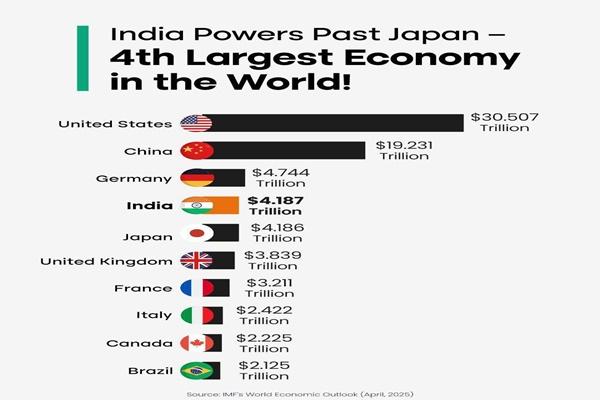
Recently, BVR Subrahmanyam, CEO of NITI Aayog, claimed that India has overtaken Japan to become the fourth-largest economy in the world, citing data from the International Monetary Fund (IMF).
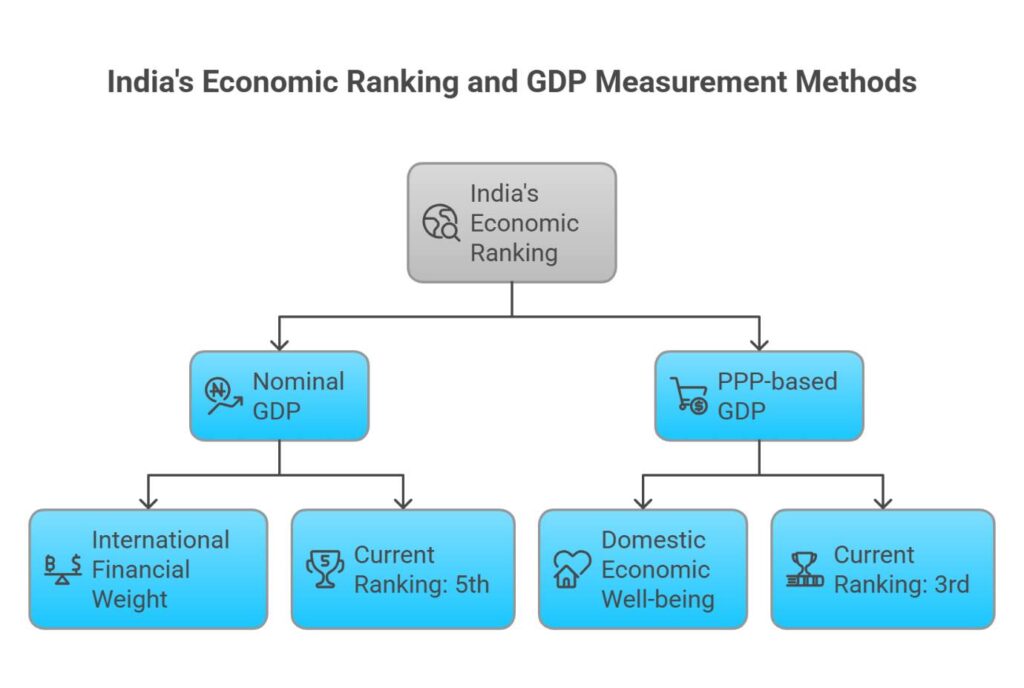
India’s rank as the world’s largest economy varies by measure—nominal GDP or purchasing power parity (PPP)—each with key implications for economic analysis.
International Monetary Fund (IMF)
- Notably, the International Monetary Fund (IMF), in its World Economic Outlook (WEO) report released in April, said that India is expected to be the fourth-largest economy in the world, with a GDP of $4.19trn in 2025, surpassing Japan.
- The report also noted that India’s nominal GDP for 2025 (FY26) is expected to be $4.187trn marginally more than the GDP of Japan, which is estimated at $4.186trn.
- The IMF data also showed that India’s per capita income has doubled from $1,438 in 2013-14 to $2,880 in 2025.
- Selective Emphasis: Political leaders or commentators may selectively cite either nominal or PPP-based GDP figures, depending on the narrative they wish to project.
- Public Misunderstanding: Many people do not distinguish between different GDP measurements, leading to conflicting interpretations of economic rank.
Methods of Measuring GDP
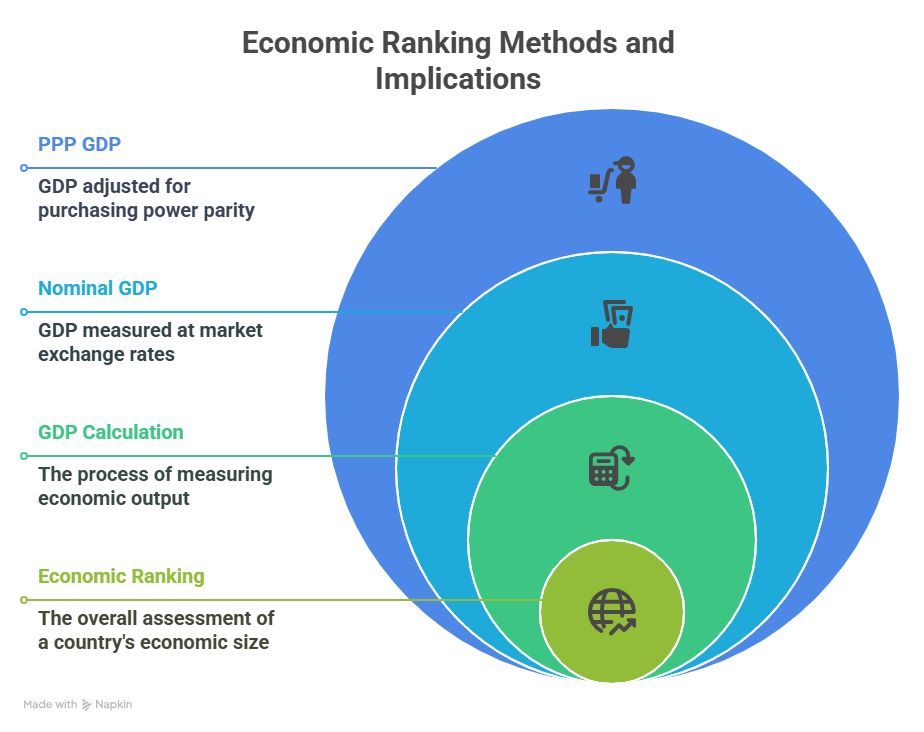
- The crux of the disagreement lies in the method of GDP calculation. There are two primary ways to measure and compare the Gross Domestic Product (GDP) of different countries:
1. GDP at Market Exchange Rates (Nominal GDP)
- Definition: The monetary value of all final goods and services produced within a country, converted into US dollars using prevailing exchange rates.
- Usage: This is the most commonly used method in international financial markets and media reporting.
- Current Ranking (IMF Estimates for 2024-25):
- United States – 1st
- China – 2nd
- Germany – 3rd
- Japan – 4th
- India – 5th
- Therefore, as per the latest available data, India is still ranked fifth in nominal terms, unless very recent exchange rate changes have caused a shift not yet reflected in official databases.
2. GDP at Purchasing Power Parity (PPP)
- Adjusts GDP to reflect differences in the cost of living and price levels across countries. It estimates how much a country’s currency can buy in its domestic market compared to other currencies.
- Usage: This method is widely used by economists and international organisations like the World Bank and IMF to assess real economic strength.
- Current Ranking (IMF PPP-based Estimates for 2024-25):
- China – 1st
- United States – 2nd
- India – 3rd
- Japan – 4th
- Germany – 5th
- India has been ranked as the third-largest economy by PPP since 2009, when it overtook Japan during the UPA government’s tenure.
Understanding the Difference Between Nominal GDP and PPP
To illustrate the difference, consider this example:
- Suppose two individuals have similar jobs. One earns ₹50,000 per month in Mumbai, and the other earns ₹45,000 per month in Patna. At first glance, the person in Mumbai appears to be doing better.
- However, due to the higher cost of living in Mumbai, the individual in Patna may actually enjoy a better standard of living. The concept of purchasing power explains this difference.
- Purchasing power changes across time and space. This is why economists use Purchasing Power Parity (PPP) to make more meaningful cross-country comparisons.
- While Nominal GDP is useful for measuring international financial weight, PPP-based GDP better reflects domestic economic well-being and real consumption power.
Conclusion
Both claims—that India is the 4th largest economy and that it is still 5th—can be valid depending on the metric used:
- By Nominal GDP, India is currently the 5th largest economy, possibly on the verge of overtaking Japan depending on currency trends.
- By PPP, India has consistently been the 3rd largest economy since 2009, a fact often under-acknowledged in mainstream discourse.

3rd UN conference on landlocked countries
UPSC CURRENT AFFAIRS – 08th August 2025 Home / 3rd UN conference on landlocked countries Why in News? At the

Issue of soapstone mining in Uttarakhand’s Bageshwar
UPSC CURRENT AFFAIRS – 08th August 2025 Home / Issue of soapstone mining in Uttarakhand’s Bageshwar Why in News? Unregulated
Groundwater Pollution in India – A Silent Public Health Emergency
UPSC CURRENT AFFAIRS – 08th August 2025 Home / Groundwater Pollution in India – A Silent Public Health Emergency Why
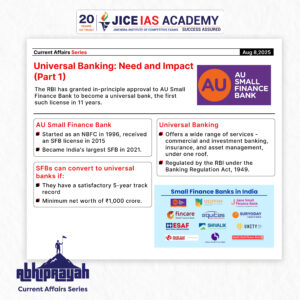
Universal banking- need and impact
UPSC CURRENT AFFAIRS – 08th August 2025 Home / Universal banking- need and impact Why in News? The Reserve Bank

India’s “Goldilocks” Economy: A Critical Appraisal
UPSC CURRENT AFFAIRS – 08th August 2025 Home / India’s “Goldilocks” Economy: A Critical Appraisal Why in News? The Finance

U.S.-India Trade Dispute: Trump’s 50% Tariffs and India’s Oil Imports from Russia
UPSC CURRENT AFFAIRS – 07th August 2025 Home / U.S.-India Trade Dispute: Trump’s 50% Tariffs and India’s Oil Imports from

Eco-Friendly Solution to Teak Pest Crisis: KFRI’s HpNPV Technology
UPSC CURRENT AFFAIRS – 07th August 2025 Home / Eco-Friendly Solution to Teak Pest Crisis: KFRI’s HpNPV Technology Why in

New Species of Non-Venomous Rain Snake Discovered in Mizoram
UPSC CURRENT AFFAIRS – 07th August 2025 Home / New Species of Non-Venomous Rain Snake Discovered in Mizoram Why in