UPSC CURRENT AFFAIRS – 27th June 2025

Home / UPSC / Current Affairs / India’s at SCO Defence Ministers’ Meeting, 2025

India’s at SCO Defence Ministers’ Meeting, 2025

rats sco

Why in News?

  • India opposed the SCO Defence Ministers’ joint statement in Qingdao over inadequate reference to the Pahalgam terror attack and diluted stance on terrorism.

Introduction

  • On June 26, 2025, the Shanghai Cooperation Organisation (SCO) Defence Ministers’ meeting was held in Qingdao, Shandong province, China. 
  • The meeting, aimed at promoting regional peace and security among member nations, ended without a joint statement due to India’s refusal to endorse the final document.

India’s Objection:

India, represented by Defence Minister Rajnath Singh, declined to endorse the joint statement proposed by the host country China, citing the following key objections:

  • The statement did not mention the April 22 Pahalgam terror attack, in which 26 civilians, including a Nepali national, were killed.
  • The statement included references to militant activities in Balochistan, which India perceived as an attempt by Pakistan and China to divert attention from Pakistan-sponsored terrorism in Kashmir.
  • The dilution of focus on terrorism and lack of support for India’s stance prompted India to opt out.

The Pahalgam Terror Attack (April 22, 2025):

  • Perpetrated by The Resistance Front (TRF), a proxy of Lashkar-e-Taiba (LeT), a UN-designated terror group.
  • The attack involved profiling of victims based on religious identity and killing of civilians, including foreign tourists.
  • India described the attack as “dastardly and heinous” and called for international condemnation and action.
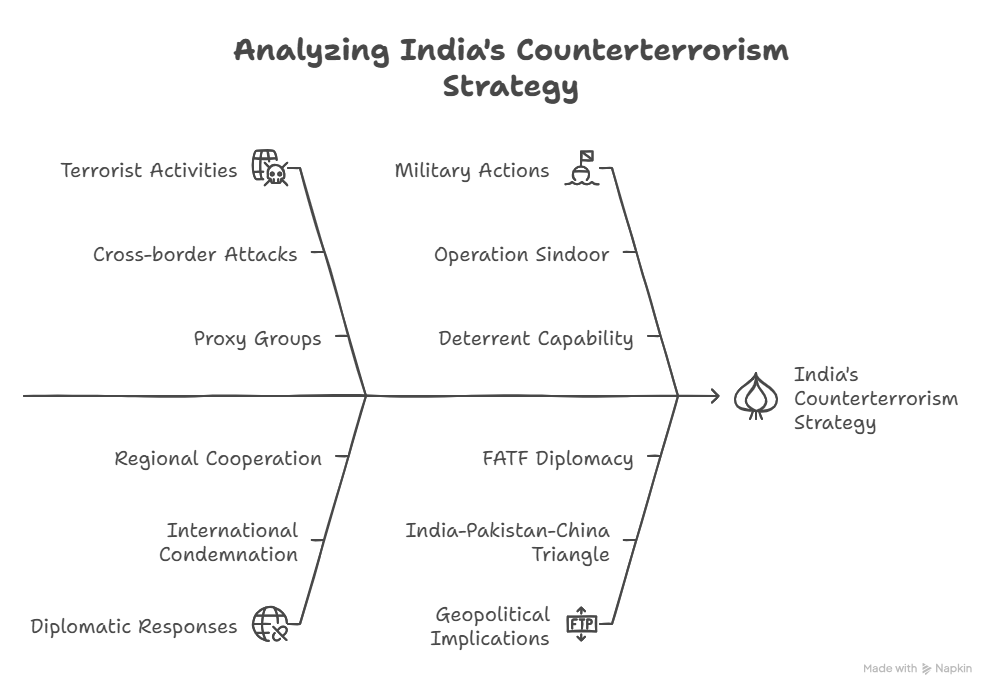
analyzing india counterterrorism strategy

India’s Position at SCO: Key Highlights from Rajnath Singh’s Address

  1. Zero Tolerance on Terrorism:
    • Emphasised that peace and prosperity cannot co-exist with terrorism or the proliferation of Weapons of Mass Destruction (WMDs) in the hands of non-state actors.
    • Called for decisive global action against nations that sponsor or provide safe havens to terrorists.
  2. Criticism of Double Standards:
    • Asserted that cross-border terrorism as state policy must be condemned unequivocally.
    • Urged SCO members to avoid double standards in counterterrorism cooperation.
  3. India’s Right to Self-Defence:
    • Reiterated India’s sovereign right to act against terror threats, especially across the border.
    • Recalled India’s strong retaliatory actions against terror epicentres, including military operations in the past.

“Operation Sindoor” (May 7, 2025):

In response to the Pahalgam attack, India launched “Operation Sindoor” with the following objectives:

  • Neutralize cross-border terror launchpads in Pakistan-occupied territories.
  • Disrupt terror logistics and communication networks linked to LeT and its proxies.
  • Reinforce India’s deterrent capability and send a message of no impunity for terrorism.

Diplomatic Developments:

  • India held bilateral talks with Defence Ministers of Russia, Kazakhstan, Tajikistan, and Belarus on the sidelines.
  • India pushed for enhanced regional cooperation on counterterrorism and non-traditional security threats.

Wider Geopolitical Implications:

  1. India’s Diplomatic Assertion:
    • India’s refusal to sign the statement highlights a more assertive foreign policy posture on terrorism.
    • It reflects India’s desire to set the global narrative on cross-border terrorism rather than be a passive participant.
  1. India-Pakistan-China Triangle in SCO:
    • India’s move may increase tensions with Pakistan and China, who appear to be aligning positions on deflecting focus from Kashmir to Balochistan.
    • May affect SCO’s unity on security cooperation.
  1. Impact on FATF Grey List Diplomacy:
    • India may use the Pahalgam incident to re-raise concerns about Pakistan’s terror financing and push for greater scrutiny through bodies like the Financial Action Task Force (FATF).

Economic Implications

For Indian Exporters

  • These reforms reduce transaction costs and compliance hurdles
  • Encourage a more competitive and efficient export environment
  • Promote value addition in key sectors like leather

For Tamil Nadu

  • The reforms particularly benefit the state’s leather industry, a major contributor to employment and exports
  • Boost the marketability of GI-tagged E.I. leather, enhancing rural and traditional industries

For Trade Policy

  • These decisions indicate a shift from regulatory controls to policy facilitation

Reinforce the goals of Make in India, Atmanirbhar Bharat, and India’s ambition to become a leading export power

Recently, BVR Subrahmanyam, CEO of NITI Aayog, claimed that India has overtaken Japan to become the fourth-largest economy in the world, citing data from the International Monetary Fund (IMF). 

India’s rank as the world’s largest economy varies by measure—nominal GDP or purchasing power parity (PPP)—each with key implications for economic analysis.

Significance and Applications

19 Responses

Leave a Reply

Your email address will not be published. Required fields are marked *

Call Us Now !

Copyright © JICE ACADEMY FOR EXCELLENCE PRIVATE LIMITED