UPSC CURRENT AFFAIRS – 05th July 2025

Home / UPSC / Current Affairs / India, Trinidad & Tobago ink six pacts to expand ties

India, Trinidad & Tobago ink six pacts to expand ties

pm modi 2025 visit to trinidad and tobago

Why in News?

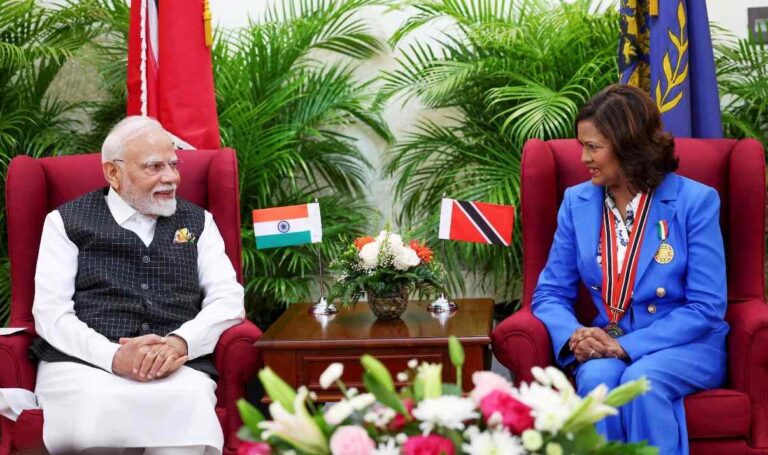
  • Prime Minister Modi’s 2025 visit to Trinidad and Tobago marked a historic diplomatic engagement, enhancing bilateral ties through MoUs, diaspora outreach, and support for UN reforms.

Introduction

  • Prime Minister Narendra Modi undertook a significant bilateral visit to Trinidad and Tobago in July 2025—the first such visit by an Indian Prime Minister since 1999. 
  • The visit marked an important milestone in reinvigorating India’s diplomatic engagement with the Caribbean, and in particular with Trinidad and Tobago, a country that shares historical, cultural, and diaspora linkages with India.
  • The visit came as part of the second leg of the Prime Minister’s five-nation tour and reflects India’s continued outreach to the countries of the Global South and its emphasis on shared development, capacity building, and multilateral cooperation.

Key Developments During the Visit

1. Bilateral Agreements and Areas of Cooperation

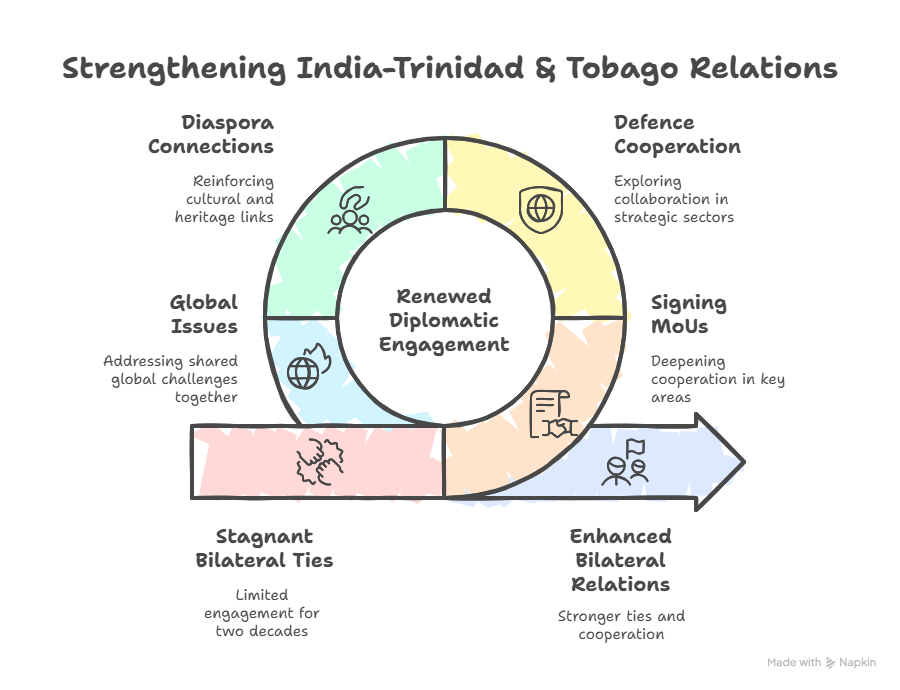
India and Trinidad and Tobago signed six Memoranda of Understanding (MoUs) aimed at deepening cooperation in the following areas:

  • Infrastructure development
  • Pharmaceutical sector
  • Culture and sports
  • Diplomatic training and capacity building
  • Pharmacopoeia (standards for drugs and medicine)
  • Quick-impact projects for local development

These agreements are expected to facilitate knowledge exchange, improve healthcare cooperation, and promote cultural diplomacy between the two nations.

2. Defence, Digital, and Agricultural Cooperation

The two leaders explored potential collaboration in strategic and emerging sectors, including:

  • Defence and maritime cooperation
  • Agriculture and agro-processing
  • Healthcare and traditional medicine
  • Digital transformation and the use of India’s Unified Payments Interface (UPI) in Trinidad and Tobago

This reflects India’s growing emphasis on digital public infrastructure diplomacy and its export of successful governance platforms to friendly nations.

3. People-to-People Engagement

A major focus of the visit was on reinforcing cultural and diaspora connections. India announced the extension of the Overseas Citizenship of India (OCI) card to the sixth generation of people of Indian origin in Trinidad and Tobago. This move is aimed at strengthening cultural identity and fostering closer links with the Indian diaspora.

Prime Minister Modi addressed the Parliament of Trinidad and Tobago, where he highlighted the contributions of the Indian-origin community to the country’s development, and the unique cultural amalgamation seen in the form of “calypso to chutney” and “cricket to commerce.”

Multilateral and Global Issues

1. Reform of the United Nations Security Council

Both nations reaffirmed their commitment to comprehensive reform of the United Nations system, including the expansion of the UN Security Council to reflect contemporary geopolitical realities. Trinidad and Tobago reiterated its full support for India’s permanent membership in an expanded Security Council.

Additionally, it was agreed that:

  • India would support Trinidad and Tobago’s candidature for a non-permanent seat on the UNSC for 2027–28
  • Trinidad and Tobago would support India’s candidature for 2028–29

2. Joint Approach to Global Challenges

Prime Minister Modi and Prime Minister Kamla Persad-Bissessar discussed global issues including:

  • Climate change and sustainable development
  • Disaster risk management
  • Cybersecurity
  • Dialogue and diplomacy in the face of rising global conflicts

The leaders also agreed to work together to promote greater solidarity among countries of the Global South and to enhance the India–CARICOM partnership. The Caribbean Community (CARICOM) is an intergovernmental organisation of 15 Caribbean states, with which India has been steadily enhancing engagement.

strengthening india-trinidad tobago relations

About the 'The Order of the Republic of Trinidad and Tobago'

  • The Order of the Republic of Trinidad and Tobago is the highest national award presented to individuals for exceptional service to the country or to humanity at large.
  •  Prime Minister Modi received this award for his distinguished global statesmanship, leadership during the pandemic, and efforts to deepen diaspora ties across the world.
  • In his acceptance message, Prime Minister Modi dedicated the honour to the 140 crore citizens of India, stating that the award was a symbol of the strong India–Trinidad and Tobago relationship.

Historical and Cultural Significance

  • This is the first bilateral visit by an Indian Prime Minister to Trinidad and Tobago since 1999. The honour reflects the deep-rooted people-to-people connections that exist due to the Indian diaspora, whose ancestors migrated to Trinidad and Tobago as indentured labourers in the 19th century. 
  • Today, people of Indian origin form over 37% of the country’s population and are actively involved in its political, cultural, and economic spheres.
  • The conferral of the award serves as an acknowledgment of the historical bonds and civilisational linkages between the two nations, particularly those rooted in shared values of pluralism, democracy, and multiculturalism.

Diplomatic and Strategic Dimensions

The timing and context of this honour highlight several broader strategic dimensions of India’s foreign policy:

1. Global South Leadership

  • Prime Minister Modi’s visit and the honour reinforce India’s commitment to the Global South, particularly the Caribbean region. India and Trinidad and Tobago agreed to enhance cooperation in multilateral forums, especially the United Nations, and called for comprehensive reforms of the UN system, including expansion of the UN Security Council.

2. Support for UNSC Candidature

  • During the visit, both nations agreed to support each other’s candidatures for a non-permanent seat on the United Nations Security Council—Trinidad and Tobago for the 2027–28 term and India for 2028–29. 
  • Trinidad and Tobago also reiterated its full support for India’s permanent membership in a reformed and expanded UNSC.

3. Diaspora and Cultural Diplomacy

  • The award also acknowledges Prime Minister Modi’s efforts in strengthening ties with the global Indian diaspora.
  • India’s decision to extend the Overseas Citizenship of India (OCI) card to the sixth generation of people of Indian origin in Trinidad and Tobago was a major gesture, reinforcing cultural diplomacy and people-centric foreign policy.
  • Symbolically, Prime Minister Modi gifted holy water from the Mahakumbh and a replica of the Ram Mandir in Ayodhya to the Prime Minister of Trinidad and Tobago, reflecting India’s civilisational outreach.

4. Soft Power and Humanitarian Diplomacy

  • India’s humanitarian response during the COVID-19 pandemic, particularly the Vaccine Maitri initiative, played a crucial role in boosting India’s image as a global public goods provider. 
  • The recognition by Trinidad and Tobago can be viewed as an acknowledgment of India’s solidarity with small and vulnerable nations during times of crisis.

Symbolic Gestures and Cultural Diplomacy

Prime Minister Modi presented:

  • Holy water from the Mahakumbh (representing India’s spiritual tradition)
  • A replica of the Ram Mandir in Ayodhya (representing civilisational and religious heritage)

These gestures served to enhance cultural bonds and emotional connect with the Indian diaspora in Trinidad and Tobago.

He also congratulated President Christine Carla Kangaloo for receiving the Pravasi Bharatiya Samman Award for her contributions to public service and engagement with the Indian community.

Conclusion

Prime Minister Modi’s visit to Trinidad and Tobago in July 2025 provided a renewed thrust to India–Caribbean relations and highlighted the central role of diaspora, development partnerships, and multilateral cooperation in India’s foreign policy. The agreements and symbolic gestures during the visit reflect both continuity and evolution in India’s diplomacy—anchored in shared history, mutual respect, and a commitment to a multipolar world order.

Economic Implications

For Indian Exporters

  • These reforms reduce transaction costs and compliance hurdles
  • Encourage a more competitive and efficient export environment
  • Promote value addition in key sectors like leather

For Tamil Nadu

  • The reforms particularly benefit the state’s leather industry, a major contributor to employment and exports
  • Boost the marketability of GI-tagged E.I. leather, enhancing rural and traditional industries

For Trade Policy

  • These decisions indicate a shift from regulatory controls to policy facilitation

Reinforce the goals of Make in India, Atmanirbhar Bharat, and India’s ambition to become a leading export power

Recently, BVR Subrahmanyam, CEO of NITI Aayog, claimed that India has overtaken Japan to become the fourth-largest economy in the world, citing data from the International Monetary Fund (IMF). 

India’s rank as the world’s largest economy varies by measure—nominal GDP or purchasing power parity (PPP)—each with key implications for economic analysis.

Significance and Applications

Leave a Reply

Your email address will not be published. Required fields are marked *

Call Us Now !

Copyright © JICE ACADEMY FOR EXCELLENCE PRIVATE LIMITED