
UPSC CURRENT AFFAIRS – 07th July 2025

Home / UPSC / Current Affairs / Indian agriculture’s prospects depend on innovating and adopting genetic tech

Indian agriculture’s prospects depend on innovating and adopting genetic tech

elements related to corn and genetically modified organisms

Why in News?

  • India’s resistance to genetically modified (GM) food crops amid growing global adoption and trade negotiations reflects a deeper conflict between agricultural innovation, farmer welfare, and regulatory inertia.

Introduction

  • As the July 9, 2025, trade deadline nears, U.S. negotiators are pressuring India to allow access to its agricultural market for genetically modified (GM) crops.
  • However, India has drawn clear red lines, especially in agriculture and dairy, with Finance Minister Nirmala Sitharaman reiterating concerns about food safety and the livelihood of Indian farmers.
  • Globally, GM crop adoption has surged since 1996, with over 200 million hectares under cultivation across 76 countries as of 2023. 
  • India, however, remains largely resistant to commercialising GM food crops, even though it has allowed GM cotton since 2002. 
  • This contradiction, and the broader implications of the GM debate, are crucial for India’s agriculture, trade, and innovation policies.

What are GM Crops?

Genetically Modified (GM) crops are plants whose DNA has been artificially altered using biotechnology to give them traits such as:

  • Resistance to pests (e.g., Bt cotton against bollworms),
  • Tolerance to herbicides (e.g., HT-Bt cotton),
  • Resistance to diseases or droughts.

The goal of GM technology is to improve productivity, reduce chemical pesticide use, and increase farmers’ incomes. Countries like the United States, Brazil, and Argentina have widely adopted GM crops such as soybean, maize (corn), and canola.

GM Crop Status in India

Bt Cotton: The Only Approved GM Crop

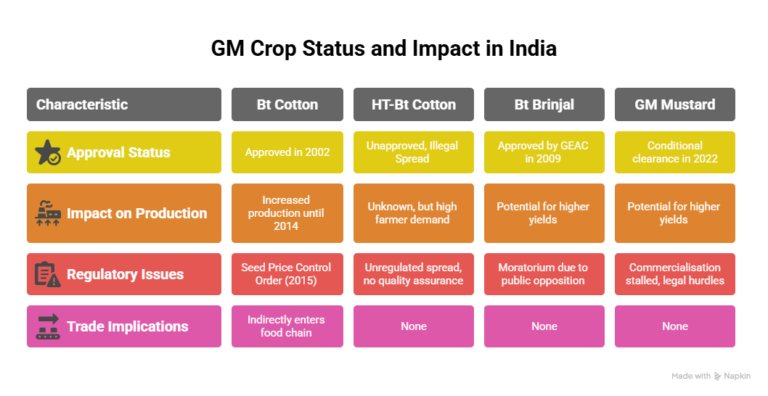
  • Introduced in 2002 under the Vajpayee government, Bt cotton remains the only GM crop officially permitted in India.
  • More than 90% of India’s cotton area is under Bt cotton cultivation today.
  • Cottonseed oil, derived from Bt cotton, enters the human food chain, while the seed itself is used in cattle feed.

This means GM crops have already entered the Indian food system, albeit indirectly.

gm crop status and impact in india

Achievements of Bt Cotton (2002–2014)

The introduction of Bt cotton led to significant gains in production, productivity, and exports:

  • Cotton production rose from 13.6 million bales (2002–03) to 39.8 million bales (2013–14) — an increase of 193%.
  • Productivity improved from 302 kg/ha to 566 kg/ha, a jump of 87%.
  • Cotton cultivated area expanded by 56%.
  • Farmers’ incomes grew, particularly in Gujarat, which experienced an agrarian boom and achieved over 8% annual growth in agricultural GDP.
  • By 2011–12, India became the second-largest cotton producer after China and the second-largest exporter after the United States.

This period showcased the transformative potential of biotechnology in agriculture.

Decline of Bt Cotton Since 2015

However, the Bt cotton success story lost momentum post-2015:

  • Productivity fell to around 436 kg/ha in 2023–24, down from 566 kg/ha in 2013–14.
  • India’s yield now lags behind the global average of 770 kg/ha, as well as countries like China (~1,945 kg/ha) and Brazil (~1,839 kg/ha).
  • The decline has been accompanied by a 2% average annual drop in production, driven by:
    • Pest outbreaks (e.g., pink bollworm, whiteflies),
    • Lack of access to newer-generation seeds (such as HT-Bt cotton),
    • Inflexible regulations and policy stagnation.

Illegal Spread of Unapproved GM Seeds: HT-Bt Cotton

HT-Bt cotton (Herbicide Tolerant Bt cotton), which can survive herbicide spraying for weed control, has not received official approval in India. However, its seeds have:

  • Spread illegally across states like Gujarat, Maharashtra, Telangana, Andhra Pradesh, and Punjab,
  • Covering 15–25% of India’s total cotton area, according to industry estimates.

This illegal proliferation shows the mismatch between farmer demand and regulatory policy. Farmers, desperate for relief from weeds and pests, are using unapproved seeds with no formal quality assurance or accountability. This also creates a shadow seed economy, undermining legal seed suppliers and putting farmers at greater risk of crop failure.

Regulatory and Policy Roadblocks to Innovation

Several regulatory decisions have discouraged biotech innovation in India:

The Cotton Seed Price Control Order (2015)

  • Drastically reduced Bt cotton seed royalties, cutting trait fees from ₹180 to just ₹39 per seed packet.
  • Made investment in research and development financially unattractive for biotech firms.

2016 Regulations

  • Mandated that trait licensors transfer technology within 30 days.
  • Capped trait fees at 10% of MSP for five years, with further cuts thereafter.

By 2020, regulatory restrictions became even tighter, forcing global firms to withdraw and discouraging the development of next-generation GM crops.

Missed Opportunities in Other GM Crops

India’s restrictive approach has stalled commercialisation of several important biotech innovations:

  1. Bt Brinjal:
    • Developed by Mahyco, approved by GEAC in 2009,
    • Placed under a moratorium due to public opposition.
  2. GM Mustard (DMH-11):
    • Developed by Delhi University,
    • Received conditional environmental clearance in 2022,
    • Commercialisation is still pending due to additional reviews and potential legal hurdles.

Despite scientific approval, these crops have not reached farmers, denying them access to higher-yielding and pest-resistant varieties.

Trade Implications

  • India’s reluctance to open its market to GM crops is now a sticking point in bilateral trade negotiations, particularly with the United States. 
  • While Indian policy maintains a cautious stance, India’s import of GM soybean and corn for poultry feed, and indirect consumption of cottonseed oil, reveal inconsistencies in its position.
  • India has even become a net importer of raw cotton in 2024–25, with imports valued at $0.4 billion — a reversal from its status as a major exporter in the early 2010s.

What Needs to be Done?

India must adopt a science-led, farmer-centric policy approach. Suggested steps include:

  1. Scientific and Transparent Regulation
    • Reform the GEAC and ensure approvals are time-bound, evidence-based, and insulated from political or ideological pressures.
  1. Commercialisation of Approved GM Crops
    • Allow field-level rollout of crops like HT-Bt cotton, Bt brinjal, and GM mustard.
  1. Monitor and Legalise Proven Technologies
    • Prevent the unregulated spread of illegal seeds and provide quality-certified alternatives.
  1. Encourage Private Investment
    • Reassess royalty caps and price controls to revive biotech R&D.
    • Promote public-private partnerships for seed innovation.
  1. Public Awareness Campaigns
    • Educate citizens about the science, safety, and benefits of GM crops.
    • Address misinformation spread by activist groups.

The Vision of Science-Led Agriculture

Former Prime Minister Atal Bihari Vajpayee had extended the slogan “Jai Jawan, Jai Kisan” by adding “Jai Vigyan” — hailing the role of science in national development. Prime Minister Narendra Modi has further extended this with “Jai Anusandhan” (Hail Innovation).

To make this vision a reality, India must:

  • Unlock its biotech potential,
  • Tap into the ₹1 lakh crore Research, Development and Innovation (RDI) fund,
  • Build a policy ecosystem that encourages scientific entrepreneurship and rural prosperity.

Just as information technology (IT) transformed urban India, biotechnology (BT) can transform rural Bharat.

Conclusion

  • India’s stance on GM crops reflects the broader tension between precaution and progress
  • While legitimate concerns around safety, biodiversity, and farmer welfare must be addressed, blanket resistance risks stalling innovation, crippling exports, and depriving farmers of much-needed technological solutions.
  • The path forward lies in balancing risk with opportunity, building robust institutions, and embracing the transformative potential of science.

Economic Implications

For Indian Exporters

  • These reforms reduce transaction costs and compliance hurdles
  • Encourage a more competitive and efficient export environment
  • Promote value addition in key sectors like leather

For Tamil Nadu

  • The reforms particularly benefit the state’s leather industry, a major contributor to employment and exports
  • Boost the marketability of GI-tagged E.I. leather, enhancing rural and traditional industries

For Trade Policy

  • These decisions indicate a shift from regulatory controls to policy facilitation

Reinforce the goals of Make in India, Atmanirbhar Bharat, and India’s ambition to become a leading export power

Recently, BVR Subrahmanyam, CEO of NITI Aayog, claimed that India has overtaken Japan to become the fourth-largest economy in the world, citing data from the International Monetary Fund (IMF). 

India’s rank as the world’s largest economy varies by measure—nominal GDP or purchasing power parity (PPP)—each with key implications for economic analysis.

Significance and Applications

Leave a Reply

Your email address will not be published. Required fields are marked *

Call Us Now !

Copyright © JICE ACADEMY FOR EXCELLENCE PRIVATE LIMITED