UPSC CURRENT AFFAIRS – 2nd June 2025
Indian cities have a drainage problem
Why in News?
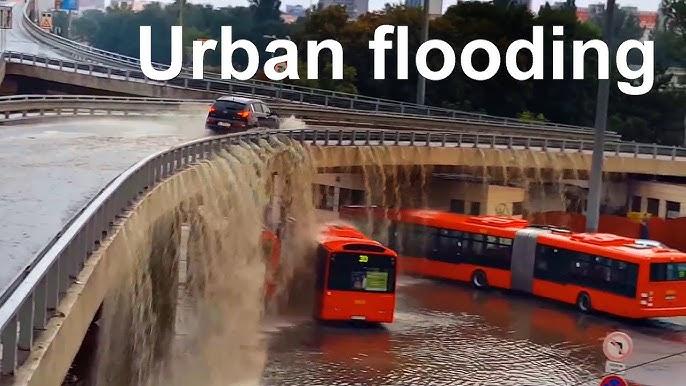
- Several Indian cities, including Delhi, Mumbai, and Bengaluru, have recently witnessed severe urban flooding due to intense rainfall and inadequate drainage infrastructure.
Changing Rainfall Patterns and the Impact of Climate Change
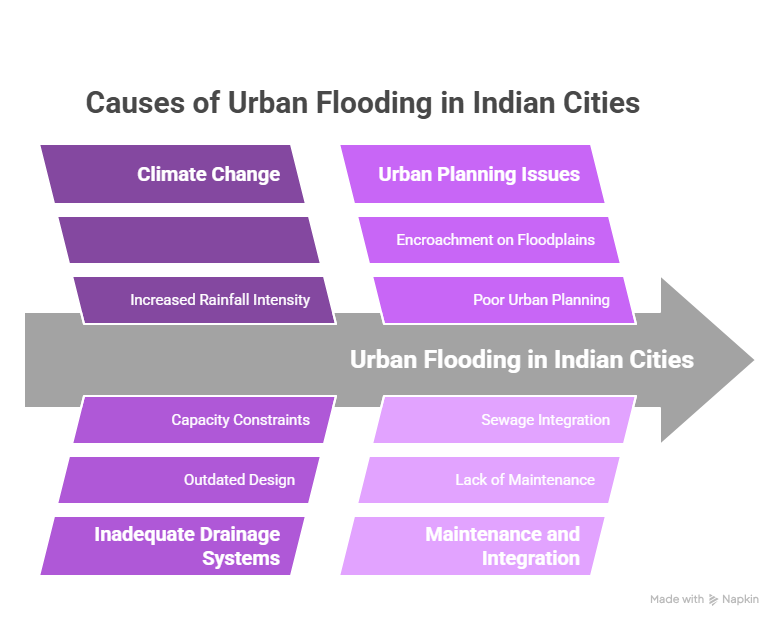
- One of the primary causes of increased urban flooding in Indian cities is the change in rainfall patterns due to climate change. There has been a noticeable rise in the intensity and frequency of rainstorms, particularly short-duration high-intensity rainfall events.
- Traditionally, city drainage systems were designed based on a return period of one in two years, meaning they were expected to handle rainfall events likely to occur once every two years.
- However, current rainfall events often exceed these estimates, leading to widespread urban inundation.
- The gap between designed capacity and actual rainfall has widened significantly due to the effects of global warming and erratic monsoons.
- This is a critical issue for urban resilience, as most cities have not updated their infrastructure to cope with extreme weather events.
Outdated and Inadequate Drainage System Design
When Indian cities were first developed, their drainage systems were designed to carry stormwater from roofs, streets, and roads to natural water bodies. These systems were based on:
- Historic rainfall data
- Land use patterns prevalent at the time
- Limited urban spread and population
Over time, these parameters have changed drastically. Urban areas have grown both in size and population, but the drainage systems have not been correspondingly updated or expanded. The result is systemic inadequacy, where even moderate rains can lead to flooding in certain areas.
The design limitations are further compounded when drains are unable to discharge stormwater efficiently due to capacity constraints.
Increase in Impervious Surfaces
- The increase in paved, concretised, and built-up areas has drastically reduced the amount of land available for natural absorption of rainwater.
- Earlier, open spaces and unpaved surfaces absorbed a significant portion of the rainfall, reducing the burden on stormwater drains.
- Now, with fewer permeable surfaces, a larger volume of water becomes surface runoff, which flows directly into the drainage system.
- This excess volume was not anticipated during the original design of stormwater systems, leading to system overload and flooding.
Mismatch Between Catchment Areas and Drain Sizes
- Stormwater drains are designed based on the catchment area, which refers to the land area from which rainwater flows into a particular drain.
- As urban areas expand, these catchment areas also grow, but the drain dimensions often remain unchanged.
- The flow of stormwater increases as it moves from smaller drains to larger ones in the network. If intermediate and main drains do not have adequate cross-sectional area to accommodate this increasing volume, overflow and localized flooding occur.
- This mismatch in scale and design is a technical flaw that leads to widespread urban flooding.
Poor Urban Planning and Encroachment
- In many Indian cities, urban planning has not accounted for the natural topography and hydrological features.
- Construction is frequently permitted in low-lying areas, floodplains, and former water bodies. This has eliminated natural buffers and increased the vulnerability of these areas to flooding.
- Moreover, in underpasses and other low-elevation zones, gravity-based flow is not feasible.
- These areas require the installation of mechanical pumps to evacuate stormwater, but such systems are often missing, inadequate, or poorly maintained.
Integration of Sewage and Stormwater Drains
Another major challenge is the mixing of sewage with stormwater in the drainage network. This occurs due to:
- Incomplete or poorly maintained sewerage systems
- Informal settlements and newly urbanized areas being outside the sewerage network
This mixture reduces the functional efficiency of storm drains, leading to clogging and contamination. The presence of solid and liquid waste in stormwater channels further obstructs the free flow of water and adds a public health hazard during flood events.
Lack of Maintenance and Desilting
- Drains often get clogged with silt, solid waste, and debris, which reduces their effective capacity.
- Regular desilting and cleaning are required before every monsoon season, but in most Indian cities, this process is either not undertaken properly or done as a formality.
- Many stormwater drains are permanently covered with concrete slabs, making them inaccessible for cleaning. This leads to long-term sediment buildup and blockages that are difficult to remove.
Failure to Incorporate Updated Standards
- In 2015, the Ministry of Housing and Urban Affairs released a Manual on Stormwater Drainage Systems recommending that cities adopt a return period of one in five years or higher for designing or retrofitting drainage systems.
- However, implementation of these guidelines has been poor. As a result, even relatively moderate storms today can cause drainage failure and urban flooding.
- The current situation demands not only adoption of these standards but also further upgradation, considering the unprecedented scale of climate change-induced rainfall events.Measures for Mitigation and Long-term Resilience
Scientific and Technological Interventions
Cities need to adopt GIS-based simulation frameworks that can model:
- Urban topography
- Land use patterns
- Stormwater flow paths
Such tools enable urban planners to design effective and responsive drainage systems that account for changing population densities and impervious surface areas. This simulation approach was successfully tested in Delhi.
Structural and Non-Structural Solutions
- Groundwater Recharge and Rainwater Harvesting Promoting recharge wells and harvesting systems to divert runoff and reduce load on drains.
- Rejuvenation of Lakes and Water Bodies Restoring urban lakes and wetlands to act as storage basins during rainfall events.
- Green Infrastructure Constructing rooftop gardens, green pavements, and bioswales to absorb and filter rainwater locally.
- Underground Storage Systems Building detention and retention tanks to temporarily hold excess stormwater.
- Dedicated Stormwater Tunnels Some developed countries have constructed deep tunnels that collect excess rainwater and divert it safely to rivers or the sea. However, such infrastructure is highly capital-intensive and requires substantial base-level drainage networks.
- Regular Maintenance Ensuring timely desilting, cleaning, and modernization of drains, especially before the monsoon.

3rd UN conference on landlocked countries
UPSC CURRENT AFFAIRS – 08th August 2025 Home / 3rd UN conference on landlocked countries Why in News? At the
Issue of soapstone mining in Uttarakhand’s Bageshwar
UPSC CURRENT AFFAIRS – 08th August 2025 Home / Issue of soapstone mining in Uttarakhand’s Bageshwar Why in News? Unregulated
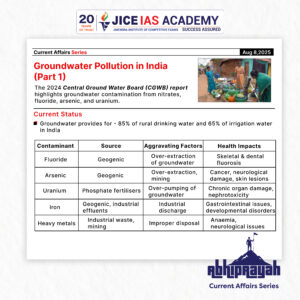
Groundwater Pollution in India – A Silent Public Health Emergency
UPSC CURRENT AFFAIRS – 08th August 2025 Home / Groundwater Pollution in India – A Silent Public Health Emergency Why

Universal banking- need and impact
UPSC CURRENT AFFAIRS – 08th August 2025 Home / Universal banking- need and impact Why in News? The Reserve Bank

India’s “Goldilocks” Economy: A Critical Appraisal
UPSC CURRENT AFFAIRS – 08th August 2025 Home / India’s “Goldilocks” Economy: A Critical Appraisal Why in News? The Finance

U.S.-India Trade Dispute: Trump’s 50% Tariffs and India’s Oil Imports from Russia
UPSC CURRENT AFFAIRS – 07th August 2025 Home / U.S.-India Trade Dispute: Trump’s 50% Tariffs and India’s Oil Imports from
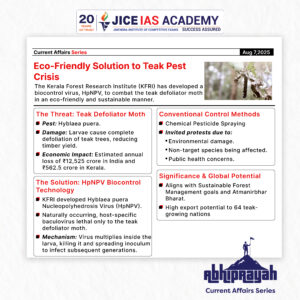
Eco-Friendly Solution to Teak Pest Crisis: KFRI’s HpNPV Technology
UPSC CURRENT AFFAIRS – 07th August 2025 Home / Eco-Friendly Solution to Teak Pest Crisis: KFRI’s HpNPV Technology Why in

New Species of Non-Venomous Rain Snake Discovered in Mizoram
UPSC CURRENT AFFAIRS – 07th August 2025 Home / New Species of Non-Venomous Rain Snake Discovered in Mizoram Why in

Economic Implications
For Indian Exporters
- These reforms reduce transaction costs and compliance hurdles
- Encourage a more competitive and efficient export environment
- Promote value addition in key sectors like leather
For Tamil Nadu
- The reforms particularly benefit the state’s leather industry, a major contributor to employment and exports
- Boost the marketability of GI-tagged E.I. leather, enhancing rural and traditional industries
For Trade Policy
- These decisions indicate a shift from regulatory controls to policy facilitation
Reinforce the goals of Make in India, Atmanirbhar Bharat, and India’s ambition to become a leading export power
Recently, BVR Subrahmanyam, CEO of NITI Aayog, claimed that India has overtaken Japan to become the fourth-largest economy in the world, citing data from the International Monetary Fund (IMF).
India’s rank as the world’s largest economy varies by measure—nominal GDP or purchasing power parity (PPP)—each with key implications for economic analysis.