
UPSC CURRENT AFFAIRS – 19th July 2025

Home / UPSC / Current Affairs / Indian inequality and the World Bank’s claims

Indian inequality and the World Bank’s claims

indian inequality and the world bank claims

Why in News?

  • Debate over inequality in India intensifies as the World Bank’s April 2025 report sparks sharp reactions and highlights data misinterpretation in public discourse.
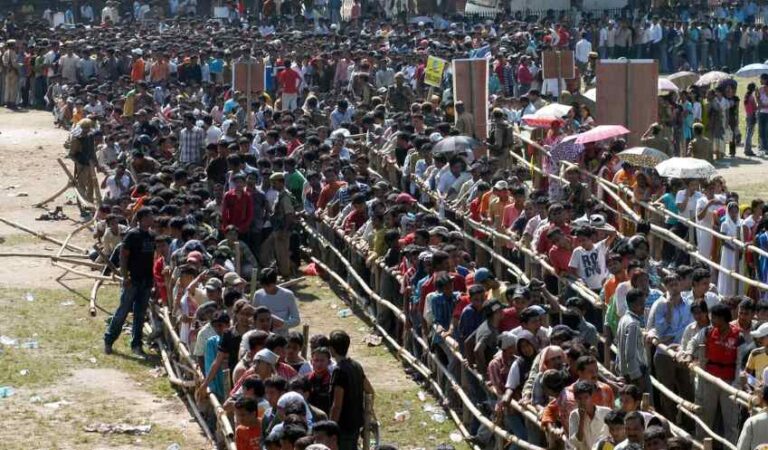
very large crowd of people

Introduction

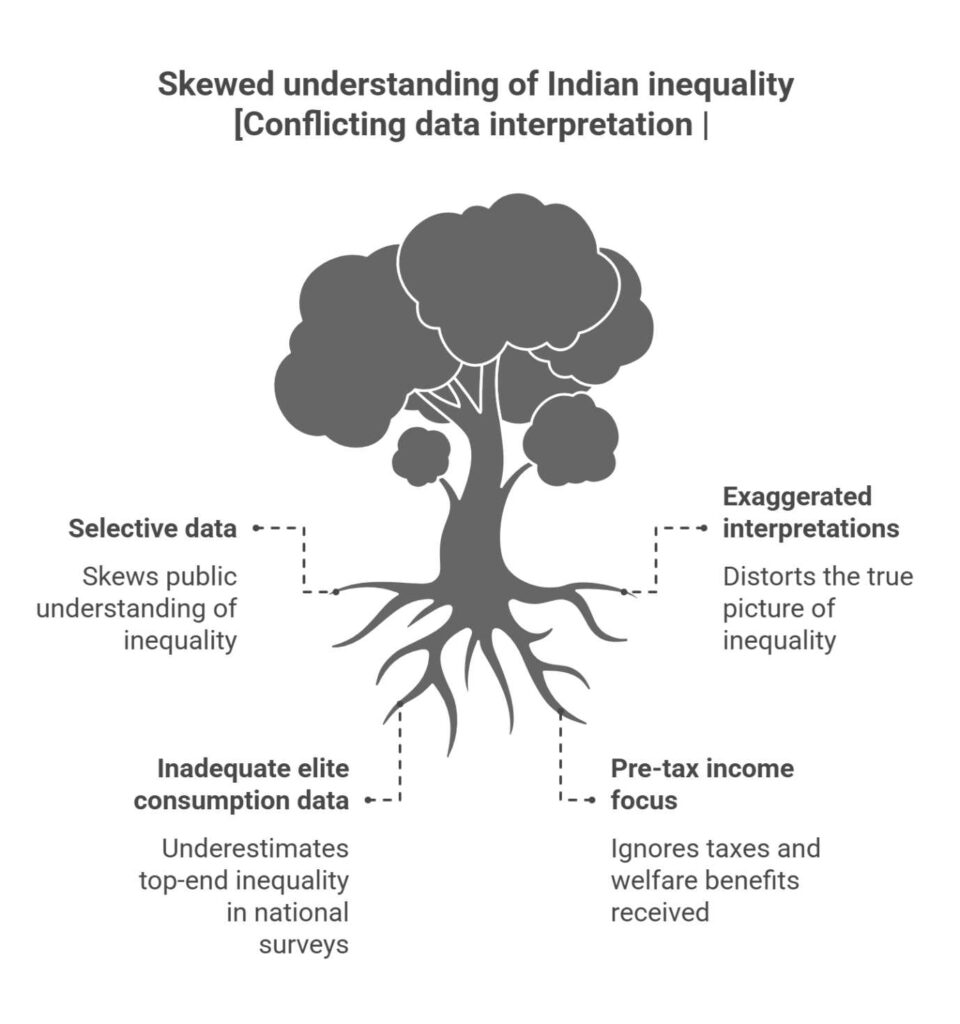
The issue of inequality remains central to the political economy of any democracy. In India, however, the inequality debate is often marred by selective use of data and exaggerated interpretations, resulting in skewed public understanding. The sharp reactions to the recent World Bank report (India Poverty and Equity Brief: April 2025) reflect this tendency.

Key Findings of the World Bank Report

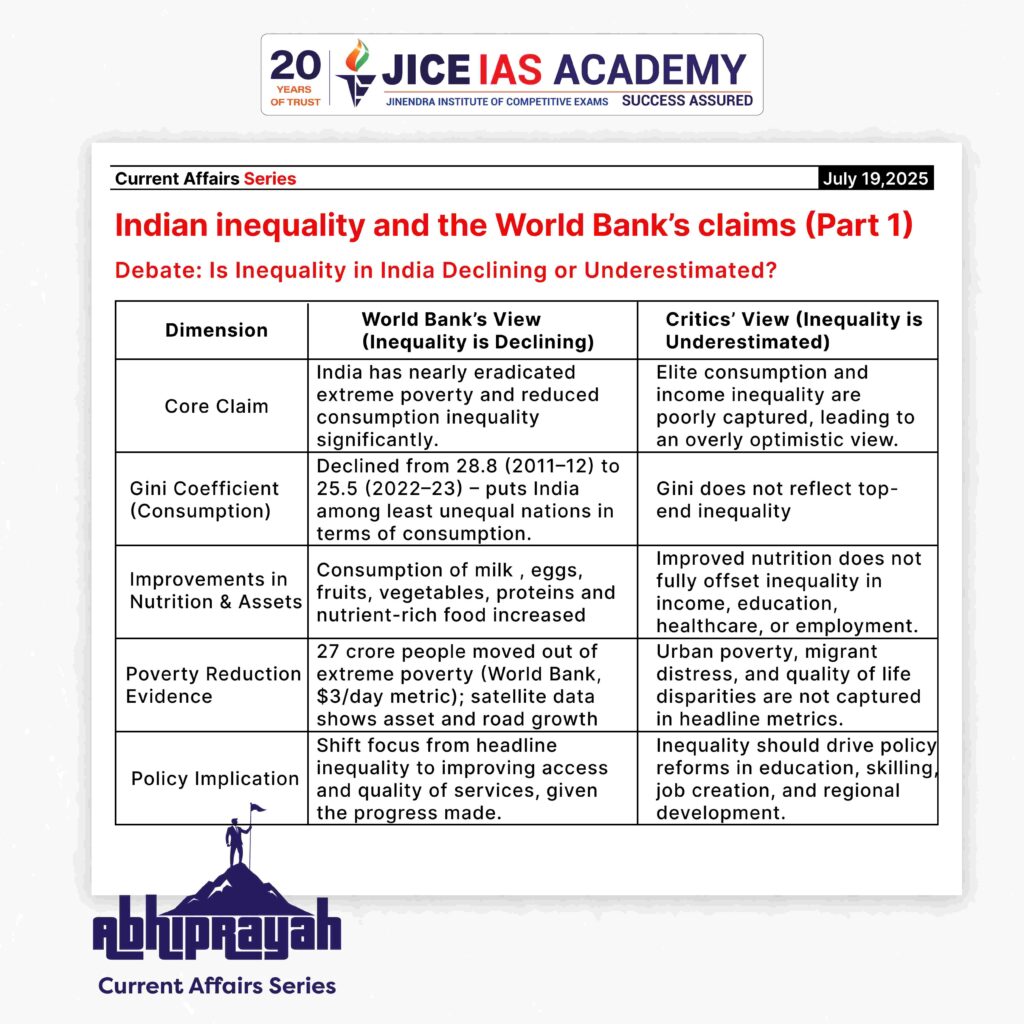
The World Bank report presents a significant claim: India has nearly eradicated extreme poverty and reduced consumption inequality since 2011-12. It uses the 2022–2023 Household Consumption Expenditure Survey (HCES) based on the Modified Mixed Reference Period (MMRP) methodology, which is aligned with global statistical best practices.

  • The consumption-based Gini coefficient declined from 28.8 in 2011-12 to 25.5 in 2022-23.
  • Based on these measures, India is placed among the top four least unequal countries in the world in terms of consumption inequality.

Understanding the Basis of These Claims

  • The MMRP method captures short- and long-recall periods for different items and is considered a robust approach.
  • The World Bank adjusted for certain free public goods and services in its estimation, though not comprehensively.
  • Critics argue that elite consumption is not captured adequately, especially for the top 5%, but this limitation applies to all national surveys across countries.

Implication:

Even if the consumption of the wealthiest is underestimated, inequality has indisputably declined for the remaining 95% of the population.

Improvement in Household Consumption Patterns

According to HCES 2022–23:

  • Dietary quality has improved, with a rise in the consumption of milk (45% increase), eggs (63%), fruits, vegetables, and proteins.
  • The share of cereals in total food consumption has decreased, replaced by more nutrient-rich options.
  • Among the bottom 20% of rural households, fruit consumption rose from 63.8% in 2011-12 to 90% in 2023.
  • These trends indicate better nutrition security and a shift towards healthier lifestyles.

Poverty Reduction: Multidimensional Evidence

  • Based on international standards (e.g., the $3 poverty line), India has lifted approximately 27 crore people out of extreme poverty between 2011 and 2023.
  • Additional data sources — such as nightlight satellite imagery — show a surge in:
    • Ownership of pucca houses
    • Paved roads in villages
    • Vehicle ownership among the poorest 20%, rising from 6% in 2011-12 to over 40% in 2023

These outcomes align with the impact of government schemes such as:

  • Pradhan Mantri Gramin Awas Yojana
  • Pradhan Mantri Gram Sadak Yojana
  • Ayushman Bharat
skewed understanding of indian inequality conflicting data interpretation

Income Inequality: Data Gaps and Misinterpretations

The World Inequality Lab (WIL) estimates:

  • Suggest high income inequality in India, with the top 1% owning a large share of national income.
  • However, WIL data is based on income tax filings and older consumption data, assuming that 70-80% of families spend more than they earn — an unrealistic assumption.
  • This results in underestimation of lower incomes and overestimation of the top tier’s share.

The Role of Taxes and Transfers

  • WIL estimates are based on pre-tax income, ignoring taxes paid and welfare benefits received.
  • For meaningful insights, inequality must be assessed on a post-tax, post-subsidy basis:
    • The top 1% paid 72.77% of total taxes in 2023-24.
    • The individual top 1% paid 42% of all income tax.
    • Effective income for low-income groups is higher due to government transfers, which now constitute over 8% of GDP.

This significantly narrows the real gap between top and bottom income earners.

Conclusion: Towards a Balanced Understanding

India still faces deep structural inequalities — especially in healthcare, education, and opportunities. But the narrative is no longer one of stagnation.

  • The eradication of extreme poverty, improved nutrition, and asset ownership among the poor reflect remarkable socio-economic progress.
  • The debate on inequality must be data-informed, not driven by assumptions or headlines.
  • The challenge ahead lies in continuing this trajectory while addressing inequality of opportunity and access to quality public services.

Economic Implications

For Indian Exporters

  • These reforms reduce transaction costs and compliance hurdles
  • Encourage a more competitive and efficient export environment
  • Promote value addition in key sectors like leather

For Tamil Nadu

  • The reforms particularly benefit the state’s leather industry, a major contributor to employment and exports
  • Boost the marketability of GI-tagged E.I. leather, enhancing rural and traditional industries

For Trade Policy

  • These decisions indicate a shift from regulatory controls to policy facilitation

Reinforce the goals of Make in India, Atmanirbhar Bharat, and India’s ambition to become a leading export power

Recently, BVR Subrahmanyam, CEO of NITI Aayog, claimed that India has overtaken Japan to become the fourth-largest economy in the world, citing data from the International Monetary Fund (IMF). 

India’s rank as the world’s largest economy varies by measure—nominal GDP or purchasing power parity (PPP)—each with key implications for economic analysis.

Significance and Applications

Leave a Reply

Your email address will not be published. Required fields are marked *

Call Us Now !

Copyright © JICE ACADEMY FOR EXCELLENCE PRIVATE LIMITED