

UPSC CURRENT AFFAIRS – 03rd August 2025
India's First Analog Space Mission – HOPE Station in Ladakh
Why in News?
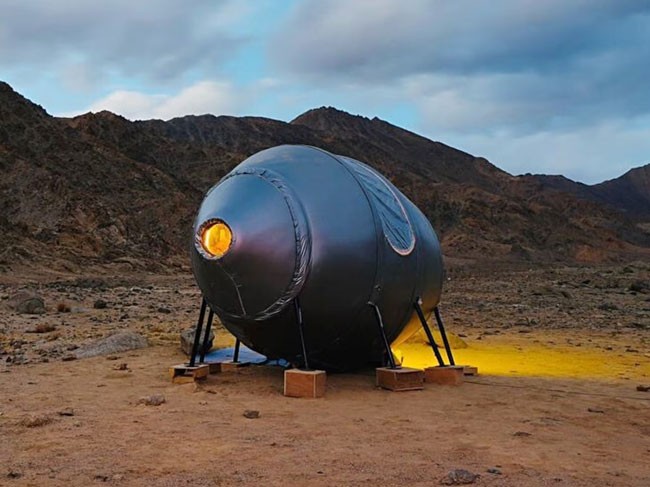
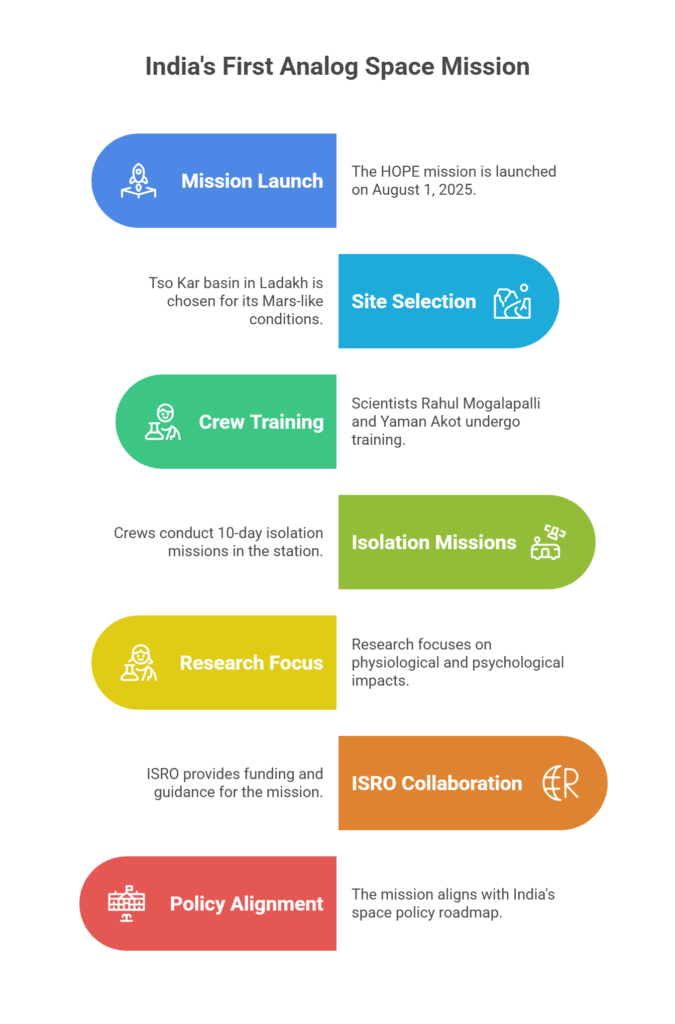
- India has launched its first analog space mission station, named Human Outer Planet Exploration (HOPE), on August 1, 2025, at Tso Kar, Ladakh.
- The mission is organized by Protoplanet, a Bengaluru-based private space research organization, in collaboration with the Indian Space Research Organisation (ISRO).
- It marks a significant step in India’s preparations for long-duration manned space missions to the Moon and Mars.
Key Highlights
- The HOPE research station is located in the Tso Kar basin, a high-altitude cold desert that mimics the terrain and conditions of the Moon and Mars.
- The site was selected after nine years of geological and environmental study, indicating a strong scientific basis for the mission.
- A rotating crew will conduct 10-day isolation missions inside the station to simulate deep space conditions.
- The first crew includes Rahul Mogalapalli and Yaman Akot, scientists trained in aerospace engineering and planetary science.
- Research will focus on physiological, psychological, and epigenetic impacts of space-like isolation, helping design systems for future human spaceflight.
- ISRO contributed through partial funding and guidance on candidate selection, showcasing increasing public-private collaboration in India’s space sector.
- This aligns with India’s larger space vision, including the Gaganyaan mission, the proposed Bharatiya Antariksh Station by 2035, and a manned Moon mission by 2040.
Concepts
- Analog space missions are Earth-based experiments designed to replicate the operational, psychological, and environmental conditions astronauts face in outer space.
- Such missions allow for safe, cost-effective testing of life-support systems, mission planning, and human adaptability before actual deployment.
- Epigenetic studies in this mission will examine how environmental stress alters gene expression without changing DNA sequences, a crucial area for long-duration spaceflight health monitoring.
- The mission will track key variables such as sleep patterns, metabolic changes, and cognitive functions, offering real-time data applicable to space exploration and even Earth-based stress research.
Related Policy and Vision
- The mission is aligned with the Indian government’s space policy roadmap that encourages private participation and innovation in frontier technology.
- Reforms such as the establishment of IN-SPACe (Indian National Space Promotion and Authorization Center) have enabled private players like Protoplanet to contribute meaningfully to national objectives.
- The mission also strengthens India’s positioning in international space collaboration and scientific diplomacy, especially as global efforts to reach Mars intensify.
- Similar analog missions globally include the Mars Desert Research Station in the United States, Flashline Mars Arctic Research Station in Canada, and BIOS-3 in Russia, all of which contribute to astronaut training and protocol development.

3rd UN conference on landlocked countries
UPSC CURRENT AFFAIRS – 08th August 2025 Home / 3rd UN conference on landlocked countries Why in News? At the

Issue of soapstone mining in Uttarakhand’s Bageshwar
UPSC CURRENT AFFAIRS – 08th August 2025 Home / Issue of soapstone mining in Uttarakhand’s Bageshwar Why in News? Unregulated

Groundwater Pollution in India – A Silent Public Health Emergency
UPSC CURRENT AFFAIRS – 08th August 2025 Home / Groundwater Pollution in India – A Silent Public Health Emergency Why

Universal banking- need and impact
UPSC CURRENT AFFAIRS – 08th August 2025 Home / Universal banking- need and impact Why in News? The Reserve Bank

India’s “Goldilocks” Economy: A Critical Appraisal
UPSC CURRENT AFFAIRS – 08th August 2025 Home / India’s “Goldilocks” Economy: A Critical Appraisal Why in News? The Finance

U.S.-India Trade Dispute: Trump’s 50% Tariffs and India’s Oil Imports from Russia
UPSC CURRENT AFFAIRS – 07th August 2025 Home / U.S.-India Trade Dispute: Trump’s 50% Tariffs and India’s Oil Imports from

Eco-Friendly Solution to Teak Pest Crisis: KFRI’s HpNPV Technology
UPSC CURRENT AFFAIRS – 07th August 2025 Home / Eco-Friendly Solution to Teak Pest Crisis: KFRI’s HpNPV Technology Why in

New Species of Non-Venomous Rain Snake Discovered in Mizoram
UPSC CURRENT AFFAIRS – 07th August 2025 Home / New Species of Non-Venomous Rain Snake Discovered in Mizoram Why in

Introduction
Economic Implications
For Indian Exporters
- These reforms reduce transaction costs and compliance hurdles
- Encourage a more competitive and efficient export environment
- Promote value addition in key sectors like leather
For Tamil Nadu
- The reforms particularly benefit the state’s leather industry, a major contributor to employment and exports
- Boost the marketability of GI-tagged E.I. leather, enhancing rural and traditional industries
For Trade Policy
- These decisions indicate a shift from regulatory controls to policy facilitation
Reinforce the goals of Make in India, Atmanirbhar Bharat, and India’s ambition to become a leading export power
Recently, BVR Subrahmanyam, CEO of NITI Aayog, claimed that India has overtaken Japan to become the fourth-largest economy in the world, citing data from the International Monetary Fund (IMF).
India’s rank as the world’s largest economy varies by measure—nominal GDP or purchasing power parity (PPP)—each with key implications for economic analysis.
Your point of view caught my eye and was very interesting. Thanks. I have a question for you.