
UPSC CURRENT AFFAIRS – 17th July 2025

Home / UPSC / Current Affairs / India’s first tribal genome project launched

India’s first tribal genome project launched

India’s first tribal genome project launched

Why in News?

  • India’s first tribal genome sequencing project to build a genetic reference database for tribal populations was launched recently by Gujarat government.

Introduction

  • Gujarat has become the first Indian state to initiate a genome sequencing project exclusively focused on its tribal communities.
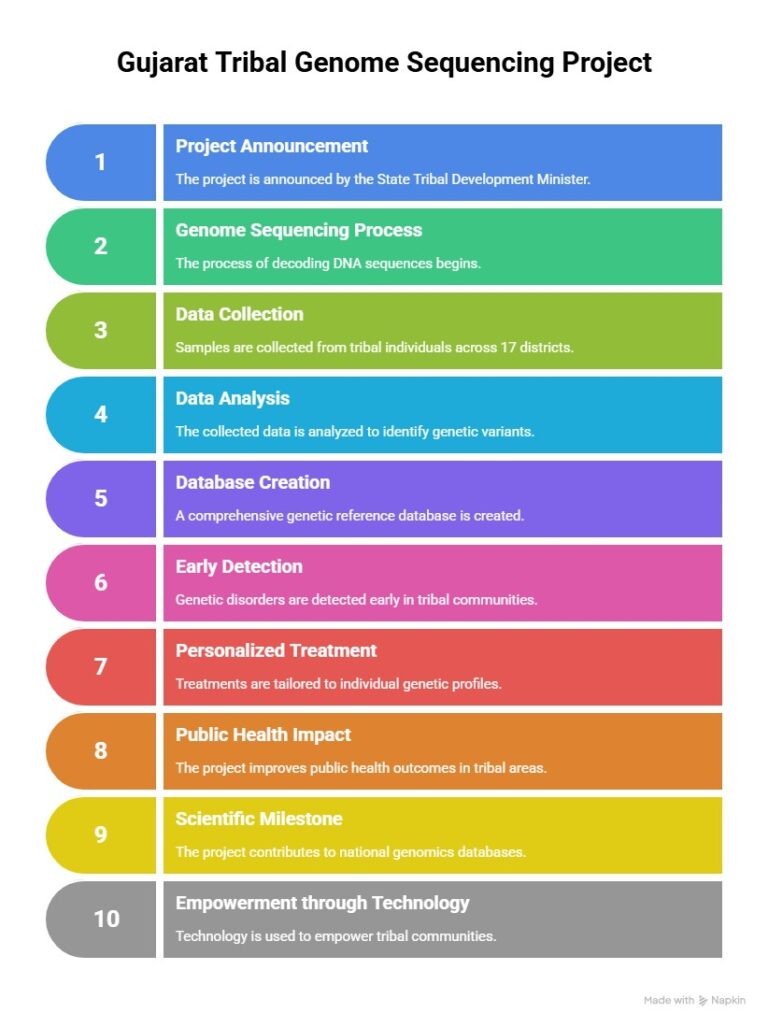
  • The project, titled Creation of Reference Genome Database for Tribal Population in Gujarat,” was announced during a high-level consultation chaired by State Tribal Development Minister Kuber Dindor.

What is Genome Sequencing?

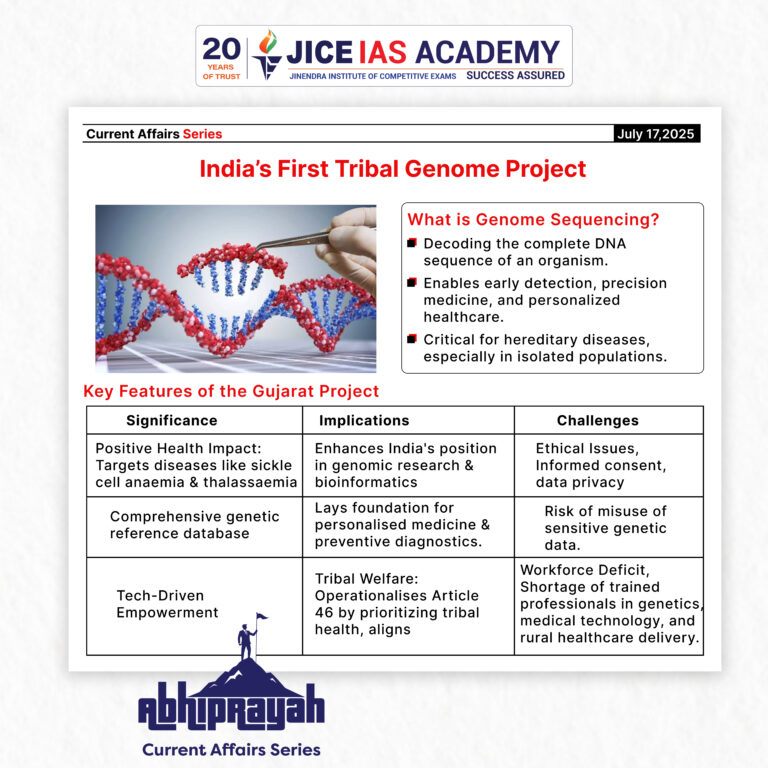
  • Genome sequencing refers to the process of decoding the complete DNA sequence of an organism’s genome.
  • It identifies genetic variants that may contribute to disease, resistance, or particular traits, and provides a foundation for personalized medicine

Key Features of the Gujarat Tribal Genome Project

Feature

Details

Title

Creation of Reference Genome Database for Tribal Population in Gujarat

Implementing Agency

Gujarat Biotechnology Research Centre (GBRC)

Scope

Sequencing of genomes of 2,000 tribal individuals from 17 districts

Budget

Part of the 2025–26 Gujarat State Budget

Targeted Disorders

Sickle cell anaemia, thalassaemia, hereditary cancers

Objective

Early detection, targeted treatment, personalized healthcare for tribal populations

Significance of the Project

  1. Public Health Impact
    • Tribal communities are often disproportionately affected by genetic disorders.
    • This project enables early detection of diseases like sickle cell anaemia, which has a high prevalence among Indian tribal populations.
    • Supports precision medicine, allowing for treatments tailored to individual genetic profiles.
  1. Scientific Milestone
    • Aims to create a comprehensive genetic reference database for tribal communities.
    • Will contribute to national-level databases for population genomics.
    • Enhances India’s capability in bioinformatics, personalised healthcare, and medical research.
  1. Empowerment through Technology
    • Tribal communities often lack access to advanced healthcare.
    • This project aims not just at research, but also technology-driven empowerment of vulnerable groups.
    • Includes infrastructure for sample collection, sequencing, and genetic interpretation.

Wider Implications

For Science & Technology

  • Boosts India’s genomic research capacity.
  • Aligns with initiatives like Genome India Project.
  • Encourages innovation in biotechnology and health informatics.

For Health

  • Addresses long-standing health inequities in tribal areas.
  • Lays the foundation for a preventive healthcare model using genetics.
  • Helps reduce the burden on healthcare systems through early interventions.

For Welfare of Tribals

  • First of its kind initiative tailored to the needs of Scheduled Tribes, fulfilling constitutional obligations for tribal welfare under Article 46.
  • Reflects commitment to inclusive development, as envisioned in schemes like Vanbandhu Kalyan Yojana and Adivasi Vikas Yojana.

Challenges Ahead

  • Ethical Concerns: Ensuring informed consent, data privacy, and community participation.
  • Infrastructure Limitations: Need for adequate medical, IT, and lab infrastructure in remote tribal areas.
  • Skilled Workforce: Requirement of trained personnel in genomics, bioinformatics, and healthcare delivery.

Way Forward

  • Community Engagement: Involving tribal leaders and NGOs in awareness and implementation.
  • Data Security Protocols: Strict guidelines for handling and storing sensitive genetic data.
  • Replication Nationwide: Use Gujarat’s model to implement pan-India tribal genome initiatives, especially in areas with high prevalence of genetic disorders.

Conclusion

  • The Gujarat Tribal Genome Sequencing Project is a pathbreaking step in integrating science with social justice.
  • By using advanced genomics to address health disparities in tribal communities, the project represents a convergence of technology, governance, and welfare — a model that other states can emulate to create an inclusive and health-secure India.

Economic Implications

For Indian Exporters

  • These reforms reduce transaction costs and compliance hurdles
  • Encourage a more competitive and efficient export environment
  • Promote value addition in key sectors like leather

For Tamil Nadu

  • The reforms particularly benefit the state’s leather industry, a major contributor to employment and exports
  • Boost the marketability of GI-tagged E.I. leather, enhancing rural and traditional industries

For Trade Policy

  • These decisions indicate a shift from regulatory controls to policy facilitation

Reinforce the goals of Make in India, Atmanirbhar Bharat, and India’s ambition to become a leading export power

Recently, BVR Subrahmanyam, CEO of NITI Aayog, claimed that India has overtaken Japan to become the fourth-largest economy in the world, citing data from the International Monetary Fund (IMF). 

India’s rank as the world’s largest economy varies by measure—nominal GDP or purchasing power parity (PPP)—each with key implications for economic analysis.

Significance and Applications

Leave a Reply

Your email address will not be published. Required fields are marked *

Call Us Now !

Copyright © JICE ACADEMY FOR EXCELLENCE PRIVATE LIMITED