

UPSC CURRENT AFFAIRS – 01st August 2025

Home / UPSC / Current Affairs / INS Himgiri a Boost to Indigenous Naval Power

INS Himgiri a Boost to Indigenous Naval Power

Why in News?

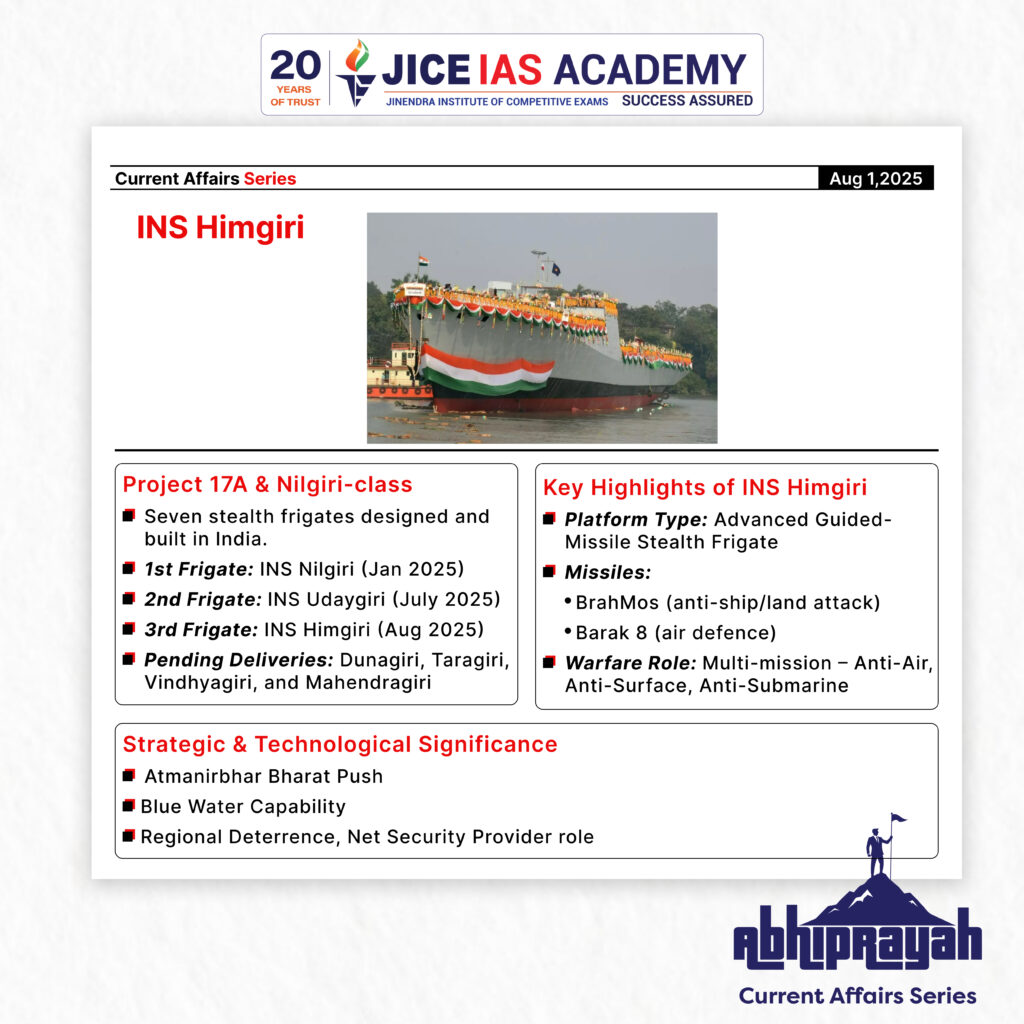
  • INS Himgiri, the third frigate of Project 17A, was delivered to the Indian Navy.

Introduction

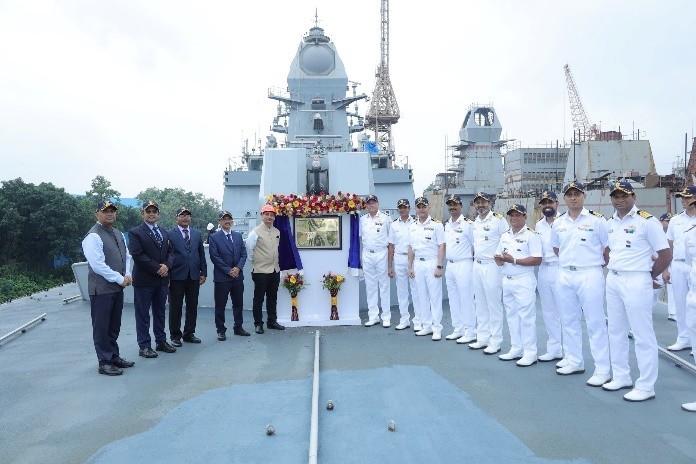
  • On August 1, 2025, the Indian Navy received INS Himgiri, an advanced guided-missile frigate built by Garden Reach Shipbuilders and Engineers (GRSE), Kolkata, under Project 17A (Nilgiri-class).
  • This marks a significant step forward in India’s maritime security, indigenisation of defence manufacturing, and naval modernization drive.

Background: Project 17A and the Nilgiri-class

  • Project 17A is the follow-up of the Project 17 (Shivalik-class frigates).
  • It involves the construction of seven stealth frigates—four at Mazagon Dock Shipbuilders Ltd. (MDL) and three at GRSE.
  • These frigates are designed by the Warship Design Bureau (WDB) of the Indian Navy and are an improved version of earlier stealth ships with more indigenous content and modular construction techniques.

INS Himgiri: Key Features and Capabilities

  1. Reincarnation of Legacy
  • Named Himgiri (Yard 3022), the new ship revives the name of the erstwhile INS Himgiri, a Leander-class frigate that served the Navy for 30 years and was decommissioned on May 6, 2025.
  • The new Himgiri embodies India’s technological and strategic evolution.
  1. Stealth and Strike Power

Equipped with:

  • BrahMos supersonic cruise missiles for anti-ship and land attack roles.
  • Barak 8 surface-to-air missiles for air defence.
  • Advanced stealth features include reduced radar cross-section, infrared and acoustic signatures, enhancing survivability in modern warfare.
  1. Multi-Mission Warfare
  • Capable of anti-air, anti-surface, and anti-submarine warfare.
  • Powered by a Combined Diesel and Gas (CODAG) propulsion system, providing both speed and fuel efficiency.
  • Armed with Advanced AESA (Active Electronically Scanned Array) radars, and modern electronic warfare systems.
  1. Aviation and Accommodation
  • Full-fledged aviation facilities for helicopters, enhancing its reconnaissance and anti-submarine capability.
  • Designed for 225 personnel, with ergonomic and modular accommodation, ensuring crew comfort on extended missions.

Technological and Industrial Significance

  1. Indigenous Design and Manufacturing
  • Designed indigenously by the Navy’s Warship Design Bureau and overseen by the Warship Overseeing Team (Kolkata).
  • Built using modular construction techniques—a first in India at this scale—enabling faster assembly and integration.
  1. High Indigenous Content
  • Over 75% of the equipment and systems onboard are indigenously developed.
  • Involvement of over 200 MSMEs, with significant contributions from the Indian private sector and DRDO labs.
  • Employment generated: ~4,000 directly and over 10,000 indirectly.
  1. Timeline and Efficiency
  • Launched in December 2020, delivered within projected timelines.
  • Demonstrates improved project management, quality control, and production efficiency in Indian shipyards.

Strategic and National Importance

  1. Maritime Security
  • Part of India’s efforts to enhance blue water naval capabilities in the Indo-Pacific.
  • Provides the Navy with a technologically advanced platform to respond to regional challenges, including maritime piracy, territorial threats, and disaster relief operations.
  1. Atmanirbhar Bharat in Defence
  • A symbol of India’s push for self-reliance in defence production under the Atmanirbhar Bharat Abhiyan.
  • Reduces dependence on foreign suppliers and strengthens defence exports potential.
  1. Regional Stability and Power Projection
  • Enhances India’s deterrence capability and strengthens its status as a net security provider in the Indian Ocean Region (IOR).
  • Supports missions related to maritime diplomacy, freedom of navigation, and regional cooperation.

Introduction

Economic Implications

For Indian Exporters

  • These reforms reduce transaction costs and compliance hurdles
  • Encourage a more competitive and efficient export environment
  • Promote value addition in key sectors like leather

For Tamil Nadu

  • The reforms particularly benefit the state’s leather industry, a major contributor to employment and exports
  • Boost the marketability of GI-tagged E.I. leather, enhancing rural and traditional industries

For Trade Policy

  • These decisions indicate a shift from regulatory controls to policy facilitation

Reinforce the goals of Make in India, Atmanirbhar Bharat, and India’s ambition to become a leading export power

Recently, BVR Subrahmanyam, CEO of NITI Aayog, claimed that India has overtaken Japan to become the fourth-largest economy in the world, citing data from the International Monetary Fund (IMF). 

India’s rank as the world’s largest economy varies by measure—nominal GDP or purchasing power parity (PPP)—each with key implications for economic analysis.

Significance and Applications

Leave a Reply

Your email address will not be published. Required fields are marked *

Call Us Now !

Copyright © JICE ACADEMY FOR EXCELLENCE PRIVATE LIMITED