
UPSC CURRENT AFFAIRS – 21th May 2025

Home / UPSC / Current Affairs / 1991 K. Veeraswami judgment in news

1991 K. Veeraswami judgment in news

k. veeraswami vs union of india 1991

Why in News?

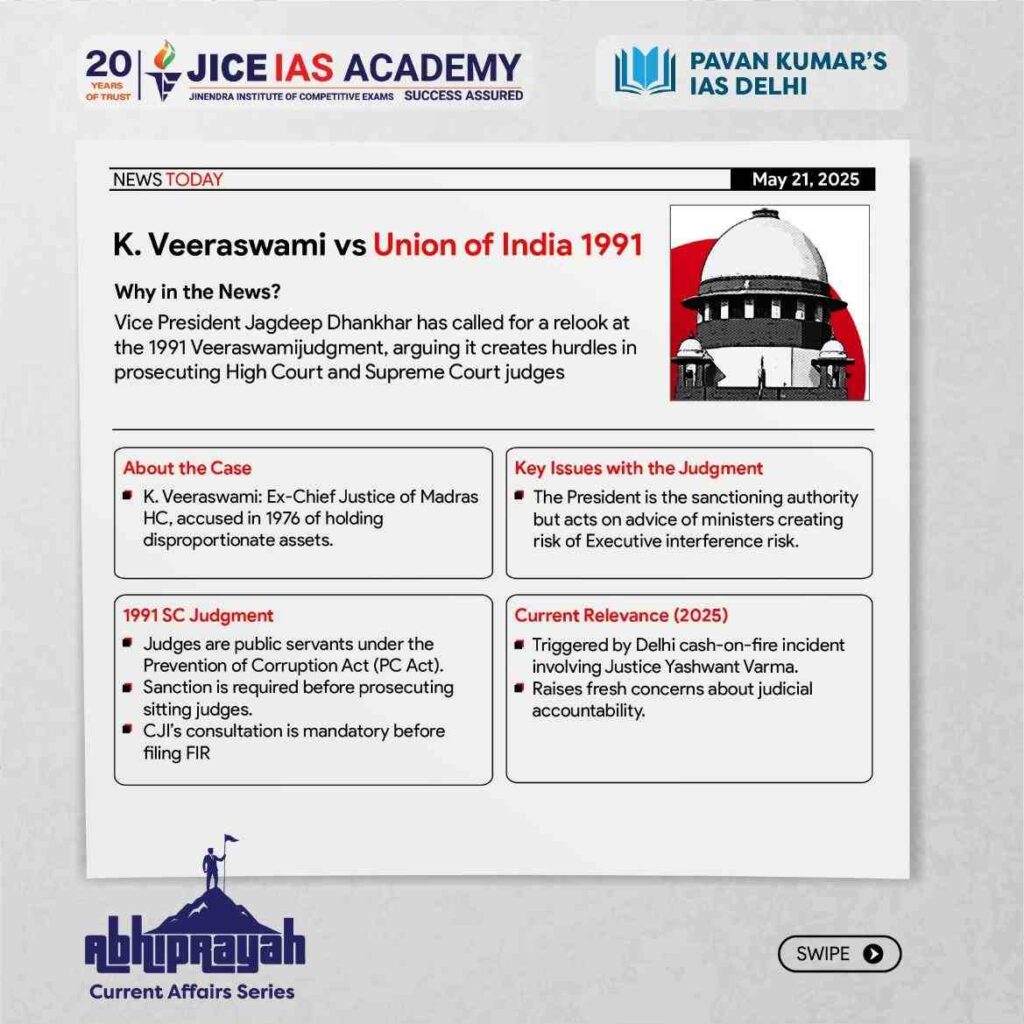
Vice President Jagdeep Dhankar has called for revisiting the 1991 K. Veeraswami vs Union of India judgment, citing it as the origin of judicial corruption and a hurdle to registering FIRs against High Court and Supreme Court judges.

Key Highlights of the Case:

  • Who was K. Veeraswami?
    • Former Chief Justice of Madras High Court (1969–1976).
    • FIR registered by the CBI in 1976 for possessing disproportionate assets under the Prevention of Corruption Act, 1947.


  • Timeline of Legal Proceedings:
    • 1976–1977: CBI filed FIR and chargesheet.
    • 1978: Veeraswami challenged the prosecution in Madras High Court.
    • 1979: Full Bench of Madras HC (2:1) rejected the plea.
    • 1991: Supreme Court upheld the prosecution in a 4:1 majority decision.


  • Supreme Court Judgment (1991):
    • Judges of High Courts and the Supreme Court are covered under the definition of ‘public servant’ under the PC Act.
    • Sanction required for prosecution of sitting judges.
    • Consultation with the Chief Justice of India (CJI) is mandatory before:
      • Filing an FIR.
      • Granting sanction for prosecution.
    • If CJI is accused, consult other senior judges of the SC.
    • Dissenting Opinion (Justice J.S. Verma):
      • Judges of higher judiciary should be excluded from the PC Act.
      • Called for a new law for corruption cases involving constitutional authorities.

Important Points:

  • Prevention of Corruption Act, 1947 (now replaced by PC Act, 1988):
    • A central anti-corruption law.
    • Requires sanction to prosecute public servants.
  • Public Servant under PC Act: Includes judges, making them liable for prosecution with procedural safeguards.
  • Sanctioning Authority: The President of India is the authority, acting in consultation with the CJI.
  • Judicial Immunity vs Accountability: The case raised critical questions about balancing judicial independence with legal accountability.
  • Current Relevance (2025):
    • The Delhi cash-on-fire case at the residence of Justice Yashwant Varma has reignited concerns over procedural hurdles in prosecuting judges.
k. veeraswami judgement 1991

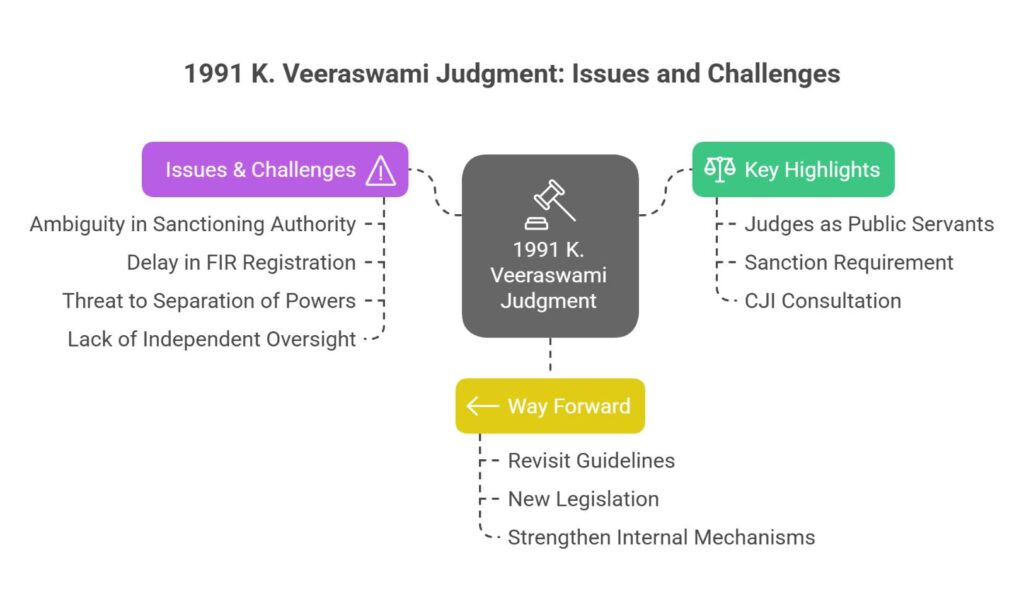
Issues & Challenges Identified in Implementing the Veeraswami Judgment

  1. Ambiguity in Sanctioning Authority
    • The judgment designates the President as the competent authority to grant sanction for prosecution, but the President acts on the aid and advice of the Council of Ministers.
    • This creates uncertainty and potential executive influence in matters concerning judicial accountability.

  2. Delay in FIR Registration
    • The mandatory requirement to consult the Chief Justice of India (CJI) before even registering an FIR against a sitting judge leads to procedural delays.
    • This may obstruct timely investigation and undermine public trust in judicial impartiality.

  3. Threat to Separation of Powers
    • Involving the executive (through the President) in sanctioning prosecutions against judges risks interference with judicial independence, violating the doctrine of separation of powers.

  4. Lack of an Independent Oversight Mechanism
    • India lacks a dedicated, independent body to examine corruption or misconduct complaints against judges of higher judiciary.
    • The internal ‘in-house mechanism’ of the judiciary is non-statutory, opaque, and not subject to public scrutiny or external audit.

Way Forward:

  • Revisit 1991 Guidelines: As suggested by the Vice President, to ensure transparency and accountability without compromising judicial independence.
  • New Legislation: May be needed for dealing with misconduct at the highest levels of the judiciary.
  • Strengthen Internal Judicial Mechanisms: To handle corruption allegations without delay.
  • Decreased oxygen-carrying capacity of RBCs.
  • Increased fragility and cell stiffness.
  • Vascular blockage, causing pain and organ injury.
  • Increased susceptibility to infections, anemia, and stroke.

Past Illegal Allotments Invalid

2 Responses

Leave a Reply

Your email address will not be published. Required fields are marked *

Call Us Now !

Copyright © JICE ACADEMY FOR EXCELLENCE PRIVATE LIMITED