UPSC CURRENT AFFAIRS – 02nd August 2025
Malaria Elimination in India by 2030: Innovations, Vaccines, and the New Battlegrounds
Why in News?
Despite major progress, India’s malaria elimination goal by 2030 faces new frontlines—hidden parasite reservoirs, dual-species infections, and the need for next-generation vaccines and public health innovation.
Introduction
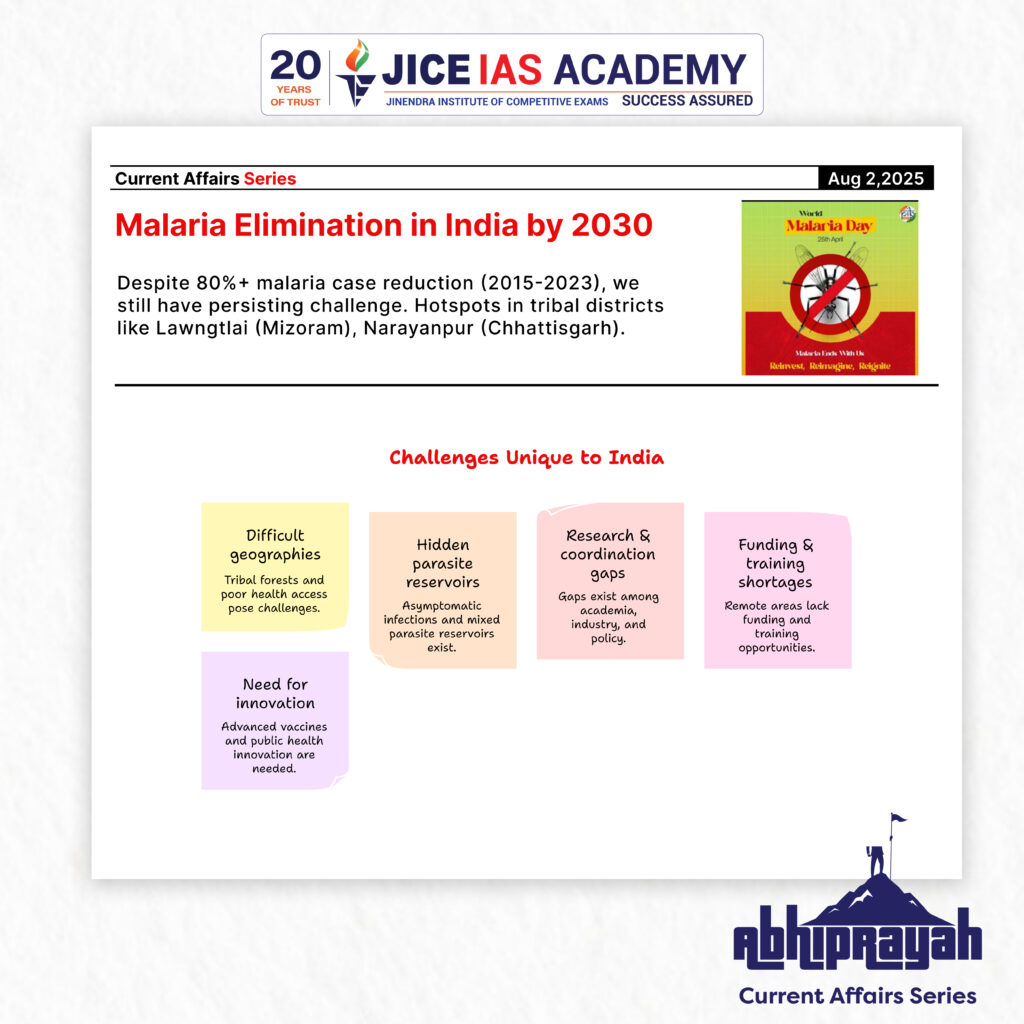
- India has made remarkable progress in malaria control, with an over 80% reduction in malaria cases between 2015 and 2023.
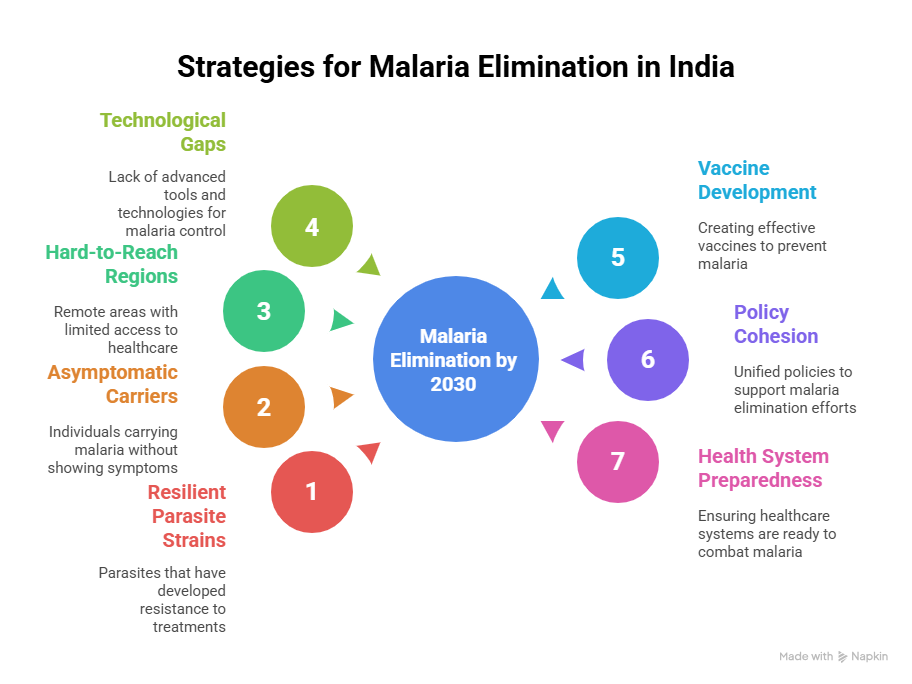
- Yet, the road to malaria elimination by 2030 is far from easy. Unlike before, the challenge is no longer a uniform national burden—it is about tackling resilient parasite strains, asymptomatic carriers, hard-to-reach tribal and forest regions, and technological gaps.
- The disease’s complex life cycle and the dual burden of Plasmodium falciparum and Plasmodium vivax require a multi-pronged, innovative approach rooted in science, vaccine development, policy cohesion, and health system preparedness.
India’s Malaria Landscape: Uneven and Complex
- National gains mask localized hotspots, especially in tribal districts such as:
- Lawngtlai (Mizoram): 56 cases per 1,000 people
- Narayanpur (Chhattisgarh): 22 cases per 1,000 people
- Mixed infections, especially in Jharkhand, where 20% of cases show both P. falciparum and P. vivax, complicate treatment and tracking.
- P. vivax, unlike P. falciparum, can relapse from dormant liver forms, requiring longer-term strategies.
- Asymptomatic carriers quietly maintain transmission chains in areas showing “success” in reducing reported cases.
Breakthrough Vaccines: Hope and Limitations
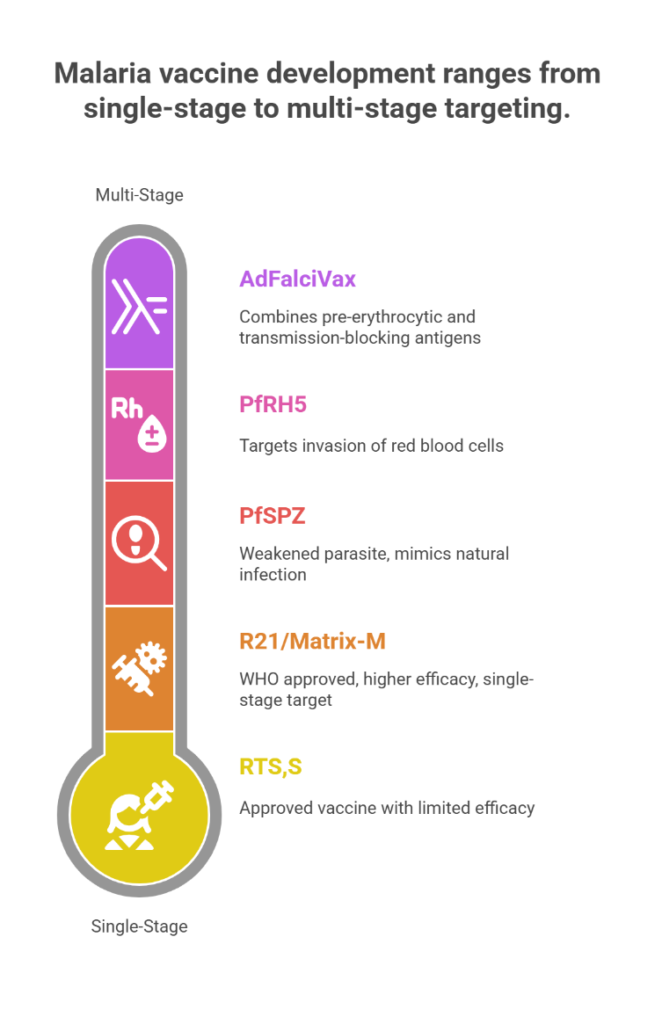
- First-generation vaccines like RTS,S and R21/Matrix-M offer partial protection (~55–77%) and target only one parasite stage, leading to reinfections.
- Whole-parasite vaccines (PfSPZ) and blood-stage vaccines (PfRH5) show higher efficacy and broader strain coverage but remain in trial phases.
- India’s AdFalciVax, developed by ICMR (2025), is a dual-stage vaccine targeting both infection and transmission.
- It is room-temperature stable, induced a strong immune response in mice, but human deployment may take 7–8 years.
- Transmission-blocking vaccines (TBVs), including India’s and global efforts (e.g., Mali, Thailand), show promise but face scalability and long-term efficacy challenges.
AdFalciVax – India’s Indigenous Dual-Stage Malaria Vaccine (2025)
- Developed by Indian Council of Medical Research (ICMR).
- Dual-stage vaccine combining:
- PfCSP – Pre-erythrocytic antigen (prevents infection).
- Pfs230 & Pfs48/45 – Transmission-blocking antigens (prevent parasite spread via mosquitoes).
- Key Achievements:
- Induced a strong immune response in mice, lasting nearly a human decade.
- Stable at room temperature, making it suitable for rural deployment.
- Human trials yet to begin; deployment expected in 7–8 years.
- Marks India’s first major step into the domain of Transmission-Blocking Vaccines (TBVs).
Transmission-Blocking Vaccines (TBVs) – Global and Indian Developments
- Pfs230D1 (Mali trial): Achieved 78% reduction in transmission.
- AdFalciVax (India): Integrates both infection prevention and transmission-blocking.
- For Plasmodium vivax:
- Pvs230D1M (Thailand trial): Reduced mosquito transmission by up to 96%.
- India is also developing TBVs specifically targeting vivax.
New Vaccine Frontiers
- Immune Response Boosters
- Ferritin nanoparticle + CpG adjuvant: Cut liver-stage parasite load by 95% in mice
- AdFalciVax + Alum: Showed 90%+ protection with even mild adjuvants
- mRNA-based Platforms
- CureVac + NIH (Pfs25 antigen): Complete mosquito transmission blockage in mice
- BioNTech (BNT165e): mRNA-based blood-stage vaccine, FDA put on hold
- T-Cell Directed Vaccines
- Modified PfCSP + MIP3α molecule → enhanced T-cell targeting, 88% reduction in liver stage parasite load (in mice)
- Engineered Antibodies
- D1D2.v-IgG: Binds parasite protein (RIFIN) 110x more strongly, restoring immune function in lab tests
Vector Control and Genetic Engineering
- Gene Drive Systems
- Fertility-disrupting genes introduced in Anopheles gambiae → colony wiped out in lab in 1 year
- Challenges:
- Ecological risks
- Evolution of resistance
- Ethical concerns
- Targeted Gene Editing (FREP1)
- One-letter gene change → malaria parasite development blocked in mosquitoes
- Spread to 90% lab population in 10 generations
- Self-Limiting Infections
- Mosquitoes die sooner if infected → reduces transmission naturally
- Less selective pressure on parasite → lower resistance risk
Challenges Unique to India
- Difficult Geographies
- Northeast, central tribal belts, and forested areas → poor health access
- Asymptomatic Reservoirs
- Adults and older children carry parasites silently
- Require mass surveillance and diagnostics
- Mixed Infections
- Need dual-species vaccines, drugs, and diagnostic tools
- Research Gaps
- P. cynomolgi is the best model for P. vivax, but legal hurdles in primate research stalled Indian progress
- Coordination Deficit
- Lack of collaboration between academia, industry, and policy
- Funding gaps, especially post-discovery phase
- Training gaps among doctors, paramedics in remote zones
The Way Forward: A Full-Spectrum Strategy
- Science + Systems
- Innovation alone is not enough.
- Need:
- Trained personnel
- Surveillance of drug resistance
- Strengthened rural health infrastructure
- Strategic deployment of multiple vaccines
- Political Will and Public Investment
- Like COVID-19, malaria elimination needs a mission-mode approach
- Push for GMP-grade production, clinical trial infrastructure, public-private partnerships
- Inclusive Health Policies
- Prioritize tribal and vulnerable regions
- Combine vector control, vaccines, and community engagement
- Global and National Collaboration
- Build alliances with WHO, ICMR, SII, NIH, and academic networks
Conclusion
While the India-U.K. FTA is a diplomatic and economic milestone, the digital trade concessions present a serious challenge to India’s long-term digital autonomy and technological self-reliance. In the age of data-driven geopolitics, sovereignty is not just about borders — it is about algorithms, access, and infrastructure. India must not repeat the mistakes of the colonial past in the digital future. A clear national roadmap for digital industrialisation, informed policy frameworks, and assertive negotiation strategies are essential to secure a prosperous and independent digital future.

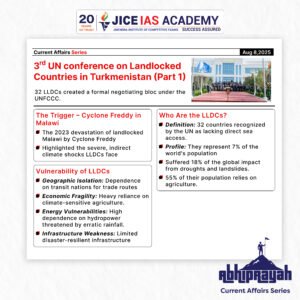
3rd UN conference on landlocked countries
UPSC CURRENT AFFAIRS – 08th August 2025 Home / 3rd UN conference on landlocked countries Why in News? At the

Issue of soapstone mining in Uttarakhand’s Bageshwar
UPSC CURRENT AFFAIRS – 08th August 2025 Home / Issue of soapstone mining in Uttarakhand’s Bageshwar Why in News? Unregulated

Groundwater Pollution in India – A Silent Public Health Emergency
UPSC CURRENT AFFAIRS – 08th August 2025 Home / Groundwater Pollution in India – A Silent Public Health Emergency Why

Universal banking- need and impact
UPSC CURRENT AFFAIRS – 08th August 2025 Home / Universal banking- need and impact Why in News? The Reserve Bank

India’s “Goldilocks” Economy: A Critical Appraisal
UPSC CURRENT AFFAIRS – 08th August 2025 Home / India’s “Goldilocks” Economy: A Critical Appraisal Why in News? The Finance

U.S.-India Trade Dispute: Trump’s 50% Tariffs and India’s Oil Imports from Russia
UPSC CURRENT AFFAIRS – 07th August 2025 Home / U.S.-India Trade Dispute: Trump’s 50% Tariffs and India’s Oil Imports from
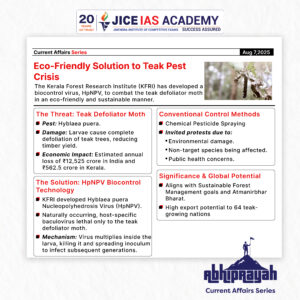
Eco-Friendly Solution to Teak Pest Crisis: KFRI’s HpNPV Technology
UPSC CURRENT AFFAIRS – 07th August 2025 Home / Eco-Friendly Solution to Teak Pest Crisis: KFRI’s HpNPV Technology Why in

New Species of Non-Venomous Rain Snake Discovered in Mizoram
UPSC CURRENT AFFAIRS – 07th August 2025 Home / New Species of Non-Venomous Rain Snake Discovered in Mizoram Why in

Introduction
Economic Implications
For Indian Exporters
- These reforms reduce transaction costs and compliance hurdles
- Encourage a more competitive and efficient export environment
- Promote value addition in key sectors like leather
For Tamil Nadu
- The reforms particularly benefit the state’s leather industry, a major contributor to employment and exports
- Boost the marketability of GI-tagged E.I. leather, enhancing rural and traditional industries
For Trade Policy
- These decisions indicate a shift from regulatory controls to policy facilitation
Reinforce the goals of Make in India, Atmanirbhar Bharat, and India’s ambition to become a leading export power
Recently, BVR Subrahmanyam, CEO of NITI Aayog, claimed that India has overtaken Japan to become the fourth-largest economy in the world, citing data from the International Monetary Fund (IMF).
India’s rank as the world’s largest economy varies by measure—nominal GDP or purchasing power parity (PPP)—each with key implications for economic analysis.