
UPSC CURRENT AFFAIRS – 02nd August 2025

Home / UPSC / Current Affairs / Mangroves as Drivers of Climate and Economic Resilience

Mangroves as Drivers of Climate and Economic Resilience

Why in News?

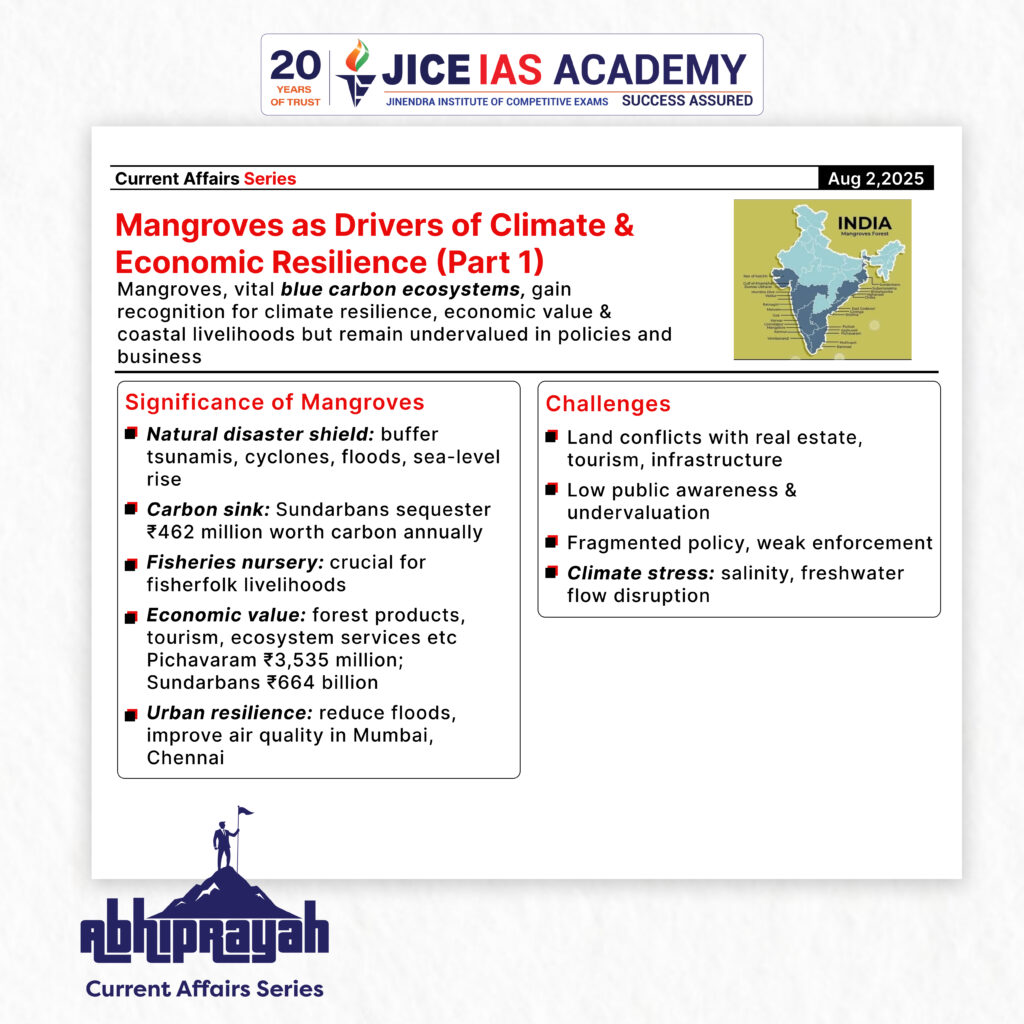
  • Mangroves, critical blue carbon ecosystems, are increasingly recognized for their vital role in climate resilience, economic stability, and sustainable livelihoods, yet remain undervalued in policy and business frameworks.

Introduction

  • Mangroves, once relegated to the periphery of environmental planning, are emerging as vital components of natural infrastructure.
  • These intertidal forests along coastlines protect against extreme weather events, nurture biodiversity, sequester carbon, and sustain coastal livelihoods.
  • Despite their substantial ecological and economic benefits, mangroves are often missing from financial balance sheets, infrastructure planning, and corporate responsibility frameworks.
  • As India and the world face rising sea levels, urban coastal vulnerability, and biodiversity loss, mangroves offer a natural solution that combines climate adaptation with economic opportunity.
  • Their conservation and regeneration now require a holistic, technology-enabled, community-led and science-based approach.

Significance of Mangroves: Ecosystem and Economic Services

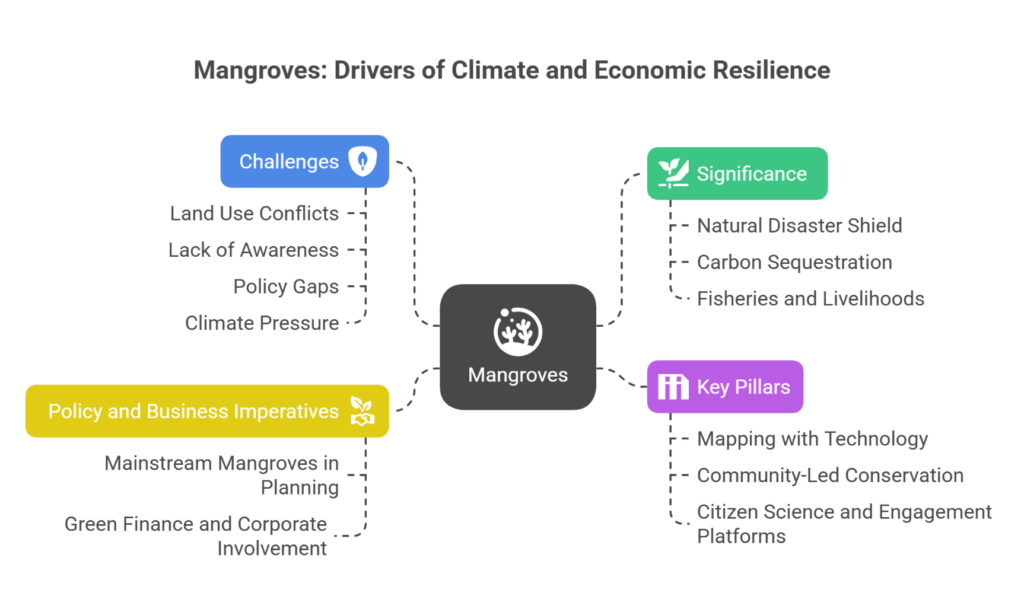
  • Natural Disaster Shield: Act as buffers against tsunamis, cyclones, floods, and sea-level rise.
  • Carbon Sequestration: Serve as ‘blue carbon’ sinks — Sundarbans alone sequester carbon worth ₹462 million annually.
  • Fisheries and Livelihoods: Function as nurseries for juvenile fish; essential to fisherfolk and coastal livelihoods.
  • Economic Value:
    • Pichavaram mangroves (Tamil Nadu): ecosystem services valued at ₹3,535 million.
    • Sundarbans (West Bengal): total ecosystem services worth ₹664 billion.
  • Urban Resilience: In cities like Mumbai and Chennai, mangroves reduce flood risk, improve air quality, and provide green cover.

Challenges to Mangrove Protection

  • Land Use Conflicts: Real estate, infrastructure, and tourism developments threaten mangrove lands.
  • Lack of Awareness: Ecosystem services are undervalued due to insufficient public understanding.
  • Policy Gaps: Fragmented legal frameworks, weak enforcement, and lack of integration in development plans.
  • Climate Pressure: Rising salinity and irregular freshwater flows disrupt ecosystem dynamics.

Steps to Protect Mangroves

  1. Mapping with Technology: Leveraging Natural Capital Data
  • Tools: Satellite imagery, drone data, and AI-driven geospatial analysis help quantify blue carbon and track degradation.
  • Policy Impact: Improved mapping feeds into evidence-based policymaking and restoration prioritisation.
  • Inclusion: Recognizes the ecological wisdom of coastal communities and supports equitable benefit-sharing.
  1. Community-Led Conservation: Empowering Coastal Stakeholders
  • Livelihood Integration:
    • Fisherfolk depend on mangroves for sustainable catch.
    • Alternative livelihoods: aquaculture, beekeeping, eco-tourism.
  • Degradation in Urban Settings: Mangroves near cities suffer due to pollution and encroachment.
  • Solution Models:
    • Community-based governance like Eco-Development Committees (EDCs) and Joint Forest Management Committees (JFMCs).
    • Building trust and participation ensures long-term ecological health and social equity.
  1. Citizen Science and Engagement Platforms
  • Participatory Monitoring: Citizens trained to assess:
    • Mangrove area and health
    • Freshwater flows and biodiversity indicators
    • Community dependence and perceived ecosystem value
  • Tools and Platforms:
    • Development of a “Mangrove Health Tool”
    • Public engagement through platforms like “Mangrove Mitras” (Friends of Mangroves)
  • Outcome: Creates a feedback loop between citizen awareness, scientific insight, and local action.

Policy and Business Imperatives

  • Mainstream Mangroves in Planning:
    • Recognize mangroves as economic infrastructure, not just biodiversity areas.
    • Integrate mangroves in coastal zone regulations (CRZ), urban planning, and disaster risk reduction frameworks.
  • Green Finance and Corporate Involvement:
    • Encourage natural capital accounting.
    • Facilitate carbon credits and ESG investments focused on mangrove regeneration.
  • Coalition Approach:
    • Government, private sector, civil society, and scientific institutions must collaborate.

Mangrove Coalition efforts are an example of cross-sectoral governance.

Way Forward

  • Integrated Coastal Zone Management (ICZM) should prioritize mangrove preservation as a central theme.
  • Link local conservation to national and global climate commitments such as India’s Panchamrit and SDGs.
  • Data-driven conservation and people-centric policies are needed to secure long-term mangrove health.
  • Reframe the narrative — “Mangroves drive business” — by showing their ROI in disaster savings, fishery yield, and carbon storage.

Introduction

Economic Implications

For Indian Exporters

  • These reforms reduce transaction costs and compliance hurdles
  • Encourage a more competitive and efficient export environment
  • Promote value addition in key sectors like leather

For Tamil Nadu

  • The reforms particularly benefit the state’s leather industry, a major contributor to employment and exports
  • Boost the marketability of GI-tagged E.I. leather, enhancing rural and traditional industries

For Trade Policy

  • These decisions indicate a shift from regulatory controls to policy facilitation

Reinforce the goals of Make in India, Atmanirbhar Bharat, and India’s ambition to become a leading export power

Recently, BVR Subrahmanyam, CEO of NITI Aayog, claimed that India has overtaken Japan to become the fourth-largest economy in the world, citing data from the International Monetary Fund (IMF). 

India’s rank as the world’s largest economy varies by measure—nominal GDP or purchasing power parity (PPP)—each with key implications for economic analysis.

Significance and Applications

Leave a Reply

Your email address will not be published. Required fields are marked *

Call Us Now !

Copyright © JICE ACADEMY FOR EXCELLENCE PRIVATE LIMITED