UPSC CURRENT AFFAIRS – 04th August 2025

Home / UPSC / Current Affairs / Mizoram Railway Project and the Act East Policy

Mizoram Railway Project and the Act East Policy

Why in News?

  • The Bairabi–Sairang railway line in Mizoram is a strategic infrastructure project under India’s Act East Policy.

Background

  • The northeastern region of India has long remained geographically isolated from the rest of the country due to difficult terrain, underdeveloped infrastructure, and limited access to transport facilities.
  • In order to overcome these challenges and integrate the Northeast with the national economy and strategic vision, successive governments have undertaken various connectivity initiatives.
  • One of the most significant of these efforts is the recent commissioning of the railway line from Bairabi to Sairang in Mizoram, which holds considerable strategic and economic significance under India’s Act East Policy.

Project Features and Status

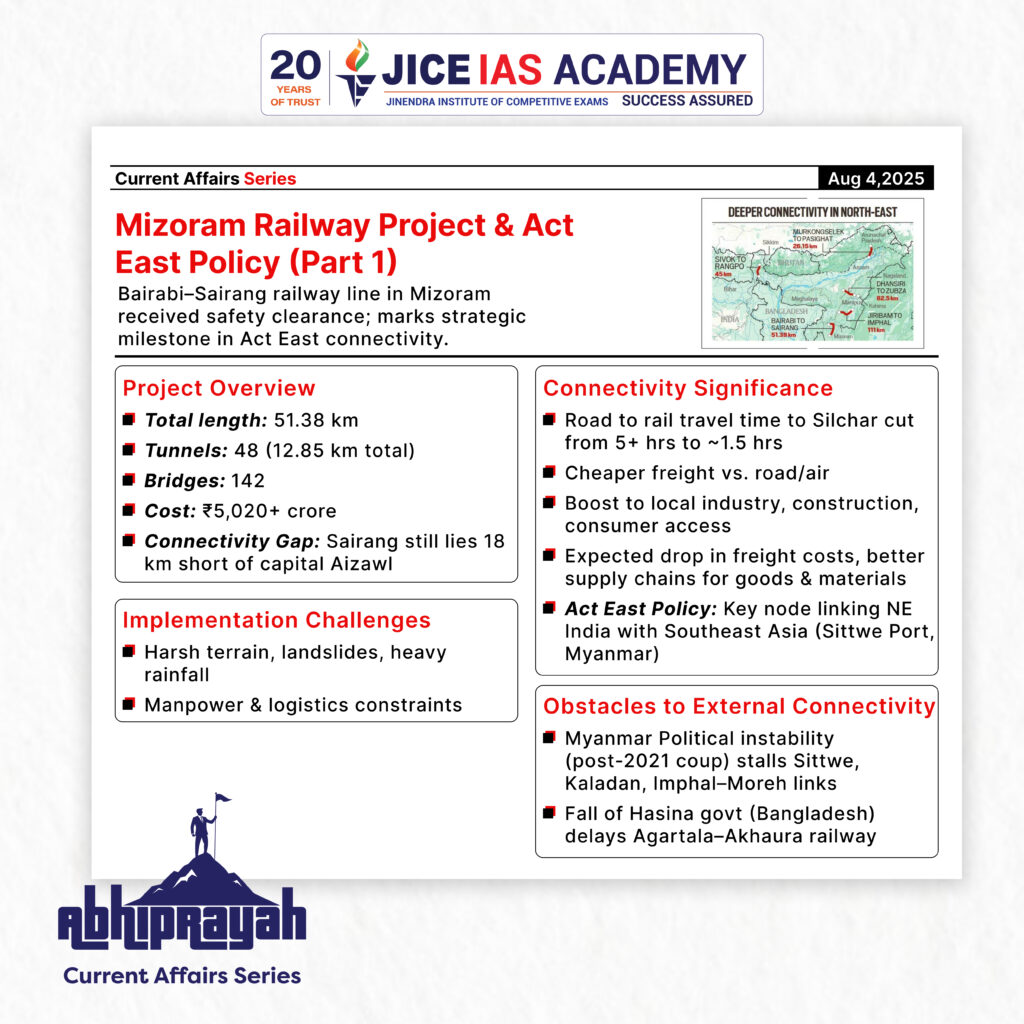
  • Total length: 51.38 km
  • Number of tunnels: 48, with a cumulative length of 12.85 km
  • Number of bridges: 142
  • Project cost: Over ₹5,020 crore
  • Current status: Received safety clearance in June 2025; awaiting formal inauguration

Implementation Challenges

The project faced several hurdles:

  • The terrain is mountainous and prone to landslides.
  • Heavy rainfall frequently disrupted construction activities.
  • Manpower shortages and logistical difficulties in transporting materials further slowed the work.
  • A major setback occurred in August 2023, when a bridge under construction collapsed, resulting in the death of 18 workers. This bridge was to feature the tallest pier of the project.

Significance of the Mizoram Railway Project

Enhanced Connectivity

  • Until now, Mizoram’s primary mode of access to other parts of the country has been through air travel or the Aizawl-Silchar highway via Sairang, which takes over five hours by road.
  • With the introduction of railway services, including the potential introduction of a Rajdhani Express, travel time to Silchar is expected to be reduced to approximately 1.5 hours.

Reduction in Transport Costs

  • Rail transport is significantly more economical compared to road or air transport. The new railway line is expected to lower freight charges and improve supply chain efficiency, particularly for essential goods and construction materials.

Boost to Trade, Tourism, and Economic Activity

  • The Sairang railhead is expected to promote trade and commerce by facilitating easier movement of goods.
  • It will also enhance tourism by providing easier access for tourists visiting Mizoram.
  • The state’s reliance on truck-based freight is expected to decline as a result.

Strategic Importance under the Act East Policy

  • From a strategic standpoint, the Sairang railhead is crucial. It serves as a key node in India’s effort to integrate the Northeast with Southeast Asia through improved connectivity, trade, and strategic partnerships.
  • The railhead is expected to facilitate the transhipment of goods from the Sittwe Port in Myanmar, which has been developed with Indian assistance.

Understanding the Act East Policy

From Look East to Act East

  • The Look East Policy was initiated in 1991 by the Government of India to develop economic and strategic relations with Southeast Asian countries.
  • In 2014, this evolved into the Act East Policy, announced by Prime Minister Narendra Modi, with the added focus on infrastructure-led connectivity, security cooperation, and deeper diplomatic engagement.
  • The Northeast was envisioned as the gateway to the ASEAN region under this policy.

Infrastructure Development Achievements

Since the implementation of the Act East Policy:

  • Budgetary allocation for the Northeast increased by 300%, from ₹36,108 crore (2014-15) to over ₹1,00,000 crore (2024-25).
  • Over 10,000 km of highways and 800 km of railway tracks have been constructed.
  • Eight new airports have been inaugurated.
  • Several inland waterway projects have been initiated.

Major Connectivity Projects Underway

  • Dimapur–Zubza Railway Project (Nagaland): 82.5 km line connecting Dimapur to Kohima, currently progressing well.
  • Imphal–Moreh Railway Project (Manipur): Intended to connect India to Myanmar by rail. Progress has been hampered due to ongoing ethnic unrest in Manipur.
  • Asian Highway 1: A road corridor linking Assam to Moreh via Kohima and Imphal, forming a major international road artery.

Obstacles to External Connectivity and Implementation

Political instability War in Myanmar

  • A significant setback to the Act East Policy has been the military coup in Myanmar in February 2021, which led to civil unrest and the suspension of bilateral connectivity projects.

Political Developments in Bangladesh

  • The fall of Sheikh Hasina’s government in Bangladesh in August 2024 has further complicated the implementation of cross-border infrastructure projects such as the Agartala–Akhaura railway.

Stalled Cross-Border Projects

  • Agartala–Akhaura Railway Project: Intended to connect Tripura with Kolkata through Bangladesh and provide access to the Chittagong Port. Currently stalled.
  • Kaladan Multi-Modal Transit Transport Project: A ₹2,904 crore project in Myanmar aimed at linking Mizoram to the Sittwe Port and reducing the distance to Kolkata by 1,000 km. This project too has been delayed due to instability in Myanmar.

Conclusion

  • The commissioning of the Bairabi–Sairang railway line is a major milestone in the Indian Railways’ efforts to integrate the Northeastern region with the rest of the country.
  • While the project will improve domestic connectivity, reduce travel time, and lower transportation costs, its true potential lies in its strategic role within the framework of the Act East Policy.
  • However, geopolitical instability in Myanmar and Bangladesh remains a significant impediment to realising the full goals of regional connectivity and economic integration with Southeast Asia.

Introduction

Economic Implications

For Indian Exporters

  • These reforms reduce transaction costs and compliance hurdles
  • Encourage a more competitive and efficient export environment
  • Promote value addition in key sectors like leather

For Tamil Nadu

  • The reforms particularly benefit the state’s leather industry, a major contributor to employment and exports
  • Boost the marketability of GI-tagged E.I. leather, enhancing rural and traditional industries

For Trade Policy

  • These decisions indicate a shift from regulatory controls to policy facilitation

Reinforce the goals of Make in India, Atmanirbhar Bharat, and India’s ambition to become a leading export power

Recently, BVR Subrahmanyam, CEO of NITI Aayog, claimed that India has overtaken Japan to become the fourth-largest economy in the world, citing data from the International Monetary Fund (IMF). 

India’s rank as the world’s largest economy varies by measure—nominal GDP or purchasing power parity (PPP)—each with key implications for economic analysis.

Significance and Applications

Leave a Reply

Your email address will not be published. Required fields are marked *

Call Us Now !

Copyright © JICE ACADEMY FOR EXCELLENCE PRIVATE LIMITED