
UPSC CURRENT AFFAIRS – 19 March 2025
National Wildlife Health Policy Draft Highlights
Why in News:
Five years after the Covid-19 pandemic, caused by the SARS-CoV-2 virus, highlighted the risks of zoonotic diseases, the Indian government is reviewing an interim draft of the National Wildlife Health Policy (NWHP).
Proposed National Wildlife Health Policy
- The policy aims to establish integrated wildlife disease surveillance, research mechanisms, and new diagnostic laboratories.
- It aligns with the National One Health Mission, which promotes a holistic approach to human, animal, and environmental health.
- The Central Zoo Authority (CZA), under the Ministry of Environment, Forest and Climate Change (MoEF&CC), organized a consultative workshop involving government agencies, NGOs, academic institutions, zoological parks, and veterinary universities to develop the National Wildlife Health Policy.
- The policy formulation is being supported by the GISE Hub at IIT Bombay and the Office of the Principal Scientific Adviser to the Government of India.
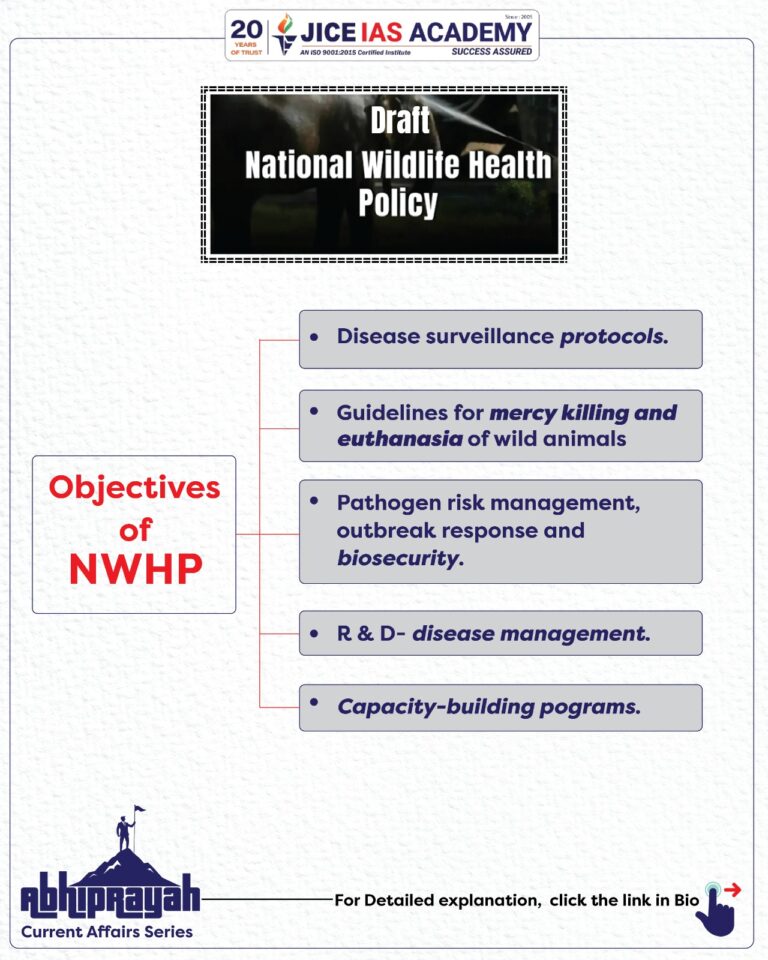
Objectives
The policy aligns with India’s National Wildlife Action Plan (2017-31) and the One Health framework, emphasizing human, animal, and environmental health interconnectivity. Key initiatives include:
Current Wildlife Health Challenges
- Indian wildlife faces multiple threats, including infectious diseases like Canine Distemper Virus, habitat degradation, climate change, and illegal activities.
- With over 91,000 species and more than 1,000 protected areas—including national parks, wildlife sanctuaries, and biosphere reserves—a comprehensive wildlife health policy is essential for effective conservation and disease management.
Need for a National Wildlife Health Policy
- According to government data, over 60% of emerging infectious diseases affecting humans originate from animals.
- India’s 1,014 protected areas—including 106 national parks, 573 wildlife sanctuaries, 115 conservation reserves, and 220 community reserves—harbor diverse terrestrial, avian, and marine species, making wildlife health monitoring crucial for preventing zoonotic outbreaks.
- The Central Zoo Authority (CZA), under the Ministry of Environment, is leading policy drafting efforts, while the Principal Scientific Adviser’s office is coordinating consultations with experts.
- The Indian Institute of Technology, Bombay and private consultancy firm Ernst & Young are supporting the formulation process.
Key Features and Recommendations of the Policy
The policy framework is being shaped by seven working groups, focusing on disease surveillance, research, capacity building, and regulatory measures. Key recommendations include:
- Establishing a Wildlife Disease Surveillance System
- Aims to monitor and report diseases affecting terrestrial, marine, and avian ecosystems.
- Encourages data sharing between the Ministry of Environment, Ministry of Agriculture, and Department of Animal Husbandry.
- Setting Up the National Wildlife Health Database & Information System
- The National Wildlife Health Database will serve as a central repository for real-time and historical disease surveillance data.
- The Wildlife Health Information System will streamline facility-level reporting, spatial-temporal data analysis, and disease monitoring.
- Role of the National Referral Centre for Wildlife (NRC-W)
- Located in Junagadh, Gujarat, the NRC-W—whose foundation stone was laid by Prime Minister Narendra Modi on March 3, 2025—will function as a nodal center for investigating wildlife mortalities, disease outbreaks, and diagnostics.
- Satellite Diagnostic Labs for Wildlife Health
- Proposed near critical forest habitats to enhance early disease detection and wildlife health management.
- Community Engagement for Disease Prevention
- Focus on vaccination programs for cattle near national parks to prevent the spread of diseases between livestock and wildlife.
Way Forward
- The National Wildlife Health Policy aims to bridge existing gaps in wildlife disease surveillance by integrating efforts across environmental, agricultural, and veterinary sectors.
- Strengthening diagnostic infrastructure, improving cross-sectoral collaboration, and enhancing real-time data collection will be critical to ensuring effective wildlife health management and pandemic preparedness.
- The final policy draft is expected to undergo inter-ministerial consultations before implementation.

3rd UN conference on landlocked countries
UPSC CURRENT AFFAIRS – 08th August 2025 Home / 3rd UN conference on landlocked countries Why in News? At the

Issue of soapstone mining in Uttarakhand’s Bageshwar
UPSC CURRENT AFFAIRS – 08th August 2025 Home / Issue of soapstone mining in Uttarakhand’s Bageshwar Why in News? Unregulated
Groundwater Pollution in India – A Silent Public Health Emergency
UPSC CURRENT AFFAIRS – 08th August 2025 Home / Groundwater Pollution in India – A Silent Public Health Emergency Why

Universal banking- need and impact
UPSC CURRENT AFFAIRS – 08th August 2025 Home / Universal banking- need and impact Why in News? The Reserve Bank

India’s “Goldilocks” Economy: A Critical Appraisal
UPSC CURRENT AFFAIRS – 08th August 2025 Home / India’s “Goldilocks” Economy: A Critical Appraisal Why in News? The Finance

U.S.-India Trade Dispute: Trump’s 50% Tariffs and India’s Oil Imports from Russia
UPSC CURRENT AFFAIRS – 07th August 2025 Home / U.S.-India Trade Dispute: Trump’s 50% Tariffs and India’s Oil Imports from
Eco-Friendly Solution to Teak Pest Crisis: KFRI’s HpNPV Technology
UPSC CURRENT AFFAIRS – 07th August 2025 Home / Eco-Friendly Solution to Teak Pest Crisis: KFRI’s HpNPV Technology Why in

New Species of Non-Venomous Rain Snake Discovered in Mizoram
UPSC CURRENT AFFAIRS – 07th August 2025 Home / New Species of Non-Venomous Rain Snake Discovered in Mizoram Why in