
UPSC CURRENT AFFAIRS – 15th July 2025

Home / UPSC / Current Affairs / Scientists identify pheromone that triggers locust swarming and a way to block it

Scientists identify pheromone that triggers locust swarming and a way to block it

Why in News?

  • A new study demonstrates how manipulating locust pheromones, specifically 4-vinylanisole (4VA), can offer an eco-friendly and targeted alternative to conventional pesticide-based locust control.

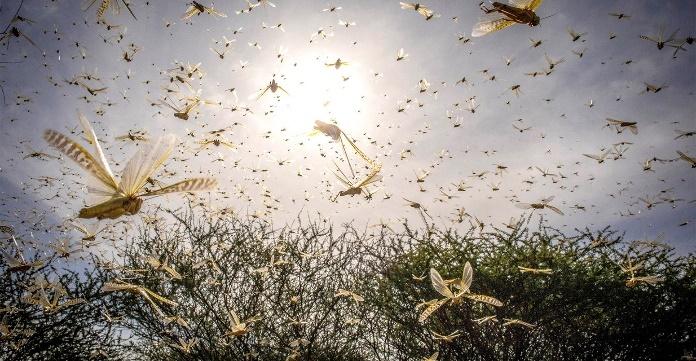
massive swarm of locusts flying

Introduction

  • Human societies have battled locust infestations for millennia, with these insects often leaving behind vast trails of destruction. 
  • Swarms of locusts can devour thousands of hectares of crops within days, posing a serious threat to food security and economic stability. 
  • Despite years of attempts to curb this menace through synthetic pesticides, these chemical solutions often cause significant environmental degradation. 
  • A new scientific breakthrough, however, points toward a more sustainable and targeted approach—by disrupting the very biological mechanism that causes locusts to swarm.

Locust Infestations: A Persistent Agricultural Crisis

  • Locust outbreaks, although sporadic, are severe in impact. The most recent and one of the most devastating infestations occurred during 2019–2020, starting in East Africa and stretching through Pakistan and into India. 
  • This was the worst such event in the region in over 25 years. The unusual weather conditions—including heavy rainfall and flooding—allowed dormant locust eggs to hatch in large numbers, triggering an 8,000-fold increase in their population.
  • In response, governments deployed aerial spraying of insecticides to control the infestation. 
  • However, the environmental and health hazards posed by widespread pesticide use underscored the urgent need for more precise and eco-friendly alternatives.
scientists identify pheromone that triggers locust swarming and way block it

A New Scientific Approach: Disrupting Swarming at the Molecular Level

  • A study published in Nature on June 25, 2025, by a team from the Institute of Zoology at the Chinese Academy of Sciences, presents a novel, pollution-free method of controlling locust swarms by targeting their chemical communication system. 
  • The researchers focused on pheromones, the chemical signals that drive the shift from solitary to swarming behaviour in locusts.

Gregariousness: The Key to Locust Swarms

  • Locusts exhibit gregariousness, a social behaviour where individual locusts aggregate and behave collectively, especially while feeding. In their solitary phase, locusts avoid one another. 
  • However, upon certain triggers—primarily food availability—they enter a gregarious phase, characterized by coordinated movement and feeding.
  • Previous studies by the same team had identified a crucial aggregation pheromone called 4-vinylanisole (4VA). Locusts release this pheromone from their hind legs after consuming food, attracting others and initiating mass gathering. This aggregation leads to serotonin release, reinforcing swarming behaviour.
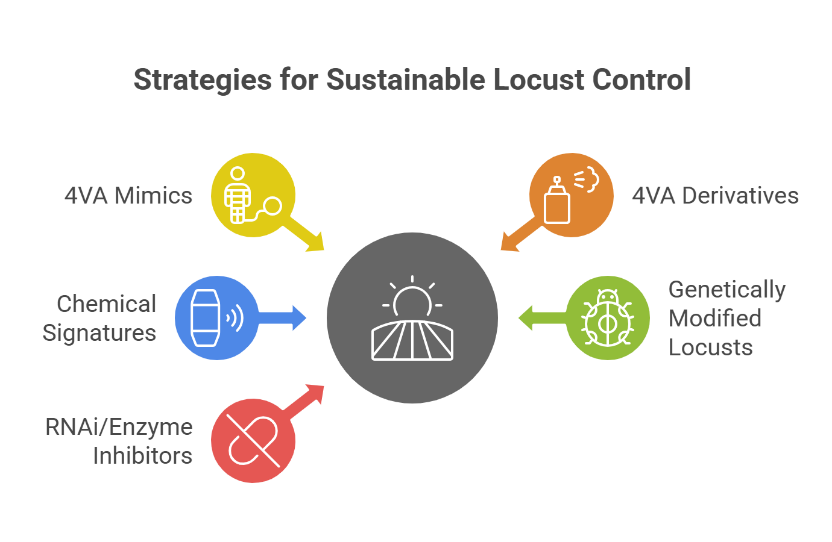
strategies for sustainable locust control

Phenylalanine and the Swarming Cascade

  • In the recent study, researchers identified that a compound called phenylalanine, found in plants consumed by locusts, acts as a precursor in the production of 4VA. When locusts ingest phenylalanine, two enzymes—4VPMT1 and 4VPMT2—help convert a non-aggregating compound (4VP) into 4VA.
  • By disabling the 4VPMT1 gene using genetic engineering, the researchers successfully halted the behavioural transition to swarming. 
  • The modified locusts remained solitary even when environmental conditions were favourable for aggregation.

Chemical Inhibition: Role of 4-Nitrophenol (4NP)

  • Further analysis led to the identification of 4-nitrophenol (4NP), a compound capable of binding to 4VPMT1 and inhibiting the enzyme’s function. 
  • When 4NP occupies the enzyme’s active site, it blocks the conversion of 4VP into 4VA, effectively preventing the swarming signal.
  • The molecular structure of 4NP allows it to bind more strongly than 4VP itself, giving it a competitive advantage in blocking the enzyme. 
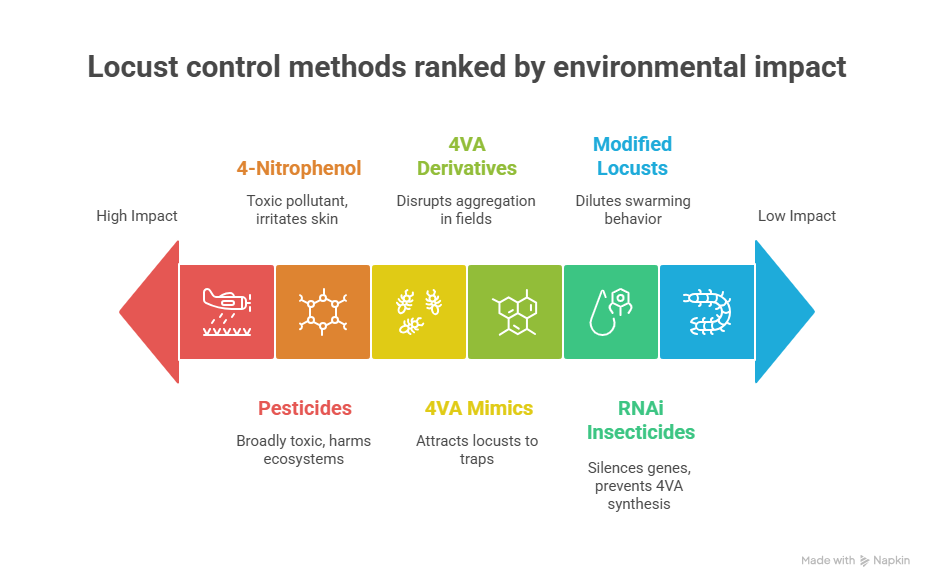
  • However, 4NP has known environmental risks: it is widely used in industrial applications and is a recognized pollutant, with the potential to irritate human skin, eyes, and respiratory tracts.
locust control methods ranked by environmental impact

Sustainable Alternatives and the Role of RNAi

  • Given the toxicity of 4NP, the researchers also suggested the development of RNA interference (RNAi)-based insecticides. 
  • These work by introducing RNA molecules that silence specific genes—in this case, the genes responsible for 4VPMT enzyme production. 
  • Such a strategy would prevent the synthesis of 4VA without introducing harmful chemicals into the environment.

Proposed Five-Step Strategy for Locust Control

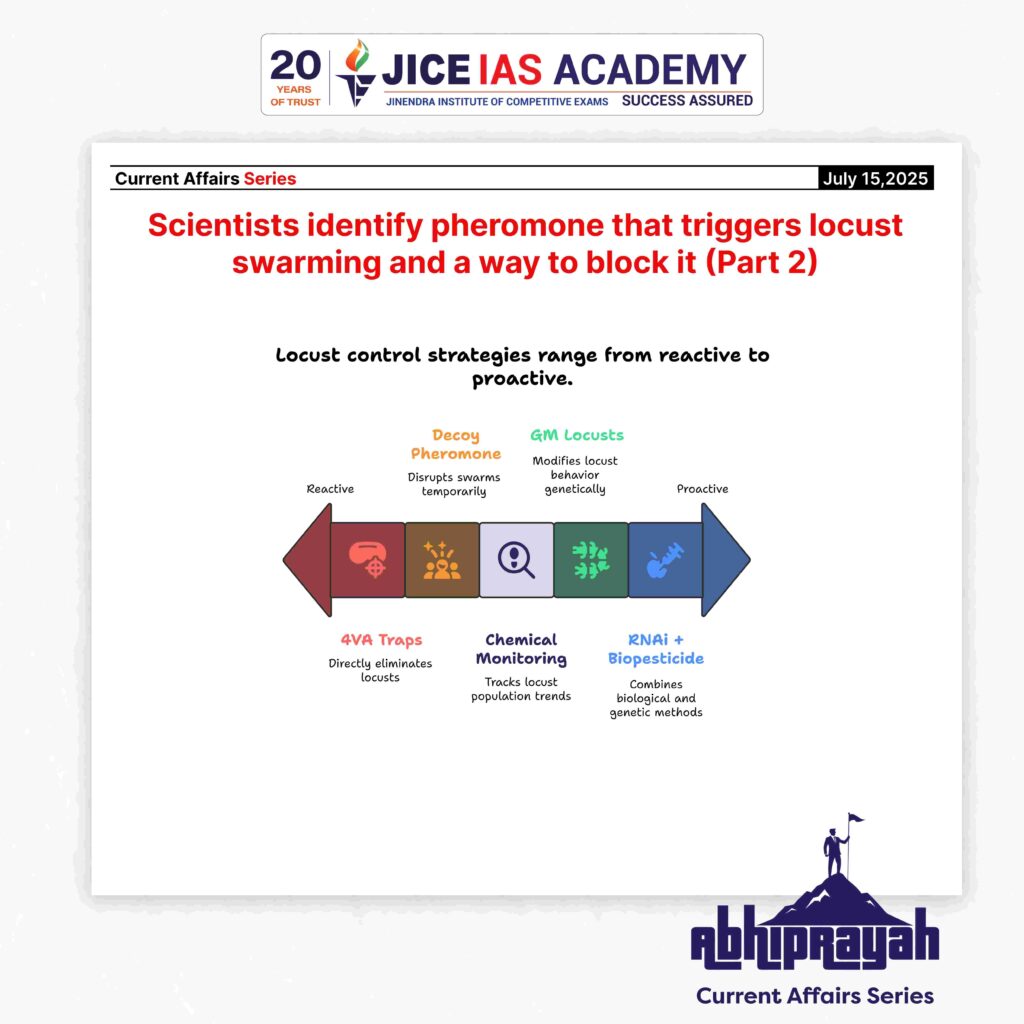
To translate this research into practical field-level applications, the study proposes a multi-pronged locust management strategy:

  1. Trapping via 4VA Mimics: Use synthetic pheromones to lure locusts into trap zones where fungal pathogens or small-scale pesticides can be applied.
  2. Spraying 4VA Derivatives: Artificially release 4VA in non-crop zones to disrupt aggregation in farmlands.
  3. Monitoring through Chemical Signatures: Track swarming trends by detecting airborne 4VA.
  4. Genetically Modified Locusts: Release lab-bred non-gregarious locusts to dilute swarming behaviour in the population.
  5. Combination Approach: Use RNAi or enzyme inhibitors along with biopesticides for an integrated pest management system.

Broader Implications and Future Prospects

  • This research represents one of the first significant steps toward non-toxic, targeted control of locust swarms. 
  • While large-scale field deployment remains to be tested, the findings hold promise for sustainable agriculture, especially in countries frequently plagued by locust invasions.
  • It also emphasizes the growing role of behavioural ecology, molecular biology, and genetic engineering in pest control strategies. 
  • With further research and careful assessment of environmental impacts, such approaches may soon complement or replace conventional chemical pesticides in locust management.

Conclusion

  • Locust swarms continue to pose a formidable threat to food security across several regions, especially in Asia and Africa. 
  • While traditional chemical control methods have provided only partial relief and raised environmental concerns, the study by Guo and colleagues offers a science-backed, eco-friendly alternative that targets the locusts’ behavioural triggers.

Economic Implications

For Indian Exporters

  • These reforms reduce transaction costs and compliance hurdles
  • Encourage a more competitive and efficient export environment
  • Promote value addition in key sectors like leather

For Tamil Nadu

  • The reforms particularly benefit the state’s leather industry, a major contributor to employment and exports
  • Boost the marketability of GI-tagged E.I. leather, enhancing rural and traditional industries

For Trade Policy

  • These decisions indicate a shift from regulatory controls to policy facilitation

Reinforce the goals of Make in India, Atmanirbhar Bharat, and India’s ambition to become a leading export power

Recently, BVR Subrahmanyam, CEO of NITI Aayog, claimed that India has overtaken Japan to become the fourth-largest economy in the world, citing data from the International Monetary Fund (IMF). 

India’s rank as the world’s largest economy varies by measure—nominal GDP or purchasing power parity (PPP)—each with key implications for economic analysis.

Significance and Applications

Leave a Reply

Your email address will not be published. Required fields are marked *

Call Us Now !

Copyright © JICE ACADEMY FOR EXCELLENCE PRIVATE LIMITED