UPSC CURRENT AFFAIRS – 16th June 2025
Prime Minister’s Visit to Cyprus – Strategic Significance and Diplomatic Implications
Why in News?
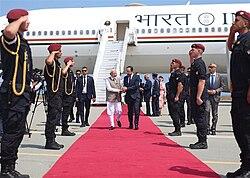
Prime Minister Narendra Modi’s 2025 visit to Cyprus signals a strategic counterbalance to Turkey’s growing proximity with Pakistan.
Introduction
- The Prime Minister arrived in Cyprus, marking the first visit by an Indian Prime Minister in over two decades.
- This visit forms the first leg of his three-nation tour, which also includes Canada (for the G7 Summit) and Croatia.
Key Highlights of the Visit:
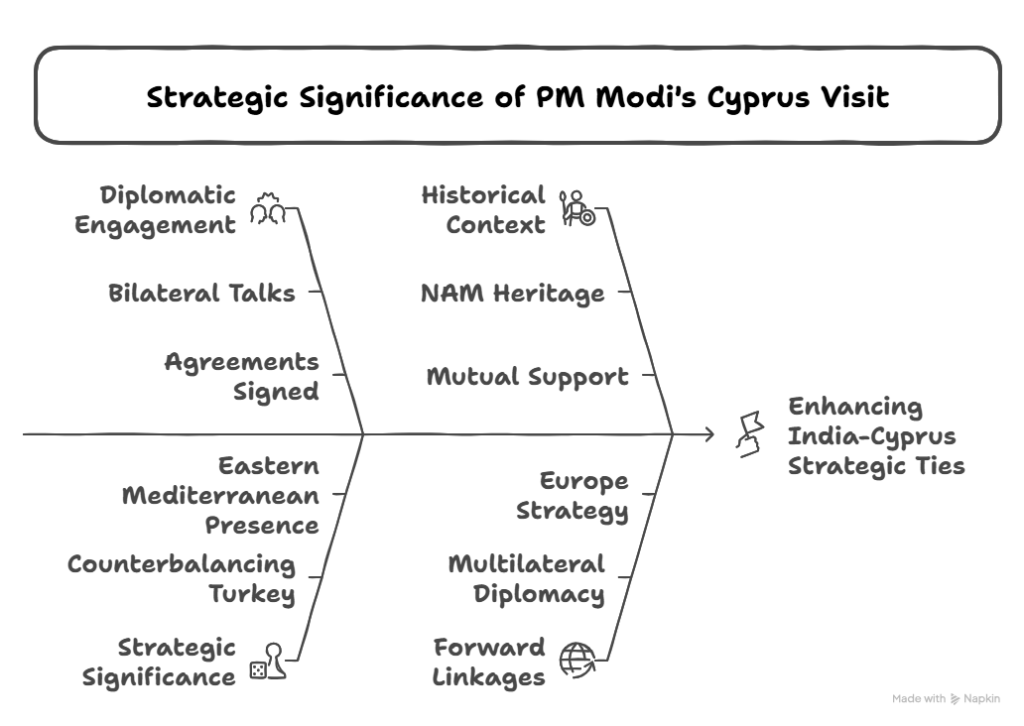
- Diplomatic Engagement: PM Modi held bilateral talks with Cypriot President Nikos Christodoulides, aimed at enhancing cooperation in sectors like defence, shipping, renewable energy, education, and technology.
- Cultural and Diaspora Connect: The Prime Minister addressed the Indian diaspora in Cyprus, acknowledging their role in strengthening India-Cyprus ties.
- Agreements Signed: Several Memoranda of Understanding (MoUs) were signed, including cooperation in cybersecurity, maritime transport, and innovation ecosystems.
Strategic Significance:
- Counterbalancing Turkey’s Posture:
- Cyprus shares a longstanding geopolitical rivalry with Turkey, which has recently deepened ties with Pakistan, often at India’s diplomatic cost (e.g., on Kashmir at global forums).
- PM Modi’s visit is seen as a calibrated signal to Turkey and a reaffirmation of India’s commitment to Cyprus’ sovereignty, particularly on the issue of Turkish-occupied Northern Cyprus.
- Eastern Mediterranean Presence:
- The visit underscores India’s strategic intent to enhance its presence in the Eastern Mediterranean, a region witnessing increased great-power competition.
- Maritime Cooperation:
- With Cyprus being a key maritime nation, the visit supports India’s ambitions under the SAGAR (Security and Growth for All in the Region) doctrine.
Historical Context of India–Cyprus Relations:
- India and Cyprus have traditionally shared warm ties, based on:
- Common Non-Aligned Movement (NAM) heritage.
- Mutual support on core issues (e.g., India supports Cyprus’s reunification, while Cyprus backs India’s UNSC permanent membership bid).
- Bilateral agreements in investment protection, double taxation avoidance, and cultural exchange.
Forward Linkages:
- Multilateral Diplomacy: The Cyprus leg sets the tone for India’s engagements at the G7 Summit in Canada, where geopolitical balancing, multilateral reforms, and regional stability are expected to be key themes.
- Europe Strategy: The visit aligns with India’s broader “Europe Outreach” aimed at diversifying diplomatic partnerships beyond traditional allies.
Conclusion:
- Prime Minister Modi’s visit to Cyprus is diplomatically symbolic and strategically calculated.
- In the backdrop of changing regional alignments and Turkey’s adversarial positioning, the visit not only revives an underutilized bilateral relationship but also reinforces India’s geopolitical signalling and maritime outreach in the Mediterranean.

3rd UN conference on landlocked countries
UPSC CURRENT AFFAIRS – 08th August 2025 Home / 3rd UN conference on landlocked countries Why in News? At the

Issue of soapstone mining in Uttarakhand’s Bageshwar
UPSC CURRENT AFFAIRS – 08th August 2025 Home / Issue of soapstone mining in Uttarakhand’s Bageshwar Why in News? Unregulated

Groundwater Pollution in India – A Silent Public Health Emergency
UPSC CURRENT AFFAIRS – 08th August 2025 Home / Groundwater Pollution in India – A Silent Public Health Emergency Why
Universal banking- need and impact
UPSC CURRENT AFFAIRS – 08th August 2025 Home / Universal banking- need and impact Why in News? The Reserve Bank
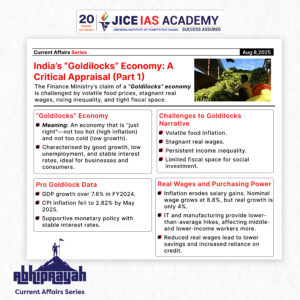
India’s “Goldilocks” Economy: A Critical Appraisal
UPSC CURRENT AFFAIRS – 08th August 2025 Home / India’s “Goldilocks” Economy: A Critical Appraisal Why in News? The Finance

U.S.-India Trade Dispute: Trump’s 50% Tariffs and India’s Oil Imports from Russia
UPSC CURRENT AFFAIRS – 07th August 2025 Home / U.S.-India Trade Dispute: Trump’s 50% Tariffs and India’s Oil Imports from
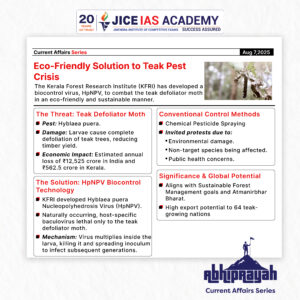
Eco-Friendly Solution to Teak Pest Crisis: KFRI’s HpNPV Technology
UPSC CURRENT AFFAIRS – 07th August 2025 Home / Eco-Friendly Solution to Teak Pest Crisis: KFRI’s HpNPV Technology Why in

New Species of Non-Venomous Rain Snake Discovered in Mizoram
UPSC CURRENT AFFAIRS – 07th August 2025 Home / New Species of Non-Venomous Rain Snake Discovered in Mizoram Why in

Economic Implications
For Indian Exporters
- These reforms reduce transaction costs and compliance hurdles
- Encourage a more competitive and efficient export environment
- Promote value addition in key sectors like leather
For Tamil Nadu
- The reforms particularly benefit the state’s leather industry, a major contributor to employment and exports
- Boost the marketability of GI-tagged E.I. leather, enhancing rural and traditional industries
For Trade Policy
- These decisions indicate a shift from regulatory controls to policy facilitation
Reinforce the goals of Make in India, Atmanirbhar Bharat, and India’s ambition to become a leading export power
Recently, BVR Subrahmanyam, CEO of NITI Aayog, claimed that India has overtaken Japan to become the fourth-largest economy in the world, citing data from the International Monetary Fund (IMF).
India’s rank as the world’s largest economy varies by measure—nominal GDP or purchasing power parity (PPP)—each with key implications for economic analysis.