
UPSC CURRENT AFFAIRS – 31th May 2025
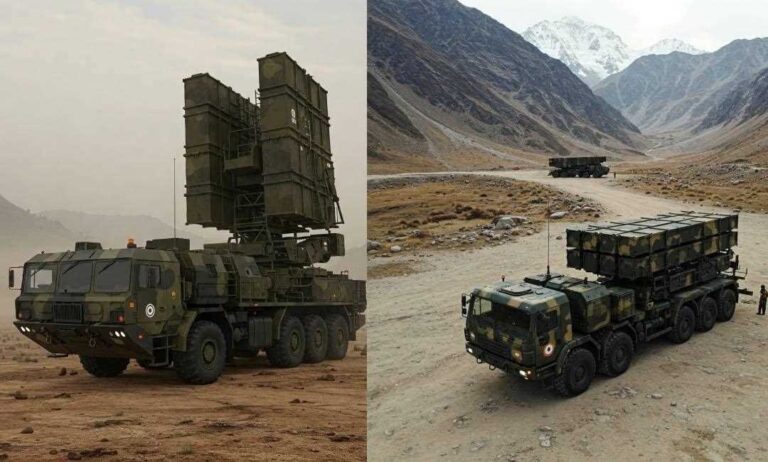
Project Kusha: India's Indigenous S-400-Style Air Defence System
Why in News?
- India is developing Project Kusha, a long-range surface-to-air missile system similar to Russia’s S-400, in collaboration with DRDO and BEL.
Introduction
- India’s focus on achieving self-reliance in defence manufacturing has led to the development of several indigenous systems aimed at strengthening national security.
- One such ambitious initiative is Project Kusha, a long-range Surface-to-Air Missile (SAM) system inspired by the capabilities of the Russian S-400 Triumf. Led by the Defence Research and Development Organisation (DRDO) and supported by Bharat Electronics Limited (BEL), this project reflects India’s growing defence technological base.
What is Project Kusha?
Project Kusha is an indigenous long-range air defence missile system program aimed at countering multiple types of aerial threats including:
- Aircraft
- Missiles
- Unmanned Aerial Vehicles (UAVs)/drones
It is comparable in intent and functionality to the Russian S-400 system but aims to be fully developed and produced within India.
Key Features (Planned):
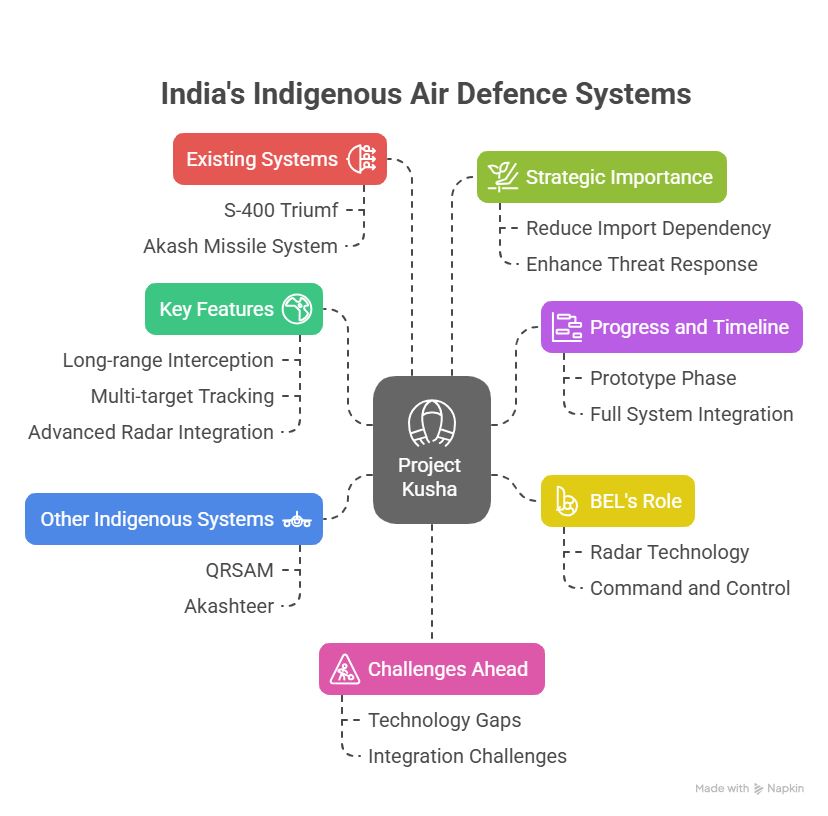
- Long-range interception capabilities
- Multi-target tracking and engagement
- Integration of advanced radar and control systems
- Designed to protect strategic assets and airspace
Progress and Timeline
As per BEL Chairman and MD, the prototype development is expected to be completed in 12–18 months, followed by user trials that could take 12–36 months.
- Prototype phase: Expected soon
- Full system integration: Awaiting decision on whether BEL will be the sole integrator or one of two system integrators.
BEL is collaborating with DRDO to develop multiple subsystems, especially:
- Radars
- Command and control modules
Significance of BEL's Role
BEL, a leading public sector unit under the Ministry of Defence, is not only a co-developer of Project Kusha but also plays a central role in:
- Developing radar technology
- Producing command and control infrastructure
- Providing expertise in sensor fusion and real-time monitoring
Other Indigenous Air Defence Developments by BEL
- Quick Reaction Surface-to-Air Missile (QRSAM)
- Aimed at providing rapid response to low-altitude aerial threats.
- Designed for mobility and quick deployment.
- BEL is the production agency and expects an order worth ₹30,000 crore, jointly for the Army and Air Force.
- Order is expected by the end of the current fiscal year or early next.
- Akashteer Air Defence Control System
- A next-generation air defence command and reporting system.
- Enables real-time engagement of multiple aerial threats.
- Integrates various sensors and weapons into a unified command network.
- Already inducted and operational in forward areas.
Existing Systems:
The Role of S-400 Triumf
While India continues to develop indigenous systems, it also operates the Russian S-400 Triumf, one of the most advanced air defence systems globally.
Capabilities:
- Can track and intercept fighter jets, drones, cruise missiles, and ballistic missiles.
- Engagement range of up to 400 km.
- Offers layered air defence and early warning capability.
- Multiple S-400 units have been strategically deployed across the country.
Strategic Relevance:
- Acts as a deterrent against aerial threats from adversaries.
- Has influenced the design and vision of Project Kusha.
- Provides a technological benchmark for indigenous systems.
Akash Missile System: A Proven Indigenous Platform
The Akash missile, India’s earlier indigenous medium-range SAM system, has shown high performance in trials:
- Successfully intercepted high-speed aerial targets
- Deployed in several regiments of the Army and Air Force
- Forms part of the layered air defence network
Strategic Importance of Indigenous Air Defence Systems
India’s efforts under Project Kusha, QRSAM, and Akashteer aim to:
- Reduce dependency on imports
- Strengthen Atmanirbhar Bharat in the defence sector
- Enhance rapid threat response capability
- Provide strategic depth in forward and border areas
Challenges Ahead
- Technology gaps in propulsion and tracking systems compared to global counterparts
- Long timelines for trials and induction
- Need for seamless integration with existing systems (like Akash, S-400)
Conclusion
Project Kusha symbolizes India’s leap toward advanced and autonomous air defence capabilities. Backed by BEL and DRDO, and inspired by global benchmarks like the S-400, it has the potential to reshape the country’s defence preparedness. Coupled with systems like QRSAM and Akashteer, India is moving closer to building a multi-layered, integrated, and indigenous air defence shield, ensuring better national security and strategic autonomy.

3rd UN conference on landlocked countries
UPSC CURRENT AFFAIRS – 08th August 2025 Home / 3rd UN conference on landlocked countries Why in News? At the

Issue of soapstone mining in Uttarakhand’s Bageshwar
UPSC CURRENT AFFAIRS – 08th August 2025 Home / Issue of soapstone mining in Uttarakhand’s Bageshwar Why in News? Unregulated

Groundwater Pollution in India – A Silent Public Health Emergency
UPSC CURRENT AFFAIRS – 08th August 2025 Home / Groundwater Pollution in India – A Silent Public Health Emergency Why

Universal banking- need and impact
UPSC CURRENT AFFAIRS – 08th August 2025 Home / Universal banking- need and impact Why in News? The Reserve Bank

India’s “Goldilocks” Economy: A Critical Appraisal
UPSC CURRENT AFFAIRS – 08th August 2025 Home / India’s “Goldilocks” Economy: A Critical Appraisal Why in News? The Finance

U.S.-India Trade Dispute: Trump’s 50% Tariffs and India’s Oil Imports from Russia
UPSC CURRENT AFFAIRS – 07th August 2025 Home / U.S.-India Trade Dispute: Trump’s 50% Tariffs and India’s Oil Imports from
Eco-Friendly Solution to Teak Pest Crisis: KFRI’s HpNPV Technology
UPSC CURRENT AFFAIRS – 07th August 2025 Home / Eco-Friendly Solution to Teak Pest Crisis: KFRI’s HpNPV Technology Why in

New Species of Non-Venomous Rain Snake Discovered in Mizoram
UPSC CURRENT AFFAIRS – 07th August 2025 Home / New Species of Non-Venomous Rain Snake Discovered in Mizoram Why in

For Indian Exporters
- These reforms reduce transaction costs and compliance hurdles
- Encourage a more competitive and efficient export environment
- Promote value addition in key sectors like leather
For Tamil Nadu
- The reforms particularly benefit the state’s leather industry, a major contributor to employment and exports
- Boost the marketability of GI-tagged E.I. leather, enhancing rural and traditional industries
For Trade Policy
- These decisions indicate a shift from regulatory controls to policy facilitation
Reinforce the goals of Make in India, Atmanirbhar Bharat, and India’s ambition to become a leading export power
Recently, BVR Subrahmanyam, CEO of NITI Aayog, claimed that India has overtaken Japan to become the fourth-largest economy in the world, citing data from the International Monetary Fund (IMF).
India’s rank as the world’s largest economy varies by measure—nominal GDP or purchasing power parity (PPP)—each with key implications for economic analysis.